
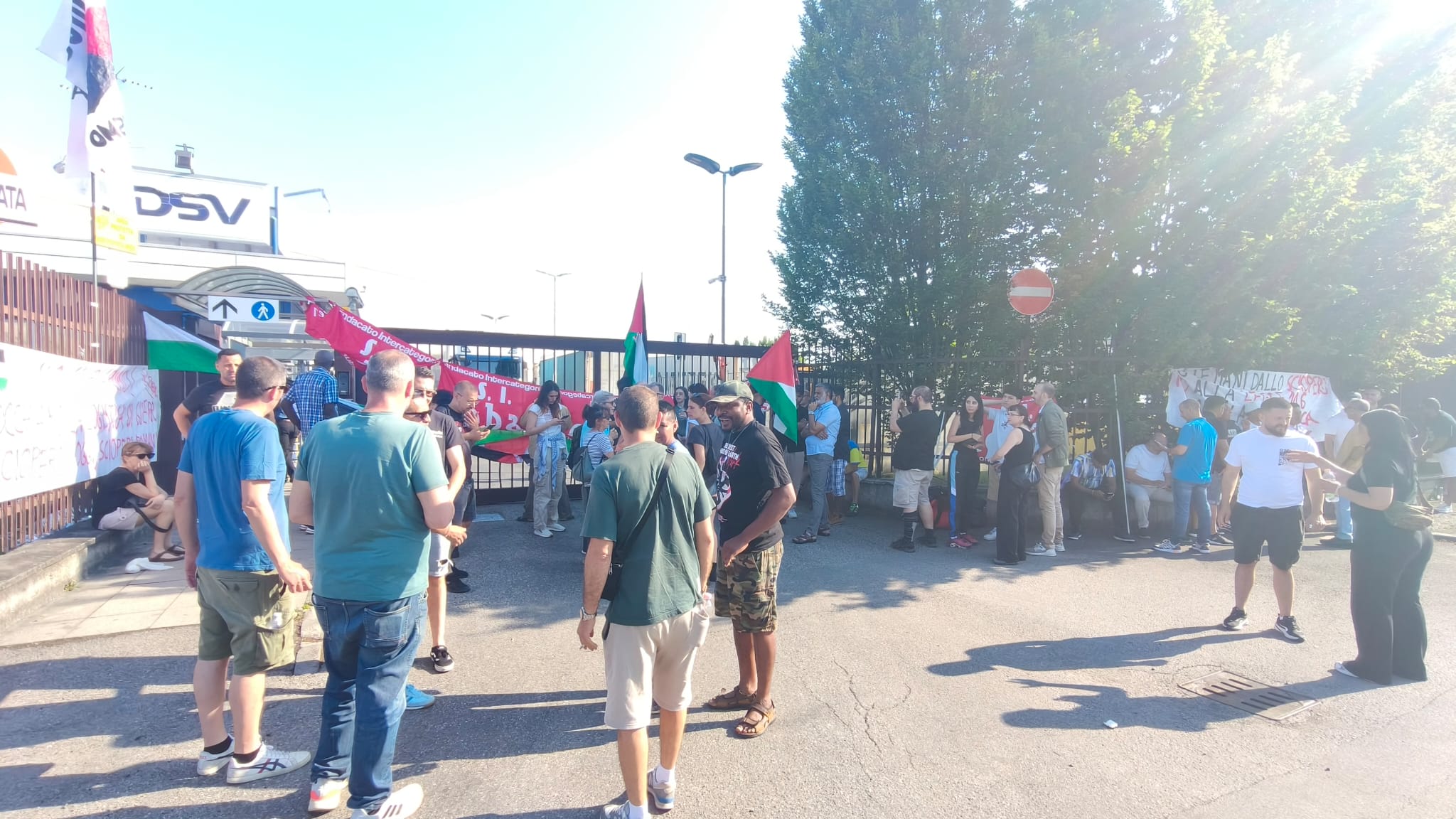
Friday, May 29th—a general strike called by much of the grassroots union movement (SI Cobas, CUB, SGB, USI, Adl Varese, and other smaller organizations)—was a day of struggle that exceeded expectations (and concerns) on the eve of the strike.
A strike against the genocide in Palestine, capital’s wars and the war economy, the Meloni government, and the police state. It affirmed the pressing needs of the working class, starting with strong wage increases and the reintroduction of the sliding wage scale, and defended the right to strike and worker organization in the workplace, which is increasingly under attack.
The three proletarian sectors most involved were logistics, railways, and local transport.
In logistics, the commitment of SI Cobas was crucial to the strike’s success. It has been deeply rooted in many warehouses for years, especially those in central and northern Italy, but also in Rome and Campania, championing a spirit of struggle that is never confined to corporate logic. It also has a particular sensitivity to the Palestinian cause, partly due to its composition as a union that organizes workers of many different nationalities, many of whom come from Arab and Islamic countries.
For the railways, the official figures are: 40.3% of trains cancelled, 36.8% of participants, significantly higher than the approximately 25% participation rate on May 18th—the strike called alone by USB, which undoubtedly had a negative impact (the PdM-PdB Assembly had indicated a double participation rate, resulting in a significant loss of wages).
The CUB Trasporti railway workers’ statement notes that the intertwining of union and political issues is real, not simply stated: many of the railway workers who “contacted us to raise specific issues to cross-reference with technical standards” have simultaneously expressed their concerns “about the filthiness of war, rearmament, and the indigestible financing of massacres. Awareness is growing that these reckless expenditures divert resources for all social needs and income support.” So, without empty demagogy: awareness is growing… And on this journey, which has finally begun, the tireless work of Ferrovieri contro la guerra, in which we participate as promoters, is noteworthy, as is that of the PdM-PdB Assembly on the union level.
Although it’s a much more fragmented world, this awareness is also growing among local transport workers, as evidenced (among others) by the demonstration organized by the SGB in Mestre, in Piazzetta Coin. At this demonstration—in which we participated as comrades from TIR and the Marghera Permanent Committee against Wars and Racism—the denunciation of the Gaza genocide and the arms race and a possible new, apocalyptic world war was joined by the denunciation of the anti-proletarian effects of the Meloni government’s and the European Union’s policies, and by the strong demands for wages commensurate with the cost of living, for healthcare to be returned to universal and free, for the right to housing, denied in a thousand ways, for public transport to be reestablished after decades of cuts that have worsened service and increased workloads, and so on.
The strike, which was very weak in schools among both teachers and students (due to the end-of-year situation), attracted a reasonable level of participation among other public sector employees: at the time of writing (compared to 1.21% for the strike called by the USB on May 18th), participation has reached 4%—a provisional figure, likely destined to grow.
Although very limited compared to the total of 15 million employees, the success of the strike on the 29th and the related city demonstrations is a motivation to continue with tenacity and faith in the united initiative.
In many workplaces, including some industrial plants, there has been a willingness to fight on the May 29th platform, which must be gathered and organized. One of the fundamental conditions for truly doing so is overcoming the fragmentation that afflicts the small amount of labor and social conflict that still exists, despite near-zero worker and proletarian spontaneity.
This is why USB members should ask themselves: what was the point of splitting from this unified effort? Did the separate strike of May 18 strengthen or weaken the class response to the employer-government coalition? For us, who have been insisting for years on the need for a united anti-capitalist class front and for collaboration among militant workers, regardless of their affiliation, the answer is clear: it weakened it.
On the other hand, in the camp of class enemies, the latest assembly of Confindustria (Italian employers’ federation) revealed strong unity between the government and industrialists. This is nothing new: the Meloni government has paved the way for the employers’ offensive against workers from the outset—evidence of this is the sequence of seven so-called security decrees. With the worsening difficulties of the Italian economy due to the US-Israeli war on Iran, the executive-employer coalition has further consolidated its polemical stance toward the EU. However, its primary target remains the working class. Beware, therefore, of underestimating the anti-strike directive from the Guarantee Commission, which extends Law 146 to logistics—a protest about which was, not coincidentally, at the center of the day of protest on the 29th, and which requires a protest consistent with the protest. Any voluntary surrender to this strangling resolution would be unforgivable.
Let us therefore build on the positive signs of this general strike with confidence. We certainly cannot expect the resumption of struggle to be sparked by the CGIL-CISL-UIL unions reconciling themselves with a policy of subordination to the needs of the national economy and businesses that is even more radical than a few years ago. Nor does it make sense to wait for the fabled elections of 2027, which would solve none of the serious problems we face, even if the “broad camp,” no less warmongering and alien to the working class, of the right-wing parties, were to win.
The international landscape leaves no room for illusions. Imperialist and inter-capitalist wars are and will remain the order of the day for a long time to come. To stop them, to repel the sacrifices imposed by the war economy, we can only count on our own strength.
After all, those that took place on the 29th are not insignificant. We must consolidate them, organize them, broaden the scope of our action to the enormous sectors of young and old proletarians still at a standstill, whom we have so far been unable to reach, fight together against repression, oppose and defeat opportunism, and increasingly unite the immediate and the future.
There is no shortage of political, trade union, orientation, and organizational work to be done.
=======
Below are the reports the editorial staff has compiled based on information received from Milan, Turin, Naples, Alessandria, Modena, Bologna, the Bolognese Apennines, Rome, Mestre, and Padua (we make no claim to be exhaustive).