
Il collasso elettorale di Trump e della sua banda MAGA ci ha rallegrato molto. Non per la vittoria del partito democratico, più guerrafondaio degli stessi repubblicani, ma per la dinamica sociale e politica che l’ha determinato.
Infatti questo collasso è l’effetto della reazione proletaria, giovanile, femminile, delle popolazioni immigrate e di colore all’aggressione frontale subìta dalla gang trumpiana negli ultimi due anni.
Non appena Trump si insediò di nuovo alla Casa Bianca con il festante contorno degli oligarchi semi-fascisti dell’High Tech stretti attorno a lui, dicemmo: prendere Trump sul serio! Nel senso di afferrare subito il feroce segno di classe e imperialista delle politiche messe in agenda per far «tornare grande l’Amerika», senza farsi sviare dalle modalità clownesche della sua comunicazione.
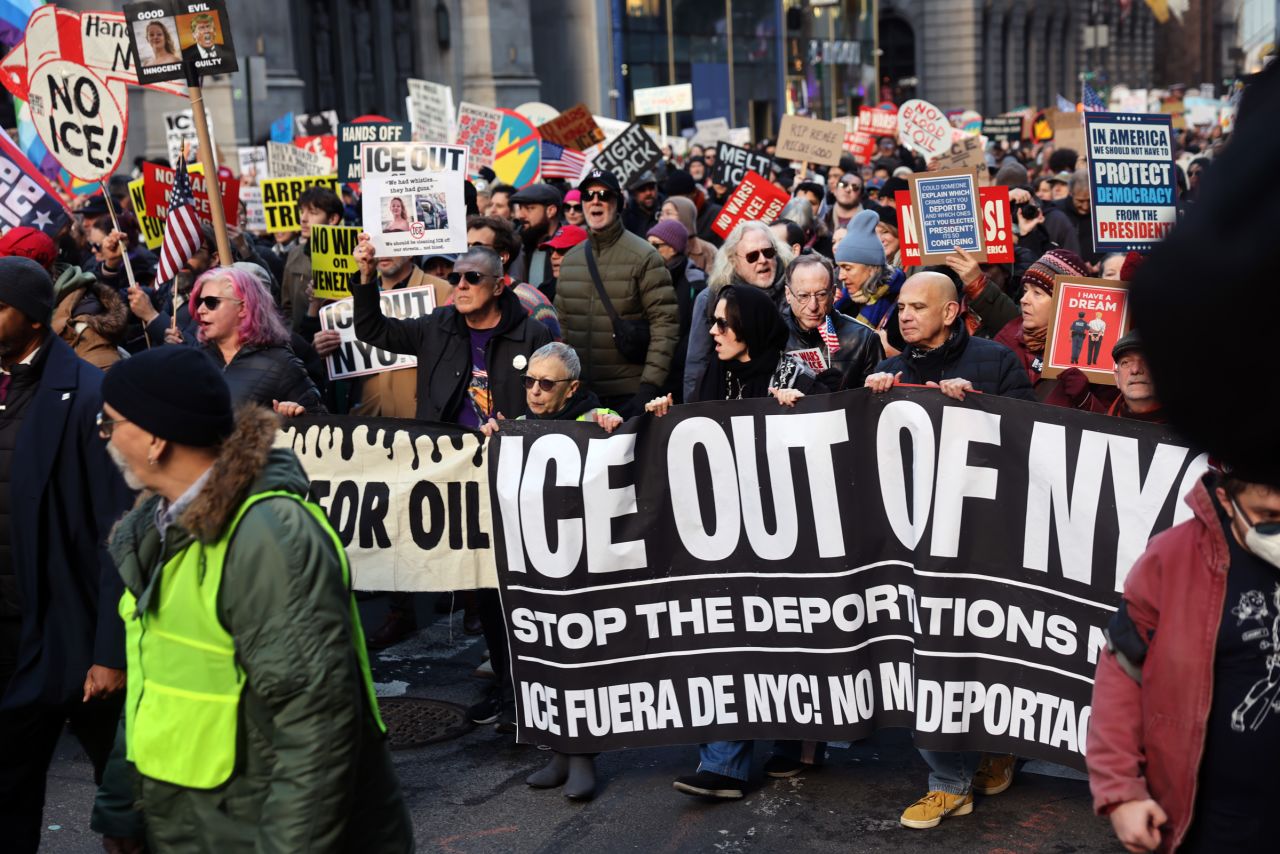
Sono stati due anni segnati da una guerra senza quartiere agli immigrati illegalizzati di tutte le nazionalità sotto il segno brutale dell’ICE; di rappresaglie contro i «colpevoli di Palestina», fossero studenti, docenti o intere università, e di isterica islamofobia. Due anni di tagli senza precedenti alla spesa socio-sanitaria e all’occupazione nei servizi pubblici attuati dal DOGE di Musk, con l’ affamamento di 42 milioni di poveri per il taglio dei food stamps; di attacco al diritto all’aborto delle donne senza privilegi attraverso la Corte Suprema trumpizzata, e di osceno machismo. Due anni di esibito suprematismo bianco, di maccartista caccia ai dissidenti in nome dell’anticomunismo, coronati negli ultimi mesi dall’esplosione dell’inflazione a seguito dell’aggressione USA-Israele all’Iran, che ha colpito la grande massa dei proletari e settori non piccoli di ceti medi da tempo in declino di reddito e di status. Il tutto mentre i boss dell’High Tech, i pescecani di Wall Street e la «Trump crime family» moltiplicavano spudoratamente le proprie ricchezze attingendo a piene mani dai privilegi di governo, e varavano uno stratosferico incremento delle spese militari, accollandone il costo alle classi lavoratrici attraverso l’esplosione del debito di stato.
Trump, il mancato premio Nobel per la pace, non potrà che portare caos e nuove guerre – fu la nostra facile previsione. E così è stato, con la raffica dei dazi e le guerre commerciali imposte a paesi nemici e «amici», con l’apporto decisivo dato al genocidio di Gaza e alle aggressioni a catena di Israele in Libano e in tutto il Medio Oriente, con l’assalto a Maduro e al Venezuela, con gli eccidi della falsa operazione anti-droga nel golfo del Messico, con l’indurimento del blocco contro Cuba, e infine con l’aggressione all’Iran.
Senonché sul suolo statunitense – non ci stancheremo di ripeterlo fin che un numero ampio di militanti e di proletari/e non lo vedrà – c’è anche un’altra «America», la nostra «America». E ne abbiamo costantemente scrutato e registrato i segni di reazione e di rivolta: nelle tante iniziative di solidarietà con la resistenza del popolo palestinese, nella risposta solidale e ben organizzata ai rastrellamenti dell’ICE a Paramount, nella magnifica Minneapolis, a Cincinnati e così via, negli scioperi e nelle manifestazioni dei dipendenti pubblici licenziati, nelle cento piazze del movimento No Kings con milioni di dimostranti, nelle accese proteste contro i data center, nel no alla guerra all’Iran che è andato crescendo trasversalmente ai diversi movimenti nel corso dei mesi…
Nasce da qui la debacle trumpiana del 3 novembre. Le inchieste sulla composizione del voto e sui flussi elettorali sono concordi: hanno votato contro Trump, le sue politiche e la sua gang il 70% dei giovani tra 18 e 29 anni; addirittura il 76% di quelli tra i 18 e i 25 anni; il 61% delle donne; il 91% dei neri; il 69% degli ispanici; il 70% degli immigrati di origini asiatiche, che si sentono vicini agli altri immigrati (sottolinea anche il South China Morning Post). Lo spostamento di voti più significativo è avvenuto tra gli «elettori a basso reddito» (alias: i proletari) taglieggiati dall’inflazione da guerra, e tra i latinos, indignati dalla campagna di polizia contro gli immigrati e dalla politica gangsteristica di Washington contro Venezuela e Cuba. I repubblicani sono riusciti a perdere anche in alcune loro storiche roccaforti: Texas, Kansas, South Carolina. Mentre le vittorie dei democratici in Ohio e nel Michigan si debbono certamente all’apporto di settori di classe operaia bianca che si erano fatti illudere che il «Make America Great Again» avrebbe coinvolto anche loro, ed ora sono disillusi.
Da un seggio di un quartiere di working class di South Central Los Angeles (la seconda metropoli degli Stati Uniti) è arrivato un bel report dal vivo di Luca Celada su il manifesto del 5 novembre:
«Gli applausi per chi dichiarava di aver votato per la prima volta, le foto ricordo davanti alle urne, hanno raccontato l’importanza del rito democratico per chi non lo può dare per scontato: cittadini naturalizzati, immigrati di seconda generazione, discendenti di schiavi che negli ultimi due anni hanno assistito alla velocità con cui l’America del ‘great again’ ha riesumato i suoi istinti peggiori. Giovani, donne, famiglie, uomini con addosso i catarifrangenti del turno di lavoro appena terminato, con la scheda in mano e in faccia la determinazione di unire la propria voce alla risposta di un’America agli antipodi della corte dorata di Mar a Lago, le sale da ballo e gli archi di trionfo di Washington».
No, calma, non siamo diventati elezionisti.
Il fatto è che l’attivizzazione di quanti, come molti/e proletari/e statunitensi, sono stati ai margini della vita politica, e spesso per lungo tempo, può passare anche per la partecipazione alle elezioni, qui vissuta in maniera non prettamente individualistica (gli applausi, le foto ricordo…, a Minneapolis i bigliettini ‘io ho votato’ attaccati sui ‘memoriali’ di Renée Good e Alex Pretti) – dietro queste elezioni ci sono due anni di mobilitazione nelle piazze, due anni di proteste e di lotte. Che, a smentita di tutte le fregnacce sulla scomparsa delle classi o sull’eterna subordinazione dei proletari ai capitalisti, hanno cominciato a schiarire le idee a milioni di ingannati dalla demagogia trumpiana nel 2024 e di disinteressati, spingendoli ad esprimere un secco NO alle guerre, anzitutto alla guerra all’Iran e al genocidio in Palestina, al carovita, alla repressione contro gli immigrati e allo stato di polizia, ai tagli alle spese e agli impieghi sociali, ai miliardari e alla loro corruzione, al suprematismo bianco razzista e machista che pretende di inferiorizzare i popoli di colore, le donne e le minoranze di genere.
Anche i più moderati tra i candidati democratici hanno insistito su questi tasti nella loro propaganda elettorale. E si spiegano così molteplici «prime volte»: la prima volta di una governatrice nera in Georgia e negli Stati Uniti; la prima governatrice latino-americana nel Texas; la prima governatrice indigena; il primo governatore nero del Wisconsin; il primo senatore musulmano; la prima senatrice indigena; il primo senatore in sedia a rotelle; il primo senatore dichiaratamente gay, e così via.
Un fuoco di paglia? Non lo crediamo perché nell’inesorabile decadenza dell’imperialismo a stelle e strisce è inscritta – e da alcuni decenni – una progressiva, sempre più estrema polarizzazione sociale che dovrà darsi, nel tempo, le sue appropriate forme e organizzazioni politiche. Dal lato della classe capitalistica, il trumpismo è tale. E sarebbe quanto mai ingenuo pensare che questa disfatta elettorale sia sufficiente ad archiviarlo, e a scaraventare nella spazzatura della storia, insieme con esso, l’oligarchia tecno-finanziaria ultra-reazionaria di cui è espressione. Non è e non sarà così.
Non a caso i due candidati democratici che sembrano destinati a presiedere Camera e Senato, Hakeem Jeffries e Chuck Schumer, si sono precipitati a gettare acqua sul fuoco: «Non dobbiamo vendicarci», ma cercare «un terreno comune» con i repubblicani nell’interesse nazionale. Per costoro, c’è troppa euforia in basso. Bisogna frenarla. Dunque: «speranza contro odio», riappacificazione. Tanto per avere un’idea di chi sono questi signori, Schumer lo scorso anno aveva marciato nella parata dell’Israel Day accanto a Smotrich… Sicché è fuori dubbio, per noi, che l’impegno verbale di Zoran Mamdani all’indomani del voto verrà smentito dal comportamento del partito democratico, già da oggi proteso a vincere le prossime presidenziali del 2028 con la benedizione dell’élite supercapitalista per affermare nel mondo gli interessi dell’imperialismo a stellestrisce meglio di Trump.
Mamdani ha dichiarato: «L’America ha eletto una nuova generazione di politici che dovrà abbassare il costo della vita, far finire la guerra, risolvere la crisi abitativa senza tradire i lavoratori che hanno consegnato il potere nelle loro mani.» Ed è indicativo che gli sia sfuggito quel «senza tradire»… Il problema, però, non riguarda solo i vertici del partito democratico o i più moderati. Si può scommettere che anche i DSA, per non essere tagliati fuori dalla corsa alla presidenza con la candidatura della Ocasio Cortez, modereranno le loro posizioni, peraltro non proprio estremiste in ambito istituzionale.
Il più chiacchierato dei nuovi entrati, il medico figlio di emigrati egiziani Abdul El-Sayed, eletto senatore in Michigan, si è presentato così: «Sono un capitalista che legge di capitalismo, e so che il capitalismo per funzionare, deve essere controllato». Le sue proposte politiche: espandere Medicare for All, abolire l’ICE, ridurre il potere delle grandi corporations, limitare i finanziamenti privati alla politica, interrompere i finanziamenti ad Israele (interruzione ventilata pure da Trump), etc., sono proposte finalizzate a rendere più equilibrato il capitalismo statunitense. E tuttavia il suo ingresso al Senato mostra l’incredibile forza della causa palestinese (lui è stato tra i pochissimi dem a parlare di genocidio); è altrettanto interessante che la sua campagna abbia di fatto avvicinato la classe operaia bianca e l’immigrazione musulmana, con una sonora sconfitta della furiosa islamofobia e dell’anticomunismo seminati da Trump&Co. – da qui la loro accusa a El-Sayed di islamo-comunismo. Il fantasma, il fantasma che ricompare dietro gli innocui El-Sayed e gli altri…
Insomma le traiettorie dei due vincitori di queste elezioni, i movimenti che si sono opposti all’amministrazione Trump e il partito democratico, non solo non coincidono, ma vanno in direzioni divergenti. Schematizzando al massimo: verso sinistra i primi, verso destra il secondo.
E Trump e la sua corte? Non hanno avuto la forza di far insorgere la propria base fanatizzata perché una parte di essa (la più popolare e anche proletaria) ha secessionato da loro, e per le dimensioni shock della sconfitta. Ma immaginarsi una loro resa è fuori dalla realtà. La nomina a capo dello staff della Casa Bianca di Stephen Miller, il sadico persecutore del proletariato di immigrazione e delle popolazioni immigrate, è l’indicatore che gli ultimi due anni di Trump saranno all’insegna della massima aggressività anti-proletaria. Uno dei suoi sostenitori, Bezos, ha già indicato ai neo-eletti democratici il compito prioritario: «il problema è il debito pubblico», da tagliare sul lato della spesa sociale, s’intende. Mentre Musk, sentendo aria di inchieste contro le sue malefatte, ha reagito da mafioso qual è: «colpirò chi mi minaccia». E l’artefice della disastrosa guerra all’Iran Hegseth non gli è stato da meno.
Certo, la sconfitta porta conflitti nel campo repubblicano. Il primo a smarcarsi da Trump è stato Vance con la sua tesi: abbiamo perso per la guerra all’Iran, che contiene una implicita presa di distanze da Israele, o almeno da Netanyahu. Tuttavia sono troppo centrali gli interessi del complesso militare-industriale-hightech nell’economia statunitense per immaginarsi che la corsa al riarmo e alla guerra venga frenata. Del resto, com’è noto, il partito democratico all’unanimità è stato dietro la preparazione della guerra della NATO in Ucraina; come è meno noto, sono raddoppiati in queste elezioni i «CIA democrats», i deputati e senatori dem provenienti dai servizi segreti e dall’esercito; sicché è mera fantapolitica ipotizzare una svolta «pacifista» nella politica di Washington.
Nell’immediato un’amministrazione fortemente indebolita com’è quella attuale cercherà, è probabile, un allentamento delle tensioni con gli avversari più potenti, Cina e Russia; ma è altrettanto probabile che questo possibile, non certo, allentamento delle tensioni con Mosca e Pechino sarà compensato da scelte aggressive nei confronti di avversari molto più deboli, Cuba per prima. Resta in bilico la soluzione della guerra all’Iran, già perduta sul campo da Washington, perché ammettere la sconfitta firmando un accordo troppo favorevole a Teheran sarebbe uno smacco pesantissimo per i suoi contraccolpi sui rapporti con le petrolmonarchie, già tentate da tempo di riappacificarsi con l’Iran e volgersi verso la Cina e la Russia. Altrettanto in bilico resta il rapporto con l’Unione europea – perché gli Stati Uniti, siano al potere i repubblicani o i democratici, hanno la necessità di lungo periodo di colpire, se non di rovinare, i concorrenti europei per restare al posto di comando almeno dentro il perimetro dell’Occidente, avendo perso – irreversibilmente – il comando sul mondo.
Avranno questa necessità in maniera tanto più urgente se dovesse esplodere, com’è possibile, la bolla dell’high tech, gonfiata negli ultimi due anni dall’illimitato sostegno trumpiano ai cavalieri dell’apocalisse che lo hanno portato di nuovo al potere. I primi segni di nervosismo di Wall Street ci sono già, e se ad essi dovesse seguire un improvviso tracollo, nulla sarebbe da escludere. Neppure decisioni di marca avventurista sullo scenario internazionale, già al momento pieno di tensioni pre-belliche : pensiamo soltanto all’ascesa prepotente, provocatoria del militarismo giapponese e alla crescita esponenziale delle spese belliche e delle esercitazioni di guerra della Cina di Xi Jin Ping, proiettata a moltiplicare le sue basi militari all’estero, anzitutto in Africa.
La crisi politica statunitense innescata dalla debacle elettorale di Trump moltiplica i fattori di instabilità nell’economia e nella politica mondiale, acuisce gli scontri inter-capitalistici nella misura in cui incoraggia gli avversari di Washington ad alzare la posta. Nello stesso tempo apre nuovi spazi allo sviluppo della lotta di classe all’interno degli Stati Uniti. Li apre anche in Europa perché incoraggia anche qui, mentre le piazze tornano a riempirsi di milioni di manifestanti, la lotta contro il carovita, le guerre del capitale, l’economia di guerra e i governi dei sacrifici e della guerra, lo stato di polizia, la persecuzione del proletariato d’immigrazione. Il colpo che le nostre sorelle e i nostri fratelli di classe hanno inferto a Trump e alla sua gang ci spinge a batterci con ancora maggior determinazione e fiducia contro il governo Meloni, la UE, la NATO. E siamo certi che avrà lo stesso effetto in Francia, in Spagna, in Germania, in Grecia. I nostri nemici di classe non sono invincibili. Possiamo batterli a condizione di batterci contro di loro senza mezze misure, e rafforzare l’organizzazione di classe.
Anni movimentati, esplosivi attendono gli Stati Uniti – anni in cui la nostra America sarà chiamata a darsi una nuova prospettiva politica indipendente dal partito democratico e dal «gioco democratico», e perciò una sua organizzazione politica autonoma, rivoluzionaria. Buone nuove ci sono arrivate da oltre Oceano, ce ne arriveranno di ottime.
Good news from our America. But beware of the “Amerika” that has always existed—both Republican and Democrat!
The electoral collapse of Trump and his MAGA gang has brought us great relief. This is not because of a victory for the Democratic Party—which is, if anything, even more warmongering than the Republicans—but because of the social and political dynamics that brought it about.
In fact, this collapse is the result of a reaction from the proletariat, the youth, women, immigrant communities, and people of color against the frontal assault they have endured at the hands of the Trumpian gang over the last two years.
As soon as Trump took his place in the White House once again—surrounded by a celebratory entourage of semi-fascist high-tech oligarchs—we urged: take Trump seriously! By this, we meant immediately grasping the fierce class-based and imperialist nature of the policies on his agenda to “make Amerika great again,” rather than being distracted by his clownish style of communication.
These have been two years marked by an all-out war against undocumented immigrants of all nationalities, carried out with the brutal tactics of ICE; by reprisals against those who “stand with Palestine”—whether students, faculty, or entire universities—and by hysterical Islamophobia. They have been two years of unprecedented cuts to social and healthcare spending and public-sector employment, orchestrated by Musk’s “DOGE” (Department of Government Efficiency)—a process that has left 42 million poor people to go hungry due to the slashing of food stamps. It has been a period defined by attacks on the abortion rights of underprivileged women, facilitated by a Trump-aligned Supreme Court, and by obscene machismo. Two years of overt white supremacism and a McCarthyite hunt for dissidents in the name of anti-communism—culminating in recent months in an explosion of inflation following the U.S.-Israeli aggression against Iran—have taken a heavy toll on the vast majority of the proletariat, as well as on significant segments of the middle class, who have long seen their incomes and status decline. All this while the high-tech bosses, the Wall Street sharks, and the “Trump crime family” shamelessly multiplied their own wealth by gorging themselves on government privileges, all the while pushing through a massive increase in military spending—the costs of which were offloaded onto the working classes through an explosion in the national debt.
Trump—the man who failed to win the Nobel Peace Prize—could only bring chaos and new wars; this was our easy prediction. And so it has played out: through a barrage of tariffs and trade wars imposed on both “enemy” and “allied” nations; through the decisive support provided for the genocide in Gaza and Israel’s serial aggressions in Lebanon and across the Middle East; through the assault on Maduro and Venezuela; through the killings carried out under the guise of an “anti-drug” operation in the Gulf of Mexico; through the tightening of the blockade against Cuba; and, finally, through the aggression against Iranian people.
Yet, on U.S. soil—and we will never tire of repeating this until a large number of militants and proletarians come to see it—there exists another “America”: our America. And we have consistently observed and recorded signs of reaction and revolt: in the many initiatives of solidarity with the resistance of the Palestinian people; in the well-organized, supportive response to the ICE raids in Paramount, in the magnificent city of Minneapolis, in Cincinnati, and elsewhere; in the strikes and demonstrations by laid-off public sector workers; in the hundred public squares occupied by the “No Kings” movement, involving millions of protesters; in the heated protests against data centers; and in the opposition to a war with Iran—a sentiment that has grown and cut across various movements over the course of several months…
This is the root of the Trumpian debacle on November 3rd. Analyses of the composition of the vote and electoral trends are in agreement: 70% of young people aged 18 to 29—and as many as 76% of those aged 18 to 25—voted against Trump, his policies, and his gang. The same is true for 61% of women, 91% of Black voters, 69% of Hispanic voters, and 70% of Asian immigrants, who identify with other immigrant groups (a point also highlighted by the South China Morning Post). The most significant shifts in voting occurred among “low-income voters”—in other words, the proletariat—who have been squeezed by wartime inflation, as well as among Latinos, who were outraged by the aggressive policing of immigrants and Washington’s gangster-like policies toward Venezuela and Cuba. The Republicans even managed to lose in some of their traditional strongholds, such as Texas, Kansas, and South Carolina. Meanwhile, the Democrats’ victories in Ohio and Michigan can certainly be attributed to the support of segments of the white working class—people who had been led to believe that “Make America Great Again” would benefit them too, but who are now disillusioned. From a polling station in a working-class neighborhood of South Central Los Angeles—the second-largest metropolis in the United States—came a compelling on-the-ground report by Luca Celada, published in il manifesto on November 5th:
“Applause for those declaring they were voting for the first time, and souvenir photos taken in front of the ballot boxes, spoke to the significance of this democratic ritual for people who cannot take it for granted: naturalized citizens, second-generation immigrants, and descendants of enslaved people—all of whom have witnessed, over the last two years, how quickly the ‘Make America Great Again’ movement has resurrected its worst instincts. Young people, women, families, and men still wearing the high-visibility gear from the shifts they had just finished—ballots in hand, their faces set with the determination to add their voices to a response from an America that stands at the complete opposite pole from the gilded court of Mar-a-Lago, or the ballrooms and triumphal arches of Washington.”
Now, hold on—we haven’t suddenly become “electionists.”
The point is that the political activation of those who—like many American proletarians—have long remained on the margins of political life can, at times, involve participating in elections. In this context, that participation is not experienced in a purely individualistic way—as evidenced by the applause, the souvenir photos, or, in Minneapolis, the “I Voted” stickers left on the memorials created for Renée Good and Alex Pretti. Behind these elections lie two years of mobilization in the streets, two years of protests and struggles. This has—refuting all the nonsense about the disappearance of social classes or the eternal subordination of the proletariat to the capitalists—begun to clarify things for millions of people who had been deceived by Trumpian demagoguery in 2024, as well as for those who had previously been disengaged. It has prompted them to voice a firm “NO” to wars—above all the war on Iran and the genocide in Palestine—as well as to the rising cost of living, the repression of immigrants, the police state, cuts to social spending and public services, the billionaires and their corruption, and the racist, macho white supremacism that seeks to relegate people of color, women, and gender minorities to an inferior status.
Even the most moderate among the Democratic candidates emphasized these points in their election campaigns. This explains various “firsts”: the first Black female governor in Georgia—and in the U.S. as a whole; the first Latina governor in Texas; the first Indigenous female governor; the first Black governor of Wisconsin; the first Muslim senator; the first Indigenous female senator; the first senator who uses a wheelchair; the first openly gay senator, and so on.
Is this just a flash in the pan? We do not believe so, because the inexorable decline of U.S. imperialism has—for several decades now—entailed a progressive and increasingly extreme social polarization, which, over time, will inevitably develop its own appropriate political forms and organizations. On the side of the capitalist class, Trumpism is one such form. It would be incredibly naive to think that this electoral defeat is enough to put an end to it—or to consign to the dustbin of history both Trumpism and the ultra-reactionary techno-financial oligarchy that it represents. That is not, and will not be, the case.
It is no coincidence that the two Democratic candidates who appear set to lead the House and Senate—Hakeem Jeffries and Chuck Schumer—rushed to pour cold water on the situation: “We must not seek revenge,” they argued, but rather look for “common ground” with the Republicans in the national interest. In their view, there is too much euphoria among the grassroots—an impulse that needs to be reined in. Hence the narrative: “hope versus hate,” a call for reconciliation. To give you an idea of who these men are: just last year, Schumer marched in the Israel Day parade alongside Smotrich… It is therefore beyond doubt, in our view, that the verbal commitments made by Zoran Mamdani in the wake of the vote will be contradicted by the actual conduct of the Democratic Party —a party already focused on winning the 2028 presidential election, with the blessing of the super-capitalist elite, to advance the interests of U.S. imperialism even more effectively than Trump.
Mamdani stated: “America has elected a new generation of politicians who must lower the cost of living, end the war, and resolve the housing crisis—without betraying the working people who placed power in their hands.” It is telling that he felt the need to include that “without betraying” clause. The issue, however, extends beyond the Democratic Party leadership or its more moderate wing. One can safely bet that even the DSA (Democratic Socialists of America)—anxious not to be sidelined in the race for the presidency, should Alexandria Ocasio-Cortez run—will moderate their positions, which, in any case, are hardly extreme within the institutional framework.
Abdul El-Sayed, the most talked-about newcomer—a physician and son of Egyptian immigrants, elected as a senator in Michigan—introduced himself as follows: “I am a capitalist who reads about capitalism, and I know that for capitalism to work, it must be regulated.” His policy proposals—expanding “Medicare for All,” abolishing ICE, curbing the power of large corporations, limiting private political funding, halting aid to Israel (a move even Trump has floated), and so on—are aimed at creating a more balanced form of American capitalism. Yet, his entry into the Senate highlights the remarkable strength of the Palestinian cause (he was among the very few Democrats to speak of a “genocide”). It is equally significant that his campaign effectively brought together the white working class and Muslim immigrant communities, dealing a resounding blow to the virulent Islamophobia and anti-communism sown by Trump and his circle—which explains why they accused El-Sayed of “Islamo-communism.” The specter—the very same specter—reemerges behind figures like the seemingly innocuous El-Sayed and his peers…
In short, the trajectories of the two winners in these elections—the movements that opposed the Trump administration and the Democratic Party—not only fail to align but are, in fact, moving in divergent directions: the former toward the left, the latter toward the right.
And what of Trump and his inner circle? They lacked the strength to incite their radicalized base—partly because a segment of that base (the more working-class, grassroots element) has broken away, and partly due to the staggering scale of their defeat. But to imagine they might surrender is entirely unrealistic. The appointment of Stephen Miller—that sadistic persecutor of immigrant workers and immigrant populations—as White House Chief of Staff signals that Trump’s final two years will be defined by extreme anti-working-class aggression. One of his backers, Jeff Bezos, has already set a primary task for the newly elected Democrats: “the problem is the public debt”—which, needless to say, is to be addressed by slashing social spending. Sensing that investigations into his misdeeds might be on the horizon, Musk reacted like the gangster he is: “I will strike back at those who threaten me.” And Hegseth—the architect of a disastrous war against Iran—was no different.
Naturally, defeat has sown conflict within the Republican camp. Vance was the first to distance himself from Trump, arguing that the loss was due to the push for war with Iran—a stance that implies a distancing from Israel, or at the very least from Netanyahu. Yet, the interests of the military-industrial-high-tech complex are so central to the U.S. economy that it is impossible to imagine the drive toward rearmament and war being reined in. Moreover, it is well known that the Democratic Party stood unanimously behind the preparations for NATO’s war in Ukraine; less well known is the fact that the number of “CIA Democrats”—lawmakers with backgrounds in the intelligence services or the military—has doubled in this election cycle. Consequently, the notion of a “pacifist” shift in Washington’s policy is nothing more than political fantasy.
In the immediate term, a severely weakened administration—such as the current one—will likely seek to ease tensions with its most powerful adversaries, China and Russia. However, it is equally probable that this potential (though by no means certain) de-escalation with Moscow and Beijing will be offset by aggressive actions toward much weaker adversaries, starting with Cuba. The situation regarding the “war” on Iran—a conflict Washington has already effectively lost on the ground—remains precarious; acknowledging defeat by signing an agreement overly favorable to Tehran would be a devastating blow, with serious repercussions for U.S. relations with the oil-rich monarchies, which have long been tempted to reconcile with Iranian regime and pivot toward China and Russia. The relationship with the European Union remains similarly uncertain: regardless of whether Republicans or Democrats hold power, the United States has a long-term imperative to undermine—if not ruin—its European competitors in order to maintain its position at the helm, at least within the Western sphere, having irreversibly lost its global hegemony.
This imperative will become all the more urgent should the high-tech bubble—inflated over the last two years by the Trump administration’s unbridled support for the “horsemen of the apocalypse” who helped return him to power—happen to burst. Early signs of nervousness are already appearing on Wall Street; should these be followed by a sudden collapse, anything could happen. Nor should we overlook the adventurist decisions being made on the international stage—a landscape already fraught with pre-war tensions. Consider, for instance, the aggressive, provocative rise of Japanese militarism, or the exponential growth in military spending and war exercises by Xi Jinping’s China—a power intent on multiplying its military bases abroad, most notably in Africa.
The political crisis in the United States, triggered by Trump’s electoral debacle, compounds the factors of instability within the global economy and political arena; it intensifies inter-capitalist rivalries by emboldening Washington’s adversaries to raise the stakes. At the same time, it creates new openings for the development of class struggle within the United States. It does the same in Europe—where public squares are once again filling with millions of protesters—by fueling the fight against the rising cost of living, the wars waged by capital, the war economy, governments that demand sacrifice and promote war, the police state, and the persecution of the immigrant proletariat. The blow that our class sisters and brothers have dealt to Trump and his gang compels us to fight with even greater determination and confidence against the Meloni government, the EU, and NATO. We are certain that this will have the same effect in France, Spain, Germany, Greece and so on. Our class enemies are not invincible. We can defeat them, provided we fight them without half-measures and strengthen our class organization.
Turbulent, explosive years lie ahead for the United States—years in which our America will be called upon to forge a new political perspective, independent of the Democratic Party and the “democratic game,” and, consequently, to build its own autonomous, revolutionary political organization.
Good news has reached us from across the Atlantic ocean, and even better news is yet to come.