
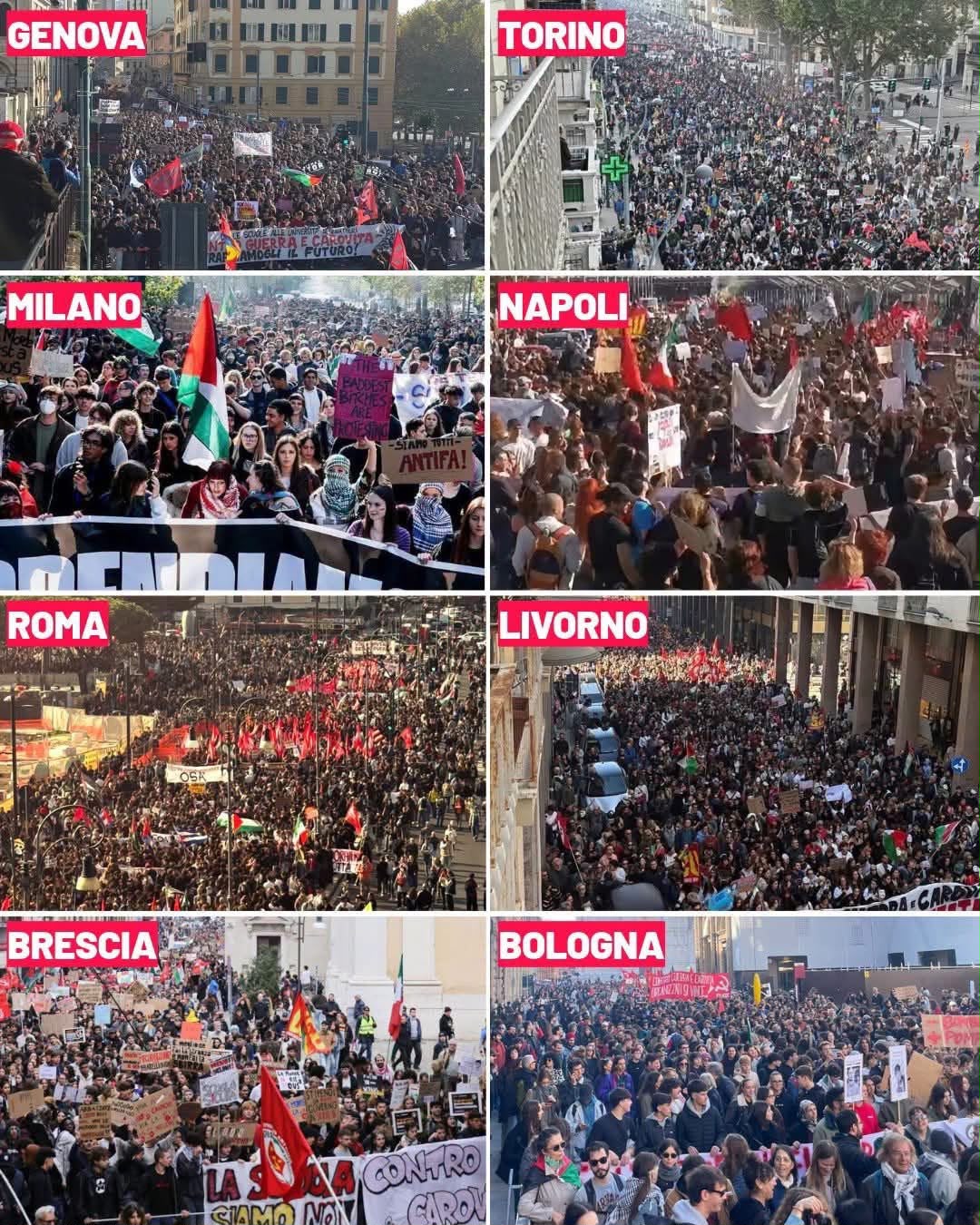
Forse è esagerato parlare di “circa un milione e mezzo di manifestanti”, ma in tutte le più grandi città – da Milano a Torino, da Firenze a Bologna, da Roma a Napoli – e almeno in altre 60 le piazze si sono riempite di grandi, grandissime manifestazioni unite dalla protesta contro il carovita e la corsa al riarmo e alla guerra.
La campagna di intimidazione messa in atto dai mass media di regime, le precettazioni, il più imponente schieramento di polizia nelle strade da anni e anni, e – all’occorrenza – le manganellate, gli idranti, i lacrimogeni, i fermi (come a Vicenza, a Mestre, a Torino, etc.), hanno fallito la loro mission. A dimostrare, ancora una volta, che sono decisivi non i decreti-sicurezza, ma i rapporti di forza. E che per il movimento di classe i fattori chiave sono la massima ampiezza della partecipazione e la determinazione organizzata. E’ questo che ha consentito oggi di bloccare il traffico dei porti (anche con una adesione modesta tra i portuali), diverse autostrade, snodi ferroviari, tangenziali, di occupare sedi universitarie (come a Pisa), infrangendo le barriere repressive e legalitarie.
Forte l’apporto delle città portuali, Livorno anzitutto, Genova, Ravenna, Salerno, Ancona, Carrara, in una giornata segnata dallo sciopero internazionale di un centinaio di porti contro il genocidio di Gaza e l’economia di guerra.
Rilevante, ancora una volta, il coinvolgimento del proletariato immigrato della logistica, mentre – come raramente succede – l’intero sindacalismo di base si è ritrovato concorde nell’organizzare la riuscita di questa grande giornata di lotta.
Amplissima ovunque la partecipazione studentesca, che conferma e rinnova il risveglio politico della parte più fresca del proletariato avvenuta nello scorso autunno intorno al sostegno alla resistenza del popolo palestinese. Un anno dopo questo risveglio ha allargato il suo sguardo all’intera dinamica che ci sta portando verso una apocalittica guerra globale. Accanto agli studenti, molte/i insegnanti.
In opposizione al governo Meloni, bersagliato in tutte le piazze, che ha appena varato una finanziaria per il 2027 con tagli alle spese sociali e l’incremento delle spese belliche (nonostante i falsi reclami di Crosetto), che è complice del genocidio sionista, nella guerra in Ucraina, che ha confermato le 40 missioni militari nel mondo decise dai governi precedenti, il tema della guerra e dei costi della guerra è stato al centro di questa giornata di lotta. Il sentimento che è necessario opporsi alla corsa al riarmo e all’economia di guerra si sta diffondendo. Ed è un messaggio inquietante anche per la falsa opposizione di centro-sinistra che magari, in qualche suo esponente, blatera contro le spese di guerra, ma non muove una sola foglia contro la corsa alla guerra, ché anzi con la sua criminale russofobia – maggioritaria nel “campo largo” – alimenta.
Un vento nuovo ha cominciato a spirare…


A strong day of struggle against the rush to war and the high cost of living
Perhaps it is an exaggeration to speak of “around one and a half million protesters” (as the USB union did), but in all the major cities—from Milan to Turin, Florence to Bologna, Rome to Naples—and in at least 60 others, public squares were filled with large, massive demonstrations united in their protest against the rising cost of living and the rush toward rearmament and war.
The campaign of intimidation orchestrated by the establishment media, the use of mandatory work orders, the largest police deployment seen on the streets in years—along with the occasional use of batons, water cannons, tear gas, and arrests (such as in Vicenza, Mestre, and Turin)—all failed to achieve their objective. This proves, once again, that what truly matters is not “security decrees,” but the balance of power. For the class-based movement, the key factors are the broadest possible participation and organized determination. It was this that made it possible today to block port traffic (even with only modest participation from dockworkers), as well as various highways, railway hubs, and ring roads, and to occupy university buildings (such as in Pisa)—effectively breaking through repressive and legalistic barriers.
There was a strong contribution from port cities—foremost among them Livorno, followed by Genoa, Ravenna, Salerno, Ancona, and Carrara—on a day marked by an international strike across roughly a hundred ports, protesting the genocide in Gaza and the “war economy.”
Once again, the involvement of the immigrant proletariat within the logistics sector was significant; meanwhile—in a rare show of unity—the entire spectrum of grassroots trade unions worked together to ensure the success of this major day of struggle. Student participation was widespread everywhere, confirming and renewing the political awakening of the youngest segment of the proletariat—an awakening that first emerged last autumn in support of the Palestinian people’s resistance. A year later, this movement has broadened its focus to encompass the entire dynamic currently driving us toward an apocalyptic global war. Alongside the students, many teachers also took part.
The day of struggle centered on the issue of war and its costs—a direct challenge to the Meloni government, which was targeted in squares across the country. This government has just unveiled a budget for 2027 that slashes social spending while increasing military expenditure (despite Crosetto’s disingenuous denials). It is complicit in the Zionist genocide and the war in Ukraine, and has upheld the 40 military missions worldwide initiated by previous administrations. A growing sentiment is taking hold: it is essential to oppose the arms race and the “war economy.” This serves as an unsettling message for the sham center-left opposition, whose representatives may occasionally blather against military spending, yet fail to lift a finger against the headlong rush toward war—a rush they actually fuel with their criminal Russophobia, which remains the dominant stance within their “broad coalition.”
A new wind has begun to blow…