
The meeting on Sunday, August 16, in Cairo between Trump’s envoy, the hyper-Zionist Kushner, and the new political leader of Hamas, Khalil Al-Hayya, confirms what has been clear for many months: Hamas agrees to move within the borders drawn by the “Trump plan” on Gaza. And after dissolving its administrative bodies in Gaza, it is ready to proceed with its own disarmament if Israel withdraws from Gaza. This, despite the colonialist and slave-owning nature of the American plan not escaping the leaders or the most conscious Hamas militants.
How can this contradiction be explained?
With a realistic assessment of the situation on the ground, which also takes into account the decidedly extremist position of the government and the Zionist state. Hamas and the other smaller Palestinian armed resistance groups waged an epic battle against the Zionist state and its Western protectors and arms suppliers (with Italy, led by Meloni and Mattarella, at the forefront). And despite an extraordinary display of organization, discipline, and heroism, they lost. For several reasons.
The reasons for a defeat
1. Because they received no support from Palestinian citizens of Israel, who remained largely at a standstill (the protests in Israel were led by very small groups of courageous young Israelis, the last on July 29 in Tel Aviv), nor from Palestinians in the West Bank, where the corrupt police and administrative structure of the PA succeeded in isolating the most radical youth groups.
2. Because of the insufficient support of the oppressed and exploited masses in Arab and Islamic countries (including Turkey and Iran): completely at a standstill in Egypt, the key country of the Arab world, and elsewhere, unable to break the ironclad repressive control they find themselves under; they mobilized en masse, especially at the beginning, in Jordan and several other countries, but always respected the legal and political constraints imposed by their respective governments and accepted by obedient leaderships (in Amman, 500,000 stood outside the doors of the US embassy without attacking it); only from Hezbollah and the Houthis did the Palestinian resistance receive great, or at least significant, concrete military aid.
3. Due to the limitations of the massive international mobilization for Palestine, which indeed delegitimized and shattered the image of an advanced, civilized, democratic Israel, exposing its colonialist, genocidal, racist, and slave-owning nature, but lacked the strength and determination to physically interrupt the supplies of weapons and goods needed by the Zionist state to carry out the massacre in Gaza and its expansion in the area—this interruption did not even occur in Italy, where strikes were held several times in solidarity with the Palestinian people.
4. But this round of the Palestinian liberation struggle was also lost because all states—including those in conflict of interest with the West—refrained from committing acts that could jeopardize Israel’s massacres, and were, to varying degrees and in various ways, complicit in them.
The states that led the mass assassination of the Palestinian people are, of course, the United States, Germany, and Italy, the major arms suppliers for Israel. The entire European Union follows. The genocide in Gaza is a crime for which they too must answer just as much as the Zionists.
Following them are the BRICS, major suppliers of goods of all kinds necessary for daily life in Israel (China first and foremost), as well as of oil (Brazil) and oil derivatives (Russia) essential for military operations. India, even after the genocide was over, rewarded the Netanyahu government by elevating its relationship with Tel Aviv to a “special strategic partnership,” signing a memorandum of understanding last February covering 16 productive sectors, starting with the war industry, the linchpin of the Zionist machine of death and destruction.
Russia and China’s abstention at the UN on Trump’s Gaza plan, well illustrated by the seemingly provocative video released months earlier by the great trashman, crowned the de facto collaboration of the anti-Western powers in the crushing of the Palestinians in Gaza. In this context, the ruling of the International Court of Justice in The Hague, initiated by South Africa, has remained a mere pinprick for the Israeli state, which is supported in one way or another by all the major and medium-sized capitalist powers—none of which even dreamed of withdrawing their ambassador, even just to show that…
As for Iran, which is a different case, of course, there were initially rumors of who knows what supplies of deadly offensive weapons to the Palestinian resistance. The ongoing war between Tehran and the US-Israeli aggressors is providing a measure of the strength and high sophistication of Iran’s war industry, while also categorically disproving the above-mentioned fable. In three years of strenuous resistance by Palestinians in Gaza, unfortunately, not a single IDF terrorist plane has been shot down (as far as we know), while in barely three months of fighting, the US Army, Navy, and bases in the area have suffered the greatest damage at the hands of Iranian forces and the Pasdaran since the Vietnam War.
Contrary to the bombastic demagogy about the so-called “Axis of Resistance,” Gaza is for Tehran merely a “rhetorical pressure point,” not an actual one, however, nor a strategically central one, unlike, for example, the situation in Lebanon and Hezbollah. It is no coincidence that Lebanon was included in the 14-point agreement with Washington, but not Gaza.
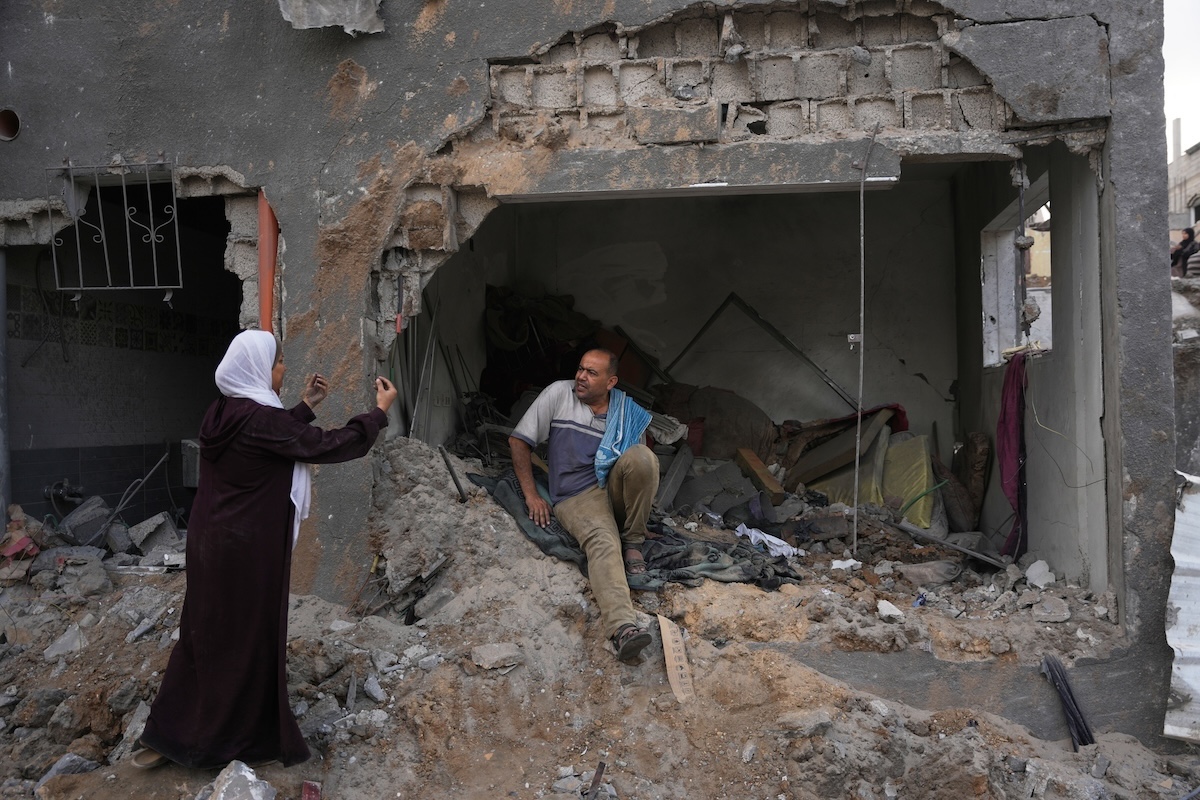
Given this totally unfavorable international framework at the state level, with Gaza reduced to a pile of rubble and threatened by brutal starvation and the uncontrolled spread of disease, thousands of fallen fighters, hundreds of thousands wounded and sick, after the UN approved the “Trump Plan,” Hamas, whose leadership has been decapitated several times, has decided to attempt to operate within that plan—despite the plan’s provision for its total disarmament and exclusion from any role in the next “technocratic government” that the White House will install in Gaza, following colonial criteria and supervised by a professional assassin of the caliber of Tony Blair.
Misplaced Trust in “Friendly States”
It can be observed, and rightly so, that Hamas, and the entire Palestinian armed resistance, trapped in a nationalist conception of Palestinian national liberation, relied too much on the aid of some Arab and Islamic states, and perhaps even on the support of anti-Western states. Here, the contrast emerges between a challenging and original military tactic compared to the past (the underground construction of a second Gaza) and Hamas’s reiteration of an old political line of the PLO and the PA itself, which continued to rely decisively on the aid of “friendly states” rather than on the oppressed and exploited masses of the vast Arab and “Islamic” world.
However, the Palestinian cause, precisely because it is a revolutionary cause, subversive of the colonial order that emerged from the First World War and the neocolonial order that emerged from the Second World War, does not have, and cannot have, friendly capitalist states willing to go all the way in supporting the Palestinian people. Neither in the Middle East nor, much less, elsewhere. The victory of the Palestinian cause, in fact, would be the defeat not only of the Zionist state, but of all the great powers that presided over the birth of Israel, and today criticize it, perhaps, but still consider it untouchable. A century and more of history has abundantly demonstrated that there is no room for two states on the land of Palestine.
And it showed how a series of Arab states, precisely because of their servility to the international imperialist order, stabbed the Palestinian liberation movement in the chest or back: starting with King Hussein’s Jordan in the Black September of 1970, continuing with Assad Sr.’s Syria in 1976 (the Tell al-Za’atar massacre), Saadat’s Egypt in 1978 (the Camp David Accords), and so on… up to the “Abraham Accords” of 2020.
Precisely against the states from which the Palestinian resistance once again expected help, the Al Qassam Brigades took a very tough stance in July 2025, remaining isolated, in which they denounced “the betrayal of the leaders of the Islamic and Arab nation, of its elites, of its scientists,” their passivity, their complicity with the monstrous Zionist machine: “We do not exempt anyone from the responsibility of bleeding blood and we do not exclude anyone who has the ability to move according to his capacity and influence” (1). With one exception: “our brothers in Yemen who forced the enemy to face” another front of battle, the only ones who deserve the salute of indomitable Palestinian resistance.
Hamas: a military step forward, a political step back
Never has the condemnation of the ruling classes of the “Islamic and Arab nation” (note well: not only Arab, but also Islamic) been so clear and sharp, coming from a Hamas structure. However, the clarity of this judgment and the fury with which it was shouted are the effect of a recurring illusion/disillusionment. Even the courageous and skillful leadership of Hamas, capable of asserting its hegemony in Gaza thanks to the coherence of its national battle against Israel, thought the impossible possible.
In this respect, politically, it is a step backward compared to the most advanced points of the Palestinian struggle between the late 1960s and early 1970s. For example, Ghassan Kanafani was able to affirm that “the only path that can lead to victory is the encirclement of Israel with the strategy of the popular war of liberation [advancing] from all sides – from Syria, Egypt, Lebanon, Jordan and the territories occupied before and after June 5, 1967.” And he went so far as to conceive of this process of liberation not as a process involving all classes without distinction, but rather essentially concerning the working classes of the Arab world opposed to “their triple enemy: Israel, imperialism, [Arab] reaction.” Kanafani drove his criticism against the role of the most reactionary Arab regimes, including the “petty bourgeois” governments, incapable of a coherent struggle against Zionist-imperialist domination. (2)
Nayef Hawatmeh and the Popular Democratic Front for the Liberation of Palestine went even further, rejecting any possible alliance with the Arab bourgeois regimes, even the “pro-Soviet” or so-called progressive ones, because they rightly judged them to be interested only in “emptying the mass movement,” and envisioning “a democratic and socialist state […] in which power, all power, will be exercised by the workers’ and peasants’ soviets” (3).
At that time, the Palestinian movement, albeit a minority of it, held a perspective of struggle in which the decisive link was between the “Palestinian revolution” and the broader Arab and “Third World” revolution. This vision brought its proponents closer to the path of other great exponents of the anti-imperialist struggle, such as Ben Barka, Amilcar Cabral, Malcolm X, Che Guevara, and later Thomas Sankara, who went further than many of their comrades in grasping the connection between “their” national revolution, the movement of the anti-colonial revolution on an international scale, and, in some cases, the class struggle in the metropolises.
The Backwardness of the Metropolitan Proletarian Movement
If none of these highly skilled fighters for the anti-colonial, anti-imperialist revolution succeeded in organically integrating it into the process of the international, anti-capitalist proletarian revolution, the fundamental deficit is not theirs, but rather the leadership of the proletarian movement in the metropolises, and of the movement itself, which was unable, even in its years of greatest combativeness, to unconditionally stand on the side of the colonized peoples of color and the oppressed “races,” and to fight to the bitter end against their own imperialist governments. Indeed, it is not enough to express oneself in favor of them if one is not willing to simultaneously fight against “one’s own” governments—capitalism and imperialism, which are at work outside one’s doorstep.
Half a century of all-out bourgeois and imperialist counteroffensive has had the effect of pushing back, far back, both the national-revolutionary movements (think of the evolution of the PKK and that of the old PLO) and the proletarian movement in the metropolises, today deprived of true political autonomy from imperialist powers.
Even the recent solidarity movement with Palestine, very broad but not as radical, with many lights and some opportunist shadows (4), has not been able to make the contribution that would have been necessary to materially defeat the Zionist machine of oppression, paralyzing its supplies. We must admit this frankly, even though we have been among its most tenacious promoters. This is why we have kept away from a certain triumphalism regarding it.
The unfavorable balance of power is now pushing Hamas to hope for (small) frictions between the White House and the Netanyahu government in order to try to implement that part of the “Trump plan” that provides for the withdrawal of the IDF from Gaza simultaneously with the disarmament of its own militia.
It is a very narrow path, perhaps imaginary. Since Israel has so far systematically violated all agreements, and has again rejected Trump’s (rather bland) invitation to apply the second tranche of the agreement, after having blatantly violated the first (5). It seems that in recent days, meeting Netanyahu, Kushner has given his assent to the continuation of the “targeted” assassinations of resistance militants – the assassination of 30-40 Palestinians a day demanded by the bloodthirsty Ben Gvir. Moreover, Islamic Jihad has already pointed out that Mladenov, the executive director of Trump’s Board of Peace, is anything but an honest mediator. Imagine if a Kushner could be!
There can be little doubt that the entire “Trump plan” for Gaza is aimed at the definitive liquidation of the Palestinian cause, a true “legal” complement (given the obscene UN endorsement) to the Zionist genocide. But historical experience demonstrates the irreducibility of this people and its resistance.
The Rebirth of the Palestinian Revolutionary Cause
The rebirth of the Palestinian revolutionary cause, which has never been considered dead, may once again occur not through the initiative of the Arab or Islamic states that have so far undermined it or exploited it for their own ends, but through the initiative of the Palestinian people themselves within the framework of a regional proletarian movement. And its center of gravity will increasingly shift toward the exploited Palestinian masses, now dispersed throughout the Middle East and the entire world, called upon to take action and overcome the constraints that have imprisoned even Hamas.
Its victory—and we’re not talking about tomorrow, of course—can only come with the breaching of Israel’s borders by armed popular mass movements (or armies won over to the revolutionary cause) from all neighboring countries, working together—at the confluence of the “great Palestinian revolution” and the “great Arab revolution” and the Middle Eastern revolution, in conjunction with a class awakening in the imperialist world of the West, also in turmoil as a result of this gigantic uprising, capable of going beyond the great Arab Intifada of 2011-2012 and on to October 7, 2023.
The Third International had a far-reaching vision when he envisioned the creation of a Federation of the free Soviet peoples of the Middle East as the only possible solution to a tangled web of contradictions left over from historical colonialism. A century has passed since then, and it hasn’t yet materialized, nor does its realization appear imminent. True. But great historical events do not happen on command; they always require a long maturation process. And in the current defeat of the Palestinians, in the path undertaken by Hamas of painful rapprochement with Fatah itself, and perhaps even with its former archenemy, M. Dahlan, now a billionaire in the service of the Emirates (6), there are—by contrast—the elements useful for making a final assessment of an entire era of the irreducible Palestinian struggle, and for opening a new one free of any illusions in “friendly states.”
And us, here?
As for us, here, we have already witnessed firsthand the clear ebb of the solidarity movement with the resistance of the Palestinian people. We must do our utmost not to be sucked into this ebb, to relaunch the denunciation of the ongoing genocide, and of the responsibilities of Italy, the EU, and the United States in this. We must continue to focus attention and condemn the expropriation of growing areas of the West Bank and the ongoing attempt (not only by the Zionists) to erase the “Palestinian question” forever. We must tenaciously oppose the repression that has targeted and targets activists in solidarity with Palestine, and the introduction and implementation of the Romeo bill promoting Zionism everywhere. We must gather and relaunch all the efforts underway in Middle Eastern countries—even among small minority groups—to pose the Palestinian question and the oppression of the Arab masses in class, revolutionary internationalist terms.
It is a matter of going beyond simple solidarity with the Palestinian people and their resistance, beyond demonstrative gestures, closely linking the initiative for a free Palestine from the river to the sea to the open struggle against “our” government. There is a strong connection between colonial policies “abroad” and anti-worker policies here, and this must be made clear to those proletarians still waiting on the sidelines. We are confident that the worsening economic, ecological, political, and financial crisis will push masses of proletarians to break their current passivity and fight for themselves. This strength has been lacking, until now, in the Palestine movement, and only its emergence will truly change the entire landscape of recent years. If the Palestinian resistance is called upon to be reborn with an increasingly classist and internationalist imprint, the same need faces the proletarian movement here in Italy, in Europe, and throughout the West.
The emergence in the metropolises of capital of a class movement independent of, and opposed to, imperialist powers and their policies, fighting for their overthrow, is, ultimately, the most effective contribution we can make to the victory of the Palestinian cause itself.
Before October 7, 2023, no one would have bet a penny on the impetuous resurgence of Palestinian resistance and the catastrophic decline in the credit of Israel and its great patrons. We are confident that the march toward the abyss of combined wars and environmental catastrophes, with the immeasurable sacrifices, risks, and human and ecological costs involved, will have the effect of a series of electroshocks on the working class. We are firmly convinced of this, and, to the extent of what little we have left, we are working toward this goal.
Notes
(1) https://pungolorosso.com/2025/07/20/una-notevole-dichiarazione-delle-brigate-al-qassam/
(2) G. Kanafani, Selected Political Writings, Pluto Press, 2024, pp. 121 ff.
(3) In the large-scale mobilizations that took place in Italy between September 22 and October 4 of last year, organizations such as Potere al Popolo, USB, and similar organizations, which have organic ties to Abu Mazen’s PNA, notoriously subservient to Zionist governments and secret services, undoubtedly played a significant role.
(4) PLO – Al Fatah – PFLP – PDPLP, Testi della rivoluzione palestinese 1968-1976, Bertani, 1976, pp. 279 ff.
(5) https://pungolorosso.com/2026/08/13/la-banda-netanyahu-rifiuta-il-piano-trump-su-gaza/
(6) G. Colarusso reports this “secret” meeting with such rich detail that it seems highly plausible, in “la Repubblica”, August 19, p. 5.