
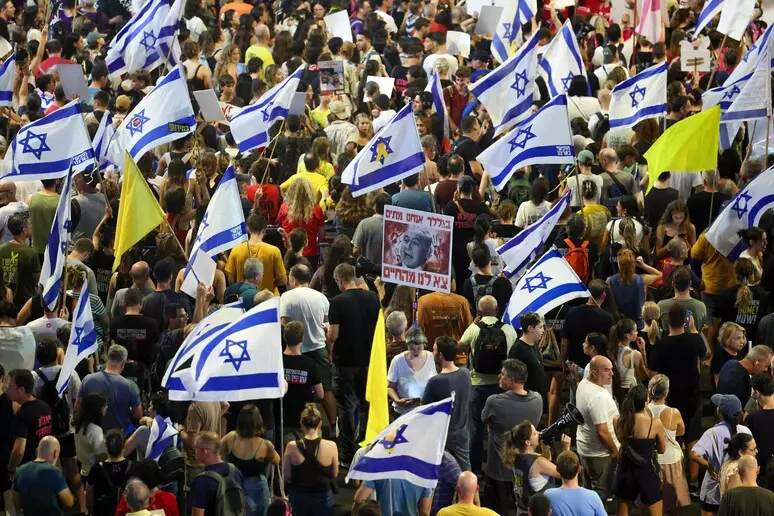
Sunday and Monday [September 1 and 2] were very difficult days for the Netanyahu government. Hundreds of thousands of demonstrators in Tel Aviv, Haifa and other cities called for a truce to bring home alive the Israeli prisoners in the hands of the Palestinian resistance. With the same objective, the Histadrut trade union called a general strike. Although half successful and halved by the diktats of the judicial power, which deemed it ‘political’ and therefore illegal, the strike disrupted public transportation (including air transport), public services, and war logistics. The agitation of society inevitably translates in the contrasts at the top of the Zionist state. Once again, Gallant says he is in favour of the truce, which would also give a breathing space to his troops, who are much more exhausted than they want to admit. In contrast, Netanyahu&Co. continue to reject the truce de facto, placing unacceptable conditions on Hamas and the entire Palestinian resistance.
Last May, when these contradictions at the top of the Israeli colonial machine of extermination and oppression emerged publicly with the distancing of Gantz, Lapid and Gallant from the most extremist positions, we wrote that ‘no matter how much aid and subsidies they receive from abroad, both the Zionist army and the Israeli economy are not able to endure for long’ the permanent war throughout the Gaza territory. Also because it is not just about Gaza. At the same time, the IDF has to attack the populations and resistance groups in the West Bank (or repel their attacks), and confront the restrained, but unremitting and militarily effective activities of Hezbollah in the north. Already in May, mutual accusations flew between the members of the genocidal gang that runs the state apparatuses: accusations of leading Israel to defeat, even to the abyss. This picture led us to the following considerations: ‘The resounding political defeat of Israel, the United States and the EU is already evident, formalised on the diplomatic level by the request of the International Criminal Court prosecutor Karim Khan. The growing military and economic difficulties, although covered and concealed, are emerging into the open day by day. By now it is clear: Israel and its protectors can destroy and slaughter, but they cannot win. Much less [can they] ‘win minds and hearts’. But they will not demur from their plans of domination: they must be defeated!’.
Months later, we regard with satisfaction the growing chaos inside Israel – a general strike is a blow to the country’s economy, a social shake-up, and Monday was in Israel the largest day of street protests since 7 October with the mobilisation of tens of thousands of workers in a context of war mobilisation. This growing chaos – and its immediate impact in Europe with the collapse of war industry stocks – is the effect of the extraordinary resistance of the Palestinians. Even the Histadrut spokesman recognised this: ‘The war is having a terrible effect on our economy. Unemployment is rising, whole areas in and around Gaza have been evacuated. Thousands of Israelis are now internal refugees’.
However, we are under no illusions about the immediate future because even in the ranks of the strikers and demonstrators of the last few days, the Zionist perspective continues to be overwhelmingly dominant, almost totalitarian, as it was in last year’s protests against the reform of the judiciary. The Histadrut leaders, accused of being friends of Hamas for calling the strike and demanding the truce, justified their decision in this way: ‘we cannot allow life to be abandoned’. But by life they only mean the lives of Jewish prisoners, not Palestinians’. The same goes for the signs depicting Netanyahu with blood on his hands: that is only Jewish blood, the only one that counts. This is confirmed by the same mainstream ‘information’ in Italy, supinely aligned with the Zionist propaganda: they have devoted more than one report to reconstructing who the six prisoners found dead in the Gaza tunnel were, they spoke extensively about their lives, work, families, affections, aspirations; in short, they described them as human beings – a privilege evidently exclusive to Israelis. The tens of thousands of Palestinians massacred in the Strip, the hundreds who meet the same fate in the West Bank, remain instead a mere ‘collateral damage’, the manifestation, at best, of the ‘over-defence’ of Tel Aviv’s slaughter machine.
Those who read us know that we carefully scrutinise Israeli society in order to catch any sign of disengagement from the Zionist perspective of the indefinite expansion (from the Nile to the Euphrates) of the colonial and racist Zionist state, increasingly steeped in fanatical religious fundamentalism. Indeed, the defeat and collapse of this regime can only occur with the explicit rebellion against the political-ideological dictatorship of Zionism by at least part of the Jewish wage labour force. Well, the only explicit signs in this direction, still terribly modest, come from a small segment of the demonstrations, mostly composed of young people, engaged in a pacifist denunciation of the genocide – as can be seen on this page of the Refuser Solidarity Network. Then there is the activity of collecting material aid for the people of Gaza carried out by the young people of Standing Together, who have also proved able to say, during the demonstrations, that the right of the Palestinians to live on their land free from occupation should be recognised. Both groups, however, are still unable to draw all the necessary consequences from these statements. This is certainly something, given the fierce anti-Palestinian air that these young people breathe from birth in every moment of their existence; but it is still little, too little!
The second reason why we do not consider the collapse of the Zionist machine to be close as we wish (and as Ilan Pappé described it in his article in the ‘New Left Review’ of 21 June) is the international protection it receives from the United States, the European Union, and NATO, and the complicity it enjoys from the totality of the Arab states for whom the ‘Palestinian question’ has long been an annoying encumbrance for their affairs and (especially for the countries bordering Israel) for their stability, not to mention their active collaboration with the occupiers of the so-called PNA. Moreover, unlike the cowards who carefully conceal it, we will not tire of repeating that Russia, Brazil, and the BRICS as a whole are also giving Israel’s genocidal war machine significant aid, consisting not only of oil, oil derivatives, and equipment for the ‘defence’ and control of the Palestinians, but also of a political nature, preventing the movement of international support for the Palestinian people from gaining a foothold in their countries.
As some geo-political and military experts argue, it may well be that Israel is approaching a time of great difficulty due to a shortage of ammunition, as is happening with Ukraine. And it is certainly true that in the North it has already suffered a setback with the evacuation of a strip of ‘its own’ territory, with several thousand refugees. But these same experts are forced to admit that Israel, while it cannot win this ‘fourth war’ of its own, cannot lose it either. Nor is it just about Israel. Zionist state terrorism is the ‘last word’ of the inexorably declining West – the weapon it has to deploy to intimidate the oppressed and exploited masses of the Arab and Islamic worlds, who, since 2011-2012, have given repeated proof that they are willing and able to rise up against their despotic regimes and their even more despotic Western overlords. The Palestinian resistance is an integral part of this chain of unfinished popular uprisings, urging them to raise their heads again.
So welcome is the growing economic, social and political chaos in Israel. Welcome is the setting in motion of a mass demand for truce and prisoner exchange, which – whether one wants it or not – is the mass recognition of a strong enemy, which has managed to checkmate an army accustomed to self-celebrating itself as invincible, in defiance of its overwhelming technological superiority. But to impose an end to the genocide and, even more, an end to the colonial occupation of Palestine, the road ahead is not short, nor is it downhill.