
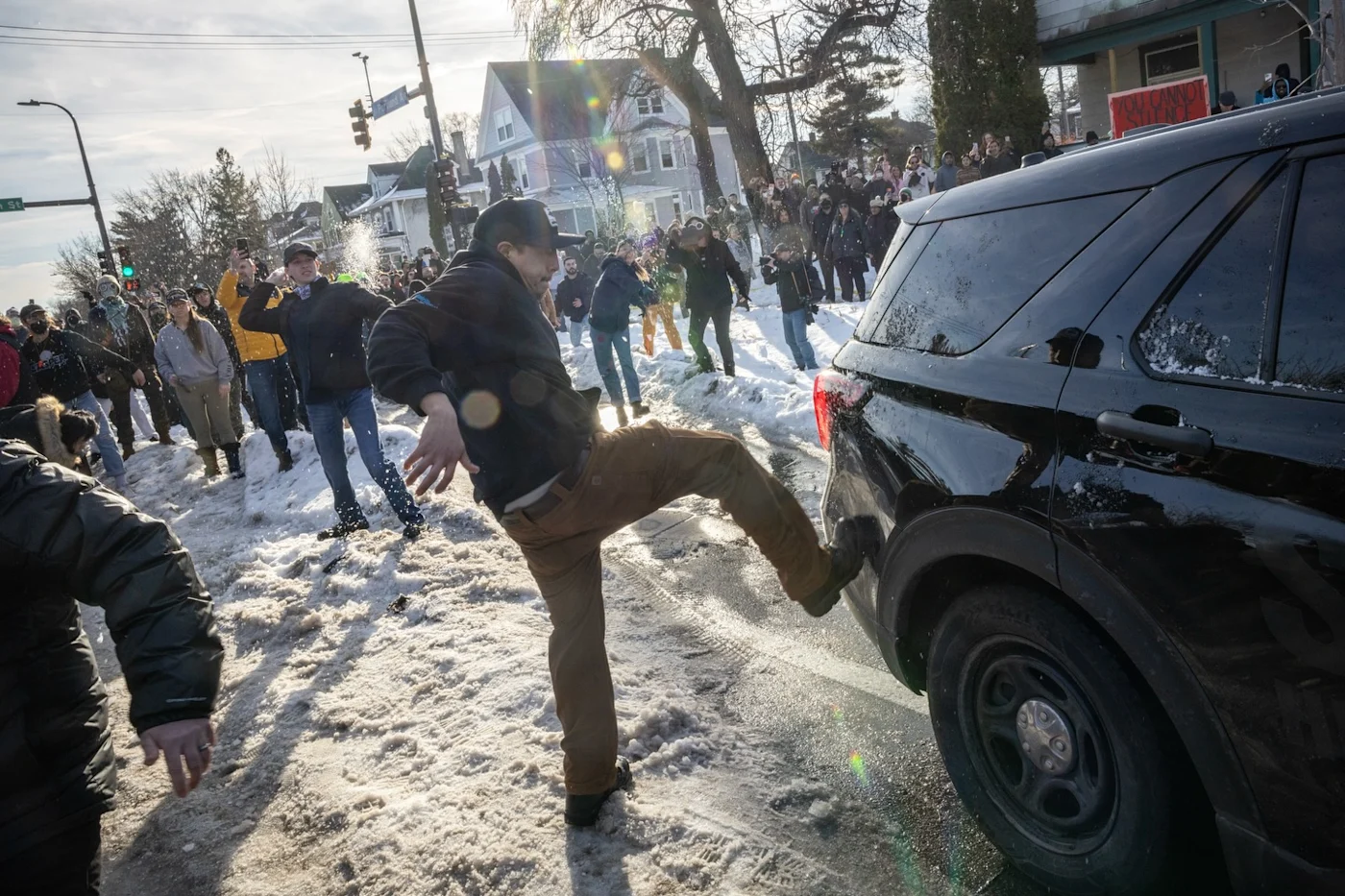
Riprendiamo da “Ill Will”, grazie alla traduzione della compagna Giulia Luzzi, un articolo che descrive le modalità d’azione della milizia mercenaria e assassina dell’ICE, e nello stesso tempo indica e smonta gli argomenti inconsistenti e, più spesso, menzogneri con cui i cosiddetti liberal tentano di deviare verso vicoli ciechi (accorati appelli alle autorità, ricorsi giudiziari, elezioni di medio-termine, etc.) il movimento di lotta in corso contro l’ICE e contro l’amministrazione Trump-2.
Secondo l’autore dell’articolo, e anche secondo noi, questo movimento si colloca già oltre quello del 2020. Ma ha bisogno di un’ancor più forte autonomia dalle diverse fazioni dell’élite capitalistica che governano gli Stati Uniti con modalità sempre più dispotiche, da regime, per sviluppare a pieno tutte le sue potenzialità anticapitalistiche. E puntare non a una semplice redistribuzione della ricchezza sociale, ma ad una trasformazione rivoluzionaria del sistema con “finalità di emancipazione”.
Torna in questo testo il tema della guerra civile (negli Stati Uniti!) – di cui ci siamo già occupati. E pensare che la maggioranza degli attivisti e delle attiviste, per non parlare dei kampisti di professione, è tuttora indifferente al movimento di lotta in corso negli Stati Uniti. Per noi, e nella realtà, ci sono due “Americhe” sempre più distanti e antagoniste, destinate a scontarsi “per la vita e per la morte”; per tanti, troppi, invece, c’è una sola Amerika: quella del Pentagono, della Casa Bianca e di Wall Street. Che cecità! (Red.)
La città ghiacciata è sotto assedio. Nei lunghi e freddi inverni nel cuore del Midwest l’aria può diventare così fredda che respirare è doloroso. Mercenari mascherati a bordo di veicoli senza insegne vagano tra i cumuli di neve, rapiscono persone per strada e le trasportano nei centri di detenzione per periodi di tempo indeterminato. Ciascuno di questi mercenari riceve decine di migliaia di dollari con “bonus di ingaggio” (fino a 50.000 dollari, e 60.000 dollari come condono dei prestiti studenteschi) semplicemente per imbracciare le armi per conto del regime in difficoltà. Di fronte a una crisi economica al rallentatore, in cui un surreale boom del mercato azionario sostenuto dallo stato si accompagna a una persistente stagflazione nell’economia reale, la professione del leccapiedi è uno dei pochi settori che registra una crescita reale. Mentre le strade di Minneapolis si ghiacciano, l’indice S&P (Standard and Poor) raggiunge livelli record. Nel frattempo, la crescita dell’occupazione dello scorso anno è stata così scarsa che, dopo la pubblicazione dei dati, il regime si è mosso rapidamente per licenziare il capo del Bureau of Labor Statistics (l’Ufficio di Statistica del Lavoro) e minacciare gli organi di informazione che ne hanno riportato i dati.1 Oltre al calo dell’occupazione dovuto al blocco dell’immigrazione, la profondità della crisi è segnalata dalla continua discesa del tasso di partecipazione alla forza lavoro, che è stato il singolo maggior freno alla crescita occupazionale nella prima metà del 2025, a indicare che sempre più persone stanno abbandonando del tutto la forza lavoro, senza però essere registrate dalle statistiche sulla disoccupazione.2 Possiamo quindi pensare all’assedio [delle grandi città attraverso le pattuglie dell’ICE] come ad una sorta di keynesismo mercenario, volto a compensare la carenza di occupazione nei nuovi settori della difesa basati sull’intelligenza artificiale, i quali sono stati al centro del più ampio approccio alla governance basata sul saccheggio delle risorse e sulla ristrutturazione (dei processi lavorativi).
Fatti venire da città lontane, ammanettano i detenuti e poi li picchiano se non riescono a difendersi. Sparano proiettili non letali allo scopo di sfigurare. Hanno ripetutamente investito persone con i loro veicoli. Persone che tornano a casa dal lavoro in auto si sono viste spaccare i finestrini e sono state trascinate fuori dai veicoli, picchiate e detenute per ore, a volte per giorni. Ora stanno sparando sulla gente con munizioni vere. Hanno fatto irruzione nel parcheggio di una scuola media. Hanno trascinato una madre fuori dalla sua auto, l’hanno caricata su un furgone senza contrassegni e sono ripartiti, lasciando il suo neonato sul seggiolino con la portiera aperta con temperature sotto lo zero (fortunatamente salvato da alcuni tra la folla accorsa alla scena). Hanno lanciato gas lacrimogeni e granate stordenti contro un’auto piena di bambini, che sono poi stati tutti ricoverati in ospedale, compreso un neonato di sei mesi che faticava a respirare.3
Per rappresaglia alla risposta della comunità, hanno iniziato a fare irruzione anche nelle case private, spesso sbagliando indirizzo. Il sindaco afferma che non c’è nulla da fare. Il governatore ha convocato la guardia nazionale, da schierare non contro i mercenari, ovviamente, ma contro coloro che protestano contro di loro. Le autorità giudiziarie del paese non solo si rifiutano di perseguire penalmente [i mercenari] ma hanno ricevuto l’ordine di indagare sulle vittime e sui loro familiari. Ogni notte, il mondo intero guarda video di corpi avvolti dalle ombre, che si muovono nel buio gelido della città sotto assedio. Nelle dirette streaming, la gente urla e piange, i mercenari urlano le loro minacce, sparano con le armi e, di fronte ad una folla abbastanza numerosa, battono in ritirata. Gli alberghi che li ospitano vengono devastati. Le auto che abbandonano vengono saccheggiate. In risposta, il presidente invia altre truppe, un re folle in un corpo in decomposizione che urla mandati incoerenti dal suo palazzo nella palude. Sorge di nuovo il sole, e ci svegliamo con il sapore amaro di nuove atrocità che ci attendono.
Cinque anni fa, a pochi isolati dal luogo in cui Renée Good fu assassinata dal codardo Jonathan Ross, un omicidio simile scatenò la più grande rivolta popolare di un’intera generazione. Subito dopo, ci vennero raccontate una serie di menzogne su questa ribellione. Ci venne detto che si trattava di un “movimento sociale non violento”, anche se l’immagine di un distretto di polizia in fiamme lampeggiava sullo sfondo. Ci venne detto che, sebbene ci fossero stati episodi di violenza, erano stati scatenati da agitatori esterni, forse poliziotti o persino suprematisti bianchi. Chiunque fossero, non erano membri della “comunità”, erano individui che “cercavano solo di creare problemi”. Ci venne detto che il piano era sempre stato quello di perseguire l’omicidio, era solo una coincidenza che le accuse fossero state formalizzate solo dopo che quasi tutti i centri urbani di questo paese avevano visto i loro centri storici saccheggiati e incendiati. Ci venne detto di tornare a casa, che era finita. Ci venne detto che i disordini erano solo la scusa di cui Trump aveva bisogno per dichiarare la legge marziale e annullare le imminenti elezioni. Ci venne detto che, se fosse stato eletto, Biden avrebbe sistemato le cose. Ci fu detto che le deportazioni sarebbero finite e che le politiche di Trump sarebbero state revocate. I ragazzi sarebbero stati liberati dalle carceri. Ci fu detto che dovevamo tornare alla politica di sempre, che questo era l’unico modo per “fare le cose”. Nel complesso, queste menzogne equivalevano ad un’unica, grande falsità: non c’è mai stata la rivolta e non potrà mai più verificarsi.4 Ma lo spirito della storia procede in modo strano. Ciò che è morto non muore mai del tutto. E sentiremo, ancora e ancora, le stesse bugie:
“Se sei qui legalmente, non hai nulla di cui preoccuparti...”
Questa è sempre la prima bugia, a cui credono solo i più squilibrati o i più scriteriati. Questa prima bugia si è sbriciolata persino agli occhi del più accanito sostenitore dello Stato, nel momento in cui è stato sparato il colpo. L’hanno perciò riconfezionata con altre parole: “se non ostacolate gli agenti federali…”. E subito hanno provveduto alle solite aggiunte: “perché, per cominciare, ti trovavi in una sommossa?” (rivolto alle persone che vivono nel quartiere); “perché stavi portando i tuoi figli a una protesta?” (rivolto alle famiglie che andavano a prendere i figli a scuola); “questi cittadini hanno legami con gruppi della sinistra radicale” (vero per definizione per tutti coloro che si oppongono alla DHS, l’Agenzia che presiede alla caccia agli immigrati). Alla fine, la litania di bugie pronunciate da qualsiasi forza tirannica tende a conformarsi allo stile guida dell’IDF, perfezionato sul terreno bombardato della Palestina, che per tanto tempo è servita da laboratorio di nuovi orrori. E naturalmente, come può dimostrare anche un rapido sguardo alla storia, gli orrori non rimangono mai confinati alla Terra Santa. Quando il boomerang imperiale torna verso la mano che lo ha lanciato, il processo ha sempre inizio con il cosiddetto “elemento criminale”. E poi gli obiettivi diventano la sinistra e gli attivisti sindacali. E poi i loro simpatizzanti. E poi qualsiasi nemico. Alla fine, vengono presi di mira i nemici per definizione di una nazione concepita in termini di sangue e suolo.

Immagini: David Guttenfelder
Già, in modo del tutto indipendente dalle proteste, durante i raid sono stati arrestati dei cittadini statunitensi ed è stata loro negata la validità dei certificati di nascita presentati. Nativi americani sono stati trattenuti per giorni, usati, in parte, come espediente per costringere i governi tribali ad aprire i loro territori all’Agenzia. Non si tratta di un’esagerazione: nella città assediata, chiunque non abbia un aspetto abbastanza bianco (e bianco in modo giusto) deve portare sempre con sé un documento di cittadinanza, per non rischiare di essere arrestato e rapito. Questo è, quasi parola per parola, lo scenario profetizzato dai “radicali di sinistra” al momento dell’introduzione di agenzie come la Homeland Security (DHS) e l’ICE, in seguito all’approvazione del Patriot Act da parte di una coalizione bipartisan durante la “Guerra contro il Terrorismo”. Fu in questo stesso periodo che alla National Security Agency (NSA) vennero attribuiti nuovi e ampi poteri. La prima operazione inter-agenzia contro le “gang transnazionali violente” fu avviata nel 2005 sotto Bush, e anticipava gran parte della terminologia ancora in uso oggi. Ma il nuovo stato di polizia fu il risultato di uno sforzo congiunto. Infatti, sebbene avviato sotto un’amministrazione repubblicana, furono i Democratici a trasformare queste agenzie in organi operativi e ad ampliarne notevolmente i poteri.
Sia l’ICE che il DHS furono rapidamente potenziati sotto Obama, che sovrintese alla più grande ondata di deportazioni e una massiccia costruzione di campi di deportazione, realizzati in parte tramite un accordo senza gara d’appalto, da 1 miliardo di dollari, con il costruttore privato di carceri Core Civic (all’epoca Corrections Corporation of America).5 Di fatto, Johnathan Ross, l’agente che ha ucciso Good, fu assunto dall’agenzia proprio al culmine di questa ondata di deportazioni dell’era Obama. Gli stessi anni videro un’espansione dei data center della NSA, compresa la cerimonia di inaugurazione del Data Center della Comprehensive National Cybersecurity Initiative nello Utah, che è forse il nucleo della moderna infrastruttura di sorveglianza di massa.6 Analogamente, fu l’amministrazione Obama a firmare i primi accordi con Palantir per tracciare la criminalità transfrontaliera, gettando le basi per la ormai consolidata collaborazione di questa azienda con l’ICE.7 Oggi, questa società è stata incaricata di realizzare un’app “che popola una mappa con potenziali bersagli delle deportazioni, genera un dossier su ogni persona e fornisce un ‘punteggio di attendibilità’ sull’indirizzo attuale dell’individuo…”8 Quelli furono gli stessi anni in cui iniziarono a prendere piede per la prima volta gli appelli per “abolire l’ICE”, insieme alle richieste di sospendere i programmi di sorveglianza della NSA e a smantellare la Homeland Security. Inutile dire che queste rivendicazioni furono liquidate sia dai Democratici che dai Repubblicani come niente più che stridule lamentele di radicali testardamente idealisti. Ora, ci troviamo proprio di fronte alla “realtà” che ci era stata promessa.
“L’assassino sarà processato…”
Questa menzogna è la scialuppa di salvataggio per quei milioni di persone che si aggrappano ancora a un briciolo di fede in uno stato di diritto un tempo solido che, secondo ogni criterio ragionevole, è già sprofondato in un mare agitato e oscuro. Ci verrà detto di aspettare, di lasciare che il sistema faccia il suo lavoro, come se l’ordine civile andato a fondo potesse riemergere. In realtà, quell’ordine è sempre stato una fragile formalità provvisoria, resa possibile solo dalle acque calme di un ordine imperiale ben oliato. In tempo di crisi, il decoro dello Stato viene sempre sacrificato al ribollire del crudo potere che sta alla sua base. Coloro che basano la propria fede su questa esteriore correttezza non sono davvero in grado di dare un senso al nuovo mondo in cui si trovano. Ciò a cui stiamo assistendo, quindi, è il lento e imbarazzante crepuscolo della educata ingenuità politica che ha definito un’intera generazione di liberal. I liberal sono, fondamentalmente, una razza di legulei. Togliete loro la legislazione e le cause giudiziarie e vi ritroverete dinnanzi dei penitenti smarriti, accecati dai cupi orrori intravisti brevemente da dietro il paravento della loro fede in frantumi. Nell’immediato, continueranno più o meno come prima, solo con maggior fervore. Di fronte a prove inconfutabili della loro realtà politica, i liberal si aggrapperanno con ancora più forza alle macerie della loro civiltà crollata, intentando una causa dopo l’altra, scrivendo ai loro rappresentanti, e andando di porta in porta a perorare la causa di mediocri candidati per le elezioni di metà mandato come zeloti coperti di piaghe che si flagellano in segno di penitenza per la peste.
Abbiamo già assistito ad una pioggia di azioni legali intentate contro quasi ogni aspetto del programma di Trump. Al 20 gennaio 2026, si contavano complessivamente 253 cause attive contro azioni dell’Amministrazione. Tuttavia, anche quando si ottengono sentenze favorevoli, queste sentenze si rivelano inapplicabili. Da un lato, grazie ad un controllo decisivo sulla Corte Suprema e sulle nomine federali di ogni agenzia competente, qualsiasi ricorso legale può essere definitivamente respinto. La Corte Suprema ha già annullato le ordinanze dei tribunali inferiori in 17 occasioni.9 Dall’altro, possono essere mobilitati i poteri esecutivi affinché, per decreto semplicemente annullino le decisioni legali, sia direttamente (ad esempio, con la proliferazione di grazie presidenziali concesse sottobanco ai propri sodali) sia perseguendo il medesimo obiettivo con canali differenti. Ad esempio, quando l’espulsione di Kilmar Abrego Garcia fu dichiarata illecita da un tribunale di grado inferiore (e, raro caso, la decisione fu confermata dalla Corte Suprema), il governo federale cercò di incriminarlo con accuse infondate per giustificare successivi tentativi di espulsione. Ciononostante, proprio perché queste cause riescono infine a farsi strada nei tribunali e, di fatto, generano un certo attrito amministrativo, i liberal riescono a conservare una fede magica nel fatto che, alla fine, potrebbero avere successo.

Tutto ciò lascia ben poca speranza per una risposta giudiziaria agli omicidi di Renée Good e Alex Pretti. Poco dopo l’omicidio di Good, Ross è stato allontanato dalla scena del crimine, che è stata sgomberata senza alcun rilevamento di prove o indagini. Allo stesso modo, ad altre agenzie è stato vietato di mettere in sicurezza la scena dell’omicidio di Pretti. Il Dipartimento di Giustizia non ha dato seguito ad alcuna accusa, così come non lo hanno fatto i funzionari cittadini o statali. Il regime ha sostenuto che Ross e tutti gli altri suoi mercenari godono di immunità totale. Hanno ripetuto sfacciate menzogne sull’omicidio di Pretti, immediatamente smentite da numerosi video. A questo punto, come per qualsiasi omicidio commesso dalla polizia, le accuse per questi omicidi verranno formalizzate solo in presenza di mobilitazioni di massa di scala e intensità sufficienti. Sfilate pacifiche, anche se di dimensioni enormi o camuffate da “sciopero generale” (che però non blocca neppure uno dei principali datori di lavoro della città), non hanno alcuna possibilità di ottenere tale risultato. Allo stato attuale, non esiste semplicemente alcun meccanismo immaginabile attraverso il quale cortei che mettono in scena la protesta al solo scopo di attirare l’attenzione politica possano convincere chi è al potere anche solo a portare questi casi a processo. Attacchi alle proprietà del nemico, blocchi stradali serrati e scioperi potrebbero forzare un tale esito, come accadde con le rivolte nel caso di George Floyd diversi anni prima. In questo caso, tuttavia, persino un processo e una condanna potrebbero essere facilmente annullati attraverso la grazia presidenziale e, se i casi del 6 gennaio sono indicativi, tutto lascia presagire che l’esecutivo percorrerebbe questa strada. Non si può più avere fiducia nello Stato, nemmeno per una parvenza di giustizia. Ai liberal non resta che piangere, flagellandosi la schiena piagata in futili atti di penitenza nella speranza di riconquistare l’attenzione del loro dio inadempiente. Alla fine, i loro bubboni scoppiano e la peste li porta via come tutti gli altri.
“L’ICE non è il benvenuto qui …”
Forse questo è vero sul piano ideale – nella mente del politico liberal convinto che, nel profondo del proprio cuore, l’ICE non abbia alcuna legittimità. Eppure, se permetti che vengano commesse atrocità davanti ai tuoi occhi e non intraprendi alcuna azione concreta per fermarle, al di là di un discorso dai toni duri e magari di un paio di deboli azioni legali, non stai forse cedendo, di fatto, anche sul piano ideale? Questa menzogna è diventata un ritornello comune tra i politici locali. L’ha detta il sindaco. E anche il governatore. E, nonostante sia palesemente “non gradito”, l’ICE si è insediato come fosse a casa propria. I mercenari si aggirano per le strade. Sfondano a calci le porte delle persone, istruiti dai loro superiori che non serve un mandato firmato da un giudice. L’ordine è chiaramente illegale, ma la cosa non sembra più avere molta importanza.10 Le uniche forze che si mobilitano, anche solo minimamente, contro questa invasione sono state le persone comuni, che rischiano il carcere, mutilazioni e anche la morte per affrontare a viso aperto gli uomini armati mandati per deportare i loro vicini nei campi di prigionia. Robuste reti di difesa comunitaria si ramificano in tutta la città gelida, solidamente basate su infrastrutture create proprio da quegli instancabili ‘estremisti di sinistra’ che tanto ossessionano il regime. Grazie a queste reti, è raro che i mercenari riescano a muoversi senza essere tracciati, riescano a fare una sosta senza essere circondati o compiano un’azione senza essere ripresi.
Non c’è dubbio, reti di risposta comunitaria di questo tipo rappresentano una delle forme di organizzazione di classe più importanti che gli Stati Uniti abbiano visto negli ultimi decenni. Come spiega Adrian Wohlleben:
“Con la costruzione di centri di difesa, i “centros”, combinati con altre pratiche di tracciamento autonomo, di pedinamento e disturbo, l’attuale lotta contro l’ICE ha dato il via ad una ri-politicizzazione dell’intelligence infrastrutturale, e a un’inversione del suo orientamento “cinegetico” (da preda a predatore). Questo fatto, unito alla notevole tendenza a ricollocare la dimensione politica negli spazi della vita quotidiana, indica un superamento dei limiti del 2020…11. Eppure, appare improbabile che persino questa intelligence infrastrutturale distribuita, e incorporata nel tessuto urbano della vita quotidiana, sia sufficiente. Sebbene sia un primo passo necessario, lo slancio della storia spesso supera i nostri sforzi. Stare al passo richiede un salto in avanti nell’ignoto.
“Andate a votare…”
Siamo di fronte a una cupa realtà: l’invasione è qui, la tanto decanta “resistenza” della classe politica non è mai arrivata e il rozzo potere che governa il mondo è sotto gli occhi di tutti. I democratici hanno già rifiutato, su tutta la linea, ogni appello a premere per l’abolizione dell’ICE e hanno invece promosso la loro logora formula, fatta di bodycam e di migliore addestramento.12 Di fronte a tutto ciò, come può persistere una menzogna tanto lampante? Come può qualcuno essere legittimamente convinto che votare —alle elezioni di metà mandato, per di più — possa indebolire il potere del regime? Eppure, persino l’ex liberal disilluso dalla propria fede nelle vie legali, che ora insegue l’ICE sulla sua Honda Fit soffiando in un fischietto e brandendo il telefono come uno scudo — rischiando, nonostante l’apparenza caricaturale, seriamente la vita per farlo — manterrà un residuo di fede nel sistema elettorale, anche dopo che ogni credo nell’ordinamento giudiziario sarà andato in frantumi. Le elezioni sono, per il liberal, precisamente il modo in cui i torti sistemici vengono riparati. Offrono la possibilità di rientrare nei corridoi del potere legislativo ed esecutivo tramite i quali il potere viene apparentemente esercitato. Così, conquistare il Congresso nel 2026 e, si spera, la presidenza nel 2028, appare come un mezzo ragionevole per deporre il regime e riparare ai suoi torti. Eppure, anche per il liberal ormai mobilitato, un timore si agita in fondo alla mente: e se tutto questo fosse, in realtà, una menzogna?
L’illusione dell’”andare e votare” persiste, in parte, perché gli Stati Uniti sono ormai degenerati a tutti gli effetti in quello che Ernst Fraenkel, un avvocato giuslavorista che visse l’ascesa del nazismo, definì lo “Stato duale“. In questo modello, il regime è in grado di “mantenere in carreggiata un’economia capitalista governata da leggi stabili – e garantire una normalità quotidiana per molti dei suoi cittadini – istituendo al contempo un dominio di illegalità e violenza di Stato”, per citare le parole dello studioso Aziz Huq. In questa modalità a doppio binario, continua a operare uno “Stato normativo” caratterizzato da un “ordinario sistema legale di regole, procedure e precedenti”, mentre al suo fianco, in determinate aree geografiche o nella governance di particolari gruppi demografici, diventa la norma un parallelo “stato di prerogativa” caratterizzato da ”arbitrarietà e violenza incondizionate, affrancate dal controllo di garanzie legali”. Per Fraenkel, questa zona “senza legge” non annulla quella legale, ma piuttosto opera in tandem con essa, anche se “i due stati coabitano in modo instabile e difficoltoso”, perché “persone o cause potrebbero essere strappate via dallo stato normativo e scaraventati in quello di prerogativa” per mero capriccio politico. Ma la tendenza è chiara: col tempo, lo “stato di prerogativa” dittatoriale distorcerà e lentamente smantellerà le procedure legali dello stato normativo, lasciando un dominio sempre più esiguo al diritto ordinario”.13

Ciò è reso possibile, in parte, dal fatto che il potere sociale non opera in primis tramite lo Stato. Alla sua radice, il potere delle élite sulla massa delle persone è un potere economico. Lo Stato e l’intera classe politica al timone sono, in ultima analisi, un’emanazione di questa forma più fondamentale di potere di classe, definita dal controllo sulla ricchezza sociale. Questa è la chiave per comprendere il comportamento apparentemente suicida del regime: lo Stato non è mai stato concepito per fungere da istituzione rappresentativa universale a difesa dei diritti del “popolo” in senso astratto. È sempre stato concepito per essere, in ultima analisi, una macchina con il compito di mediare tra le élite proprietarie e difenderne gli interessi. In certi periodi di prosperità imperiale, gli interessi generali della popolazione coincidono a grandi linee con quelli delle élite. Ma si tratta di patti temporanei. Mentre Fraenkel, nato e cresciuto in una di queste epoche, considera lo Stato di prerogativa come un’eccezione, in realtà, esso è più vicino alla norma storica. Il mistero del comportamento bizzarro del regime si dissolve se lo si considera come una lotta di fazione tra le élite attuali – in altre parole, come un meccanismo di potere e rapina messo in atto da alcune frazioni del capitale contro l’insieme della popolazione e potenzialmente a scapito di altre frazioni – come pure quale frenetico tentativo da parte di queste élite, sfidate da blocchi di capitale in ascesa altrove, di trovare una rotta strategica che permetta al loro potere di sopravvivere in un futuro geopolitico incerto.
Forse la tendenza più importante alla base dell’emergere di uno stato dittatoriale duale è questa: anche mentre nell’economia reale l’inflazione divora le buste paga e i costi energetici schizzano alle stelle, il mercato azionario è esploso raggiungendo vette senza precedenti. Di conseguenza, nel corso del 2025, i quindici capitalisti più ricchi del paese hanno accumulato quasi 1.000 miliardi di dollari di ricchezza (da 2.400 miliardi a 3.200 miliardi), mentre tutti i 935 miliardari degli Stati Uniti controllano oggi, messi assieme, il doppio della ricchezza (8.100 miliardi) rispetto alla metà più povera della popolazione (170 milioni di persone).14 E non si tratta di un’eccezione trumpiana. Fa piuttosto parte di una tendenza che si è sviluppata fin dall’era Obama, all’inizio degli anni 2010 – che a sua volta ha rilanciato una tendenza iniziata alla fine degli anni ’90 con la prima bolla delle dot-com, prima di essere interrotta dal suo crollo – e che è accelerata a ritmi senza precedenti non sotto Trump, ma sotto Biden. Nel complesso, lo 0,01% più ricco degli americani (circa 16.000 famiglie dell’élite) controlla ora circa il 12% della ricchezza nazionale, tre volte di più rispetto alla stessa quota controllata dall’élite capitalistica al culmine della Gilded Age [l’età dorata].15 Nonostante i continui avvertimenti secondo cui Trump sta “facendo crollare l’economia”, la realtà è che l’economia [dal punto di vista degli interessi di questa élite] funziona benissimo. Data questa cupa realtà, non dobbiamo immaginare che eleggere Democratici in distretti già manipolati come un pollo fatto a pezzi possa portare ad un regime sostanzialmente diverso da quello attuale.
“Non fornite pretesti a Trump…”
Qui arriviamo al nocciolo della questione. Una volta che è crollata l’illusione di civiltà, rivelando la forza e la frode del potere in quanto tale, entrano in scena nuove menzogne che servono alle classiche funzioni di contro-insurrezione. Il loro scopo è di smorzare la risposta immediata allo stato tirannico, di assisterlo nella sua repressione identificando i militanti, e di ostacolare qualsiasi preparazione per ciò che verrà. “Non date loro scuse”, “Non abboccate all’amo”, “Non date loro quello che vogliono” – il tutto abbinato a nuove teorie del complotto su sanpietrini pre-posizionati e agenti provocatori. Come nel 2020, queste menzogne ruotano attorno alla tesi secondo cui reagire contro l’esercito invasore di mercenari finirà per fornire al governo un pretesto per invocare l’Insurrection Act e imporre la legge marziale. Questa menzogna appare credibile perché il regime ha in più occasioni minacciato di fare proprio questo. Ma ogni traccia di logica evapora all’istante. Quale sarebbe una “scusa” sufficiente, e perché un regime che non ha alcuno scrupolo a violare la Costituzione, falsificare prove e perseguitare i propri oppositori avrebbe bisogno di un simile pretesto? Perché non fabbricarsene semplicemente uno? Agenti federali hanno invaso una città e stanno aggredendo e uccidendo civili: questa è già una forma di legge marziale, solo senza bisogno di scartoffie. Ancora più importante, l’obiettivo principale della legge marziale è imporre l’acquiescenza. Soddisfare preventivamente il regime proprio con ciò che desidera non serve ad evitare la legge marziale, quanto piuttosto a renderla superflua. Se la gente continua a rifiutarsi di rimanere inerte e il regime alla fine invoca i poteri normativi che gli consentono di dichiarare la legge marziale, la responsabilità non sarà di nessuno se non del regime stesso, indipendentemente da quale pretesto sceglierà come innesco.
Ma dobbiamo anche chiederci se la legge marziale sia effettivamente necessaria. Come suggerisce il modello dello Stato duale di Fraenkel, non esiste un momento specifico in cui un governo eletto diventi improvvisamente autoritario. Al contrario, forme di potere di prerogativa coesistono con quelle normative ed espandono progressivamente la loro sfera di influenza nel tempo. L’assedio delle Twin Cities [Minneapolis e Saint Paul sono dette così perché sorgono sulle due sponde del fiume St. Croix, alla sua confluenza con il Missisipi] è la prova evidente che tale processo è già in fase avanzata. Protestare pacificamente contro il potere di prerogativa non serve ad arrestarne l’avanzata. Ci troviamo quindi di fronte a una alternativa: o non fare altro che protestare ed evidenziare la repressione che si intensifica lentamente nell’ombra, oppure resistere apertamente e costringere così quella repressione a mostrarsi nuda agli occhi di tutti. La prima opzione comporta minori rischi immediati. Può essere giustificata come pausa strategica mentre sviluppiamo le nostre capacità. Ma tale giustificazione ci costringe a indicare dove stiamo sviluppando queste capacità. Nel frattempo, resistere apertamente comporta enormi rischi immediati: arresti di massa, torture e omicidi mirati di attivisti, e l’aprire la porta a un dispiegamento ancora più esteso del potere di prerogativa contro una quota più ampia della popolazione. La differenza fondamentale tra i due è che la resistenza aperta apre perlomeno la possibilità di innescare la mobilitazione di massa necessaria per costruire il potere popolare e rovesciare un’élite tirannica, mentre presentare petizioni passando per normative restrittive non offre tale possibilità.
La storia dimostra chiaramente che provare ad attendere di scivolare a maggiori livelli di tirannia, nella speranza che lo Stato normativo venga ripristinato dall’intervento dei suoi difensori superstiti (in questo caso, politici democratici, alcuni repubblicani centristi e tecnocrati governativi come Jerome Powell), non fa altro che incoraggiare ulteriormente le élite che traggono vantaggio dall’ordinamento di prerogativa. La questione è quindi duplice: primo, che fare? Secondo, che ci verrà fatto a prescindere? È qui che emerge la questione della guerra civile. La politica americana stessa può essere intesa come uno stato di guerra civile perennemente latente. In determinate condizioni, quella latenza svanisce e lo spettro di una vera guerra civile diventa visibile a tutti. Già nel 2020, questo “spettro onnipresente di una seconda guerra civile, più balcanizzata”, era entrato nella coscienza pubblica.16 La prospettiva della guerra civile tende a riflettere i mutamenti nel dispiegamento del potere statale, in particolare come risposta a movimenti di emancipazione. Come ha spiegato Idris Robinson:
“La funzione fondamentale dello Stato consiste nello sventare la minaccia onnipresente della guerra civile. Lo Stato in quanto tale può essere considerato come ciò che blocca e inibisce la guerra civile. Ciò che rende unico questo Paese è la nostra peculiare tradizione di emancipazione, essa stessa legata a doppio filo alla nostra concezione di guerra civile.”17
In realtà, l’apparente suicida ristrutturazione dello Stato su un doppio binario è un mezzo normale attraverso il quale le rivolte popolari e altri conflitti sociali incendiari vengono impediti e l’ordine esistente ripristinato.
In passato, i poteri di prerogativa vennero invocati proprio per scongiurare lo spettro della guerra civile e della rivoluzione. Dalla sua approvazione nel 1807, l’Insurrection Act è stato invocato almeno 30 volte da quindici presidenti, ufficialmente o in modo non ufficiale. Analogamente, la legge marziale è stata dichiarata almeno 68 volte. Sebbene entrambe le misure siano state utilizzate per contenere le minacce della destra (in particolare durante la Ricostruzione e il movimento per i diritti civili del dopoguerra) o i conflitti violenti tra gruppi di lavoratori, l’obiettivo di gran lunga più frequente del ricorso alla forza militare federale è stato la repressione di rivolte degli schiavi, di scioperi e di altre sollevazioni. Uno dei primi importanti dispiegamenti interni dell’esercito statunitense fu quello del genocida Andrew Jackson per reprimere la ribellione degli schiavi di Nat Turner nel 1831. Analogamente, l’Insurrection Act fu invocato da Rutherford Hayes per soffocare il grande sciopero ferroviario del 1877, da Warren Harding durante la battaglia di Blair Mountain nel 1921, la più grande rivolta armata dopo la guerra civile, da Lyndon Johnson in risposta alle rivolte scoppiate a seguito dell’assassinio di Martin Luther King Jr. nel 1968 e da George H.W. Bush in risposta alla rivolta di Los Angeles nel 1992.18 In altre parole, né l’invocazione dell’Insurrection Act né la dichiarazione della legge marziale segnalano necessariamente l’imminenza della guerra civile o anche la sospensione del potere normativo.
“È stato un agente provocatore a dare il via a tutto…”
Con l’assedio che va avanti, le atrocità che si accumulano, e gli appelli e le proteste dei politici liberal dimostrano la loro impotenza, qualcosa accadrà. Sempre più persone cominceranno a distruggere le proprietà dell’ICE ogni volta che riusciranno. Sempre più persone capiranno la necessità di chiudere e distruggere le infrastruttura economiche fondamentali attraverso cui si esplica il potere delle élite. Ad esempio, UnitedHealth Group, con sede nella periferia di Minneapolis, è stato uno dei principali donatori della campagna di Trump (oltre 5 milioni di dollari, insieme a Musk) ed è uno dei principali beneficiari delle politiche del Progetto 2025 di Trump.19 Analogamente, la Target Corporation, anch’essa con sede nella periferia di Twin Cities – e nota per gestire uno dei più grandi database di riconoscimento facciale al mondo, e che condivide questi dati con il governo – ha donato 1 milione di dollari al fondo per l’insediamento di Trump e ha collaborato attivamente con le forze di occupazione.20 Se la polizia e la guardia nazionale verranno a sostenere l’ICE, la gente si ribellerà. Gli scioperi si diffonderanno. Alla fine, quando diventerà chiaro che l’ICE può e vuole ucciderti senza pagarne le conseguenze, qualcuno risponderà al fuoco. È qui che si scopre la bugia estrema, che ci dice che la rivolta in sé non è stata scatenata dal popolo, ma da “agitatori esterni”, poliziotti sotto copertura o persino suprematisti bianchi.

Questa menzogna ha una storia antica, già ampiamente documentata.21 Eppure persiste, perpetuata da attivisti che operano come informatori [della polizia] autoproclamati all’interno di qualsiasi movimento. Affermando che qualsiasi azione aggressiva intrapresa contro il nemico sia perpetrata da agenti della polizia segreta, questi informatori di fatto inseguono, sorvegliano e talvolta trattengono i manifestanti per consegnarli alla polizia. Spesso, la polizia stessa alimenta questo mito, come durante la rivolta di George Floyd nel 2020, quando si diffuse la voce che la prima finestra fosse stata distrutta da un agente di polizia sotto copertura o da un suprematista bianco e la polizia rilasciò una dichiarazione giurata fingendo di averlo identificato come membro degli Hells Angels, salvo poi ritirare questa dichiarazione – non furono mai presentate accuse, mentre le prove dei registri degli arresti mostravano chiaramente che la maggior parte degli arrestati durante le rivolte proveniva dalla zona circostante.22 Altri due casi del 2020 dimostrano le conseguenze della diffusione di tali voci.
- Il primo caso si verificò a Seattle: dopo che la polizia ebbe abbandonato il dipartimento cittadino dell’East Precinct, l’area venne occupata dai manifestanti. Infuriarono le dispute sulla possibilità che venisse appiccato fuoco al distretto, come a Minneapolis. Molti sostenevano che un qualsivoglia tentativo in tal senso sarebbe stata l’azione di un agente provocatore. Poi, il 12 giugno, un uomo in abiti vistosi ci provò, ammucchiando detriti contro il muro dell’edificio, a cui diede fuoco, e poi fuggendo. Gli attivisti presenti spensero l’incendio mentre altri inseguirono e filmarono l’uomo, sostenendo che fosse un agente provocatore. Sebbene l’uomo fosse riuscito a fuggire, questi attivisti-informatori postarono le immagini online e le diffusero finché non furono condivise con la polizia, che le usò per identificare Isaiah Thomas Willoughby come sospettato. L’anno seguente Willoughby si dichiarò colpevole di incendio doloso e fu condannato a due anni di carcere e a molti altri anni di libertà vigilata. Ben presto si scoprì che Willoughby non era un agente provocatore, era invece il compagno di stanza di Manuel Ellis, un uomo disarmato assassinato dalla polizia nella vicina Tacoma all’inizio di quell’anno.23
- Il secondo caso si è verificato ad Atlanta: dopo che Rayshard Brooks era stato ucciso dalla polizia di Atlanta fuori dal fast food Wendy’s, alcuni abitanti del quartiere occuparono il piazzale e poi diedero fuoco all’edificio. Gli attivisti-informatori sostennero immediatamente che l’incendio doloso era opera di un agente provocatore, e setacciando Internet riuscirono a trovare video di una donna bianca che appiccava l’incendio, video poi consegnati alla polizia. La donna bianca non era però un agente provocatore. Era la fidanzata di Rayshard Brooks che, grazie a questi informatori, venne incriminata e dichiarata colpevole di incendio doloso.24
Questo non significa che poliziotti o informatori sotto copertura non si infiltrino nelle proteste. Esistono prove ben documentate del fatto che lo fanno. Anche gli agenti federali si infiltrano nei gruppi di attivisti, ai quali, per farli cadere in trappola, suggeriscono azioni illegali, aiutandoli anche a coordinarle – questa è assolutamente una cosa contro cui stare in guardia tanto nelle assemblee pubbliche che in spazi privati dove ci si riunisce per pianificare e preparare. Ma questo non avviene nel bel mezzo di una protesta. Come può confermare qualsiasi veterano delle lotte politiche negli Stati Uniti, gli agenti sotto copertura sono mandati nelle proteste quasi sempre allo scopo di registrare di nascosto, comunicare con la polizia all’esterno e, in alcuni casi, fermare i dimostranti che si preparano a lanciare oggetti o impugnare armi. In altre parole, i poliziotti in borghese svolgono più o meno la stessa funzione degli informatori-attivisti. Lo scopo ultimo del mito dell’agente provocatore è quindi quello di indurre gli attivisti a svolgere un ruolo contro-insurrezionale.
“Siamo sovrastati…”
Con l’ultima menzogna si sostiene che, anche se ci provassimo, non sarebbe possibile reagire. È la scusa già addotta dal sindaco, il quale ha giustificato la mancata mobilitazione della polizia per ostacolare o indagare sui mercenari sostenendo che l’ICE sarebbe superiore per numero e per mezzi alle forze dell’ordine locali.25 In modo analogo, il governatore sa che chiamare la Guardia Nazionale contro un’agenzia federale sarebbe un atto criminale, con conseguente federalizzazione delle truppe statali. Cosa che, nel caso ciò portasse alla scissione della catena di comando, causerebbe probabilmente scontri tra forze statali e federali e, di conseguenza, l’inizio di una guerra civile – come spiegato in un articolo molto diffuso che documenta simulazioni di potenziali conflitti civili fatte da ricercatori dell’Università della Pennsylvania.26 Eppure, tutti questi resoconti non colgono due fatti fondamentali. In primo luogo, prendono per buona la presunta opposizione tra “Democratici” e “Repubblicani” e quindi sopravvalutano la volontà dei politici locali – molti dei quali finanziati dagli stessi identici interessi corporativi di Trump – di impegnarsi in qualcosa che assomigli anche minimamente a una resistenza significativa contro un’invasione federale. In secondo luogo, presumono che la resistenza debba provenire dall’interno dello Stato stesso, magari con il sostegno di istituzioni affiliate come sindacati e organizzazioni non profit. Così facendo, ignorano completamente il ruolo di una mobilitazione popolare.

La possibilità di una vera e propria guerra civile si presenta quando conflitti materiali e consolidati tra élite coincidono con proteste popolari, il che permette a queste ultime di fungere da catalizzatore dei primi. Le guerre civili possono trasformarsi in conflitti rivoluzionari quando la loro componente di massa è organizzata in modo indipendente da queste élite e assume un carattere “partigiano”, vale a dire che non mira semplicemente ad una ridistribuzione di beni o diritti all’interno del sistema esistente, ma alla trasformazione sociale del sistema stesso, con finalità di emancipazione. Al momento, i conflitti tra gruppi elitari non sono affatto sufficienti a incoraggiare alcuna ribellione capeggiata da esponenti politici locali. È molto improbabile che il conflitto ipotizzato tra forze statali e federali si verifichi realmente, a meno che non venga innescato dall’esterno, e cioè da sommosse popolari. Ed è precisamente qui che le previsioni attuali falliscono, perché rifiutano di prendere in considerazione la prospettiva di un conflitto più generale, esteso a tutta la società, contro le forze occupanti. La realtà che i politici liberal stanno disperatamente cercando di mascherare è che il popolo supera di gran lunga le forze d’invasione per numero, che il potere delle élite economiche alle spalle di Trump dipende dai lavoratori e che, seppur minimamente organizzata, la popolazione ha dunque la capacità di sconfiggere l’occupazione da sola.
Immagini: David Guttenfelder
Note
1. Peter Hart, “Gli attacchi di Trump ai dati sull’occupazione sono solo rumore – ma comunque pericolosi”, Center for Economic and Policy Research, 23 settembre 2025 (online qui). ↰
2. Leila Bengali, Ingrid Chen, Addie New-Schmidt e Nicolas Petrosky-Nadeau, “Il recente rallentamento della domanda e dell’offerta di lavoro”, Federal Reserve Bank di San Francisco, 12 gennaio 2026. Figura 4.
3. Kilat Fitzgerald, “Sparatoria all’ICE di North Minneapolis: bambini ricoverati in ospedale dopo che un’esplosione di gas lacrimogeni ha colpito un furgone”, Fox9 KMSP, 15 gennaio 2025 (online qui).
4. Identificando questa risposta fin dall’inizio, Idris Robinson ha affermato la verità: “Si è verificata effettivamente una rivolta militante a livello nazionale. L’ala liberal della contro-insurrezione cerca di negare e disarticolare questo evento”. (“How it Might Should be Done”, Ill Will, 16 gennaio 2020 (online qui).
5. Eric Levitz, “Il regalo da 1 miliardo di dollari dell’amministrazione Obama all’industria carceraria privata”, New York Magazine Intelligencer, 15 agosto 2016 (online qui).
6. Ingrid Burrington, “Una visita al centro dati della NSA nello Utah”, The Atlantic, 19 novembre 2015. Online qui.
7. Palantir, “About Palantir,” Palantir, 21 agosto 2025 (online qui).
8. Joseph Cox, “’ELITE’: l’app Palantir utilizzata dall’ICE per trovare i quartieri da razziare”, 404 Media, 15 gennaio 2026 (online qui).
9. Lawfare, “Trump Administration Litigation Tracker”, Lawfare, 20 gennaio 2026 (online qui).
10. Luke Barr, “Il promemoria dell’ICE consente agli agenti di entrare nelle case senza mandato giudiziario: denuncia di un informatore”, ABC News, 22 gennaio 2026 (online qui).
11. Adrian Wohlleben, “Rivolte senza rivoluzione”, Ill Will, 14 novembre 2025 (online qui)
12. Mychal Denzel Smith, “‘Abolire l’ICE’ è più popolare che mai. Come faranno i democratici a mollare questa volta?”, The Intercept, 18 gennaio 2026 (online qui). ↰
13. Aziz Huq, “L’America sta osservando l’ascesa di uno Stato duale”, The Atlantic, 23 marzo 2025 (online qui).
14. Sharon Zhang, “I 15 miliardari statunitensi hanno accumulato quasi 1 trilione di dollari di ricchezza nel primo anno di Trump”, Truthout, 7 gennaio 2026 (online qui).
15. Marcus Nunes, “The Great Reconcentration: Why America’s Ultra-Wealthy Now Control 12% of National Wealth,” Money Fetish, 20 gennaio 2026. Online qui . (La cifra citata da Nunes 2026 utilizza la metodologia stabilita in: Emmanuel Saez e Gabriel Zucman, “The Rise of Income and Wealth Inequality in America: Evidence from Distributional Macroeconomic Accounts,” Journal of Economic Perspectives, 34(4), autunno 2020 (online qui).
16. Robinson, “Come si potrebbe fare”.
17. Robinson, “Come si potrebbe fare”.
18. Joseph Nunn, Elizabeth Goitein, “Guida alle invocazioni dell’Insurrection Act”, Brennan Center for Justice, 25 aprile 2022 (online qui).
19. Ian Vandewalker, “Un’impennata senza precedenti di finanziamenti per il Super PAC legata a Trump”, Brennan Center for Justice, 5 agosto 2025. Online qui ; People’s Action, “UnitedHealth sarà uno dei principali beneficiari del Progetto 2025 di Trump”, People’s Action, 15 ottobre 2024 (online qui).
20. KPFA, “Il lato nascosto di Target: sorveglianza, polizia e una richiesta di controllo”, KPFA, 20 febbraio 2025. Online qui ; Mike Hughlett, “Target ha donato 1 milione di dollari al fondo per l’insediamento di Trump, una novità per l’azienda”, The Minnesota Star Tribune, 29 aprile 2025 (online qui); Louis Casiano, “Agitatori anti-ICE occupano un negozio Target in Minnesota, chiedono al rivenditore di smettere di aiutare gli agenti federali”, Fox News, 19 gennaio 2026 (online qui).
21. Dave Zirin, “La finzione dell’”agitatore esterno”, The Nation, 3 maggio 2024 (online qui); Code Switch, “Smascherare l’”agitatore esterno””, NPR, 10 giugno 2020 (online qui); Glenn Houlihan, “L’”agitatore esterno” è un mito usato per indebolire i movimenti di protesta”, In These Times, 3 giugno 2020 (online qui).
22. Logan Anderson, “Chi era Umbrella Man, che ha rotto le finestre prima del ‘primo incendio’ nelle proteste di Minneapolis del 2020?” The Minnesota Star Tribune, 30 maggio 2025 (online qui).
23. Mike Carter, “Il manifestante del CHOP che si è dichiarato colpevole di incendio doloso era il coinquilino di Manuel Ellis, afferma l’avvocato”, The Seattle Times, 9 giugno 2021 (online qui); Ufficio del Procuratore degli Stati Uniti, “Uomo di Tacoma condannato a due anni di prigione per incendio mattutino nella zona ‘CHOP’”, Ufficio del Procuratore degli Stati Uniti, distretto occidentale di Washington, 5 ottobre 2021 (online qui).
24. Per una panoramica delle proteste di Atlanta, vedi: Anonymous, “At the Wendy’s: Armed Struggle at the End of the World”, Ill Will, 9 novembre 2020 (online qui). Per le conseguenze legali, vedi: Kate Brumback, “2 Plea Guilty in Fire at Atlanta Wendy’s During Protest After Rayshard Brooks Killing”, Claims Journal, 7 dicembre 2023 (online qui).
25.Tim Miller e Anne Applebaum, “Anne Applebaum e Jacob Frey: usare le bugie per giustificare la violenza”, The Bulwark, 9 gennaio 2026 (online qui).
26.Claire Finkelstein, “Abbiamo condotto simulazioni di guerra civile negli Stati Uniti ad alto livello. Il Minnesota è esattamente il luogo in cui iniziano”, The Guardian, 21 gennaio 2026 (online qui).
***********
Illwill 26 01 25
Lies You Will Be Told
Phil A. Neel
January 25th, 2026
The frozen city is under siege. In the long cold winters at the heart of the Midwest the air can get so cold it hurts to breathe. Masked mercenaries in unmarked vehicles rove through the snowbanks, snatching people off the street and shuttling them to detention centers for indefinite periods of time. Each of the mercenaries is paid tens of thousands in a “signing bonus” (up to 50k, and 60k in student loan forgiveness) simply to take up arms on behalf of the embattled regime. Faced with a slow-motion economic crisis in which a surreal, state-backed stock market boom is paired with persistent stagflation in the everyday economy, bootlicking is one of the few industries seeing any real growth. As the streets freeze in Minneapolis, the S&P reaches record highs. Meanwhile, the last year’s employment growth was so dismal that, after the numbers were released, the regime moved quickly to fire the head of the Bureau of Labor Statistics and threaten media outlets reporting on the figures.1 In addition to declining employment due to the freeze on immigration, the depth of the crisis is signaled by the ongoing drop in the Labor Force Participation Rate, which served as the largest single drag on employment growth in the first half of 2025 — indicating that more and more people are dropping out of the labor force entirely, but not being picked up by unemployment statistics.2 We can therefore think of the siege as sort of mercenary Keynesianism, making up for the lack of employment in the new AI-powered defense sectors that have been the focus of the larger plunder-and-restructure approach to governance.
Deployed from distant cities, they handcuff detainees then beat them when they can’t fight back. They fire non-lethal rounds with intent to maim. They have repeatedly run people over with vehicles. Individuals simply driving home from work have their windows smashed and are dragged from their vehicles to be beaten and detained for hours, sometimes days. Now they are shooting people with live ammunition. They raided a middle school parking lot. They pulled a mother out of her car and put her in an unmarked van and drove off, leaving her infant in a carseat with the door open in sub-zero temperatures (luckily rescued by those in the crowd). They teargassed and threw flashbangs at a car full of children, hospitalizing them all, including a six-month-old baby unable to breathe.3 In reprisal for community response, they’ve begun raiding the houses of citizens as well, often getting the addresses wrong. The mayor says there is nothing to be done. The governor has summoned the national guard — to be deployed not against the mercenaries, of course, but against those protesting them. The nation’s judicial authorities not only refuse to prosecute but have, instead, been commanded to investigate the victims and their family members. Every night, everyone in the world watches videos of bodies draped in shadow, moving in the icy dark of the city under siege. On the livestreams, people scream and cry, the mercenaries hurl their threats, fire their weapons, and, faced with a big enough crowd, they retreat. The hotels that host them are trashed. The cars they abandon are ransacked. In response, more troops are sent by the president, a mad king in a rotting body yelling incoherent mandates from his palace in the swamp. The sun rises and we wake with the bitter taste of fresh atrocities awaiting.
Five years ago, only a few blocks away from where Renee Good was murdered by the coward Jonathan Ross, a similar murder triggered the largest popular uprising in over a generation. Soon after, we were told a series of lies about this rebellion. We were told that it was a “non-violent social movement,” even as the image of a burning police precinct flickered in the background. We were told that, though there was some violence, it was started by outside agitators, perhaps police, or even white nationalists. Whoever they were, they were not members of “the community” but instead individuals just “looking to cause trouble.” We were told that the plan had always been to prosecute the murder, it was just a coincidence that charges were filed only after almost every major city in this country saw its downtown cores looted and burned. We were told to go home, that it was over. We were told that rioting was just the excuse Trump needed to declare martial law and cancel the upcoming election. We were told that, if elected, Biden would set things right. We were told that the deportations would end and Trump’s policies would be rolled back. The kids would be released from the cages. We were told that we must return to politics as usual — that this was the only way to “get things done.” Altogether, these lies amounted to a single, great untruth: the uprising never occurred and can never occur again.4 But the spirit of history moves in strange ways. What is dead never quite dies. And we will hear, again and again, the same lies:
“If you’re here legally, you have nothing to worry about…”
This is always the first lie, believed only by the most deranged or most mindless. Even for the adamant supporter of the state, this first lie was shattered the moment the shot was fired. It was therefore reconfigured: “if you’re not obstructing federal agents…” And soon they added the usual addendums: “why were you at a riot in the first place?” (said to the people who live in the neighbourhood); “why were you bringing your children to a protest?” (to the families picking their kids up from school); “these citizens have ties to radical leftist groups” (true by default of all who oppose the agency). Eventually, the litany of lies uttered by any tyrannical force tends to normalize around the IDF style guide refined in the bombed-out soil of Palestine, which has long served as the laboratory for new horrors. And of course, as even a brief glance at history would demonstrate, horrors never remain confined to the holy land. When the imperial boomerang returns to the hand that cast it, the process always begins with the so-called “criminal element.” And then it becomes the leftists and the trade unionists. And then their sympathizers. And then any given enemy. Eventually, they target the inherent enemies of the nation, rendered in terms of blood and soil.
Already, completely unrelated to the protests, US citizens have been detained in raids and had the validity of their proffered birth certificates denied. Native Americans have been held for days — used, in part, as leverage to force tribal governments to open their territories to the agency. This is not an exaggeration: in the besieged city, anyone who does not look white enough (and white in just the right way) must carry their proof of citizenship with them at all times, lest they risk being detained and abducted. This is, nearly word for word, the scenario that was prophesied by “radical leftists” at the advent of agencies like Homeland Security (DHS) and ICE, following the passage of the Patriot Act by a bipartisan coalition during the War on Terror. It was at this same time that the National Security Agency (NSA) gained new, wide-ranging powers. The first interagency operation to target “violent transnational gangs” was initiated in 2005 under Bush, and prefigures much of the language still used today. But the new security state was a joint effort. In fact, although initiated under a Republican administration, it was the Democrats who built these out into working agencies and vastly expanded their powers.
Both ICE and the DHS were rapidly expanded under Obama, who oversaw the largest surge in deportations and a major build-out of deportation camps, constructed in part through a $1 billion no-bid deal with private prison contractor Core Civic (at the time Corrections Corporation of America).5 In fact, Johnathan Ross, the agent who murdered Good, was hired into the agency at the height of this Obama-era deportation wave. The same years saw an expansion of NSA data centers, including the groundbreaking ceremony for the Comprehensive National Cybersecurity Initiative Data Center in Utah, which is perhaps the core of modern mass surveillance infrastructure.6 Similarly, it was the Obama administration that signed the first deals with Palantir to track cross-border crime, establishing the foundation for the firm’s now longstanding collaboration with ICE.7 Today, the company has been contracted to construct an app “that populates a map with potential deportation targets, brings up a dossier on each person, and provides a ‘confidence score’ on the person’s current address…”8 These were the same years when calls to “abolish ICE” first gained traction, alongside calls to roll back NSA surveillance programs and dismantle Homeland Security. Needless to say, these demands were dismissed by Democrats and Republicans alike as nothing more than the shrill complaints of stubbornly unrealistic radicals. Now, we face precisely the “reality” we were promised.
“The killer will be prosecuted…”
This lie is the lifeboat for those many millions who still cling to some shred of faith in a once-buoyant rule of law that, by any reasonable measure, has already sunk deep into the dark, thrashing sea. We’ll be told to wait, to let the system do its work, as if the sunken civic order will rise again. In reality, that order was always a temporary nicety, made possible only by the calm waters of a well-oiled imperial order. Thrown into crisis, the propriety of the state is always sacrificed to the seething of sheer power beneath. Those who base their faith in this propriety simply cannot make sense of the new world they find themselves in. What we are witnessing, then, is the slow and embarrassing twilight of the polite political naivete that defined an entire generation of liberals. Liberals are, fundamentally, a lawyerly species. Take away their legislation and lawsuits and you will be left with confused penitents struck blind by the grim horrors glimpsed briefly behind their shattered faith. In the immediate term, they will continue much as before, only more fervently. Presented with indisputable evidence of their political reality, liberals will cling even more strongly to the ruins of their collapsed civility, filing lawsuit after lawsuit, writing their representatives, going door-to-door to plead for middling Midterm candidates like sore-ridden zealots flagellating themselves as penitence for the plague.
Already, we’ve seen an endless stream of lawsuits filed against nearly every aspect of the Trumpist program. As of January 20th, 2026, there were a total of 253 active cases challenging the actions of the administration. Even when they win favorable rulings, however, these prove unenforceable. On the one hand, with decisive control over the Supreme Court as well as federal appointments across every relevant agency, any legal challenge can ultimately be quashed. Already, the Supreme Court has vacated the orders of lower courts on 17 occasions.9 On the other, executive powers can be mobilized to simply nullify legal decisions by fiat, either outright (through the proliferating series of backroom bidder presidential pardons, for example) or by pursuing the same ends via different channels. For example, when Kilmar Abrego Garcia’s deportation was ruled unlawful by a lower court (and in a rare case, the decision upheld by the Supreme Court), the federal government then sought to indict him on spurious charges in order to justify subsequent deportation attempts. Nonetheless, precisely because these cases do ultimately work their way through the courts and do, in fact, generate a certain amount of administrative friction, liberals are able to retain a magical faith that they might eventually succeed.
This all leaves little hope for a judicial response to the murders of Renee Good and Alex Pretti. Shortly after the killing of Good, Ross was evacuated from the scene, which was cleared with no logging of evidence or investigation. Similarly, other agencies were prohibited from securing the scene of Pretti’s murder. The Department of Justice has pursued no charges, nor have city or state officials. The regime has maintained that Ross and all its other mercenaries have blanket immunity. They have repeated outright lies about the killing of Pretti, immediately disproven by numerous videos. At this point, as with any police murder, charges will only be filed in any of these killings if there are mass mobilizations of sufficient scale and intensity. Peaceful parades, even if enormous in size or costumed as a “general strike” (yet which shuts down not one major employer in the city), have no path toward achieving this. At this point, there is simply no imaginable mechanism through which parades performing protest for the sake of winning political attention might encourage anyone in power to even bring these matters to trial. Assaults on enemy property, hard blockades, and strike activity might force such an outcome, as the riots did in the case of George Floyd several years prior. In this case, however, even a trial and a conviction could easily be nullified through presidential pardon and, if the January 6th cases are any indication, there is every indication that the executive would pursue it. The state can no longer be trusted to deliver even an imitation of justice. Liberals are left to weep, whipping their blistered backs in futile acts of penitence hoping to regain the attention of their delinquent god. Eventually, their boils burst and the plague takes them like the rest.
“ICE is not welcome here…”
Perhaps this is true in some spiritual sense — in the mind of the progressive politician convinced that, in their heart of hearts, ICE has no purchase. And yet, if you allow atrocities to be committed in front of you and take no substantive action to stop them beyond a strongly-worded speech and maybe a limp lawsuit or two, are you not, in fact, conceding in spirit as well? This lie has become a common refrain among local politicians. The mayor has said it. So has the governor. And, despite quite clearly being “not welcome,” ICE has made itself at home. The mercenaries roam the streets. They kick down people’s doors, told by their superiors that they do not need a warrant signed by a judge. The order is clearly unlawful, but that no longer seems to matter much.10 The only forces even remotely mobilizing against this invasion have been regular people, risking imprisonment, dismemberment, and death to face down the armed men sent to take their neighbors to prison camps. Robust community defense networks weave across the frozen city, rooted in infrastructure laid down by precisely those tireless “leftist extremists” the regime is so troubled by. Because of these networks, the mercenaries can rarely move without being tracked, rarely make a stop without being surrounded, and rarely take any action without being filmed.
Without a doubt, community response networks of this sort are among the most important forms of class organization that the US has seen in decades. As explained by Adrian Wohlleben:
With the construction of defense hubs, or “centros,” combined with other practices of autonomous tracking, stalking, and disruption, the current struggle against ICE has initiated a repoliticization of infrastructural intelligence, along with an inversion of its “cynegetic” orientation (from prey to predator). This fact, combined with the notable tendency to resituate the political back in spaces of everyday life, all point toward an overcoming of the limits of 2020…11
And yet it seems unlikely that even this distributed infrastructural intelligence embedded in the urban fabric of everyday life is sufficient. Though it is a necessary first step, the momentum of history often outpaces our efforts. To keep up requires a leap forward into the unknown.
“Get out and vote…”
We are faced with a grim reality: the invasion is here, the hallowed “resistance” of the political class never arrived, and the raw power that runs the world is visible for all to see. Democrats have already, across the board, refused calls to push for the abolition of ICE and have instead advocated their tired formula of bodycams and better training.12 Faced with all of this, how can such a simple lie persist? How could anyone be legitimately convinced that voting, in the midterms no less, would dampen the power of the regime? Nonetheless, even for the former liberal disabused of their faith in legal channels now chasing after ICE in their Honda Fit blowing their little whistle and brandishing their phone like a shield — and, despite the silliness of the image, legitimately risking death to do so — a residual faith in the electoral system will remain even after any belief in the judicial order has been shattered. Elections are, for the liberal, precisely the way that systemic wrongs are righted. They offer an avenue back into the legislative and executive realms from which power appears to be executed. Thus, seizing the legislature in 2026 and, hopefully, the executive in 2028, appear to be reasonable means through which the regime could be deposed and its wrongs righted. And yet, even for the now-mobilized liberal, fear shadows the back of the mind: what if this is, in fact, a lie?
The “get out and vote” illusion persists, in part, because the US has now devolved fully into what Ernst Fraenkel, a labor lawyer who lived through the rise of the Nazis, referred to as the “dual state,” in which the regime is able “to keep on track a capitalist economy governed by stable laws — and maintain a day-to-day normalcy for many of its citizens — while at the same time establishing a domain of lawlessness and state violence,” in the words of scholar Aziz Huq. In this two-track modality, a “normative state” marked by an “ordinary legal system of rules, procedures, and precedents” continues to operate, while alongside it a parallel “prerogative state” defined by “unlimited arbitrariness and violence unchecked by legal guarantees” becomes the norm in certain geographic areas or in the governance of particular demographic groups. For Fraenkel, this “lawless” zone does not negate the lawful one outright, but rather operates in tandem with it, even if the “two states cohabit uneasily and unstably” because “people or cases could be jerked out of the normative state and into the prerogative one” on a political whim. But the trend is clear: over time, the dictatorial “prerogative state would distort and slowly unravel the legal procedures of the normative state, leaving a smaller and smaller domain for ordinary law.”13
This is possible, in part, because social power does not operate primarily through the state. At its root, the power of the elite over masses of people is economic. The state and the entire political class that helms it is, ultimately, an emanation of this more fundamental form of class power, defined by control over social wealth. This is the key to understanding the apparently suicidal behavior of the regime: the state was never meant to serve as a universal representative institution defending the rights of “the people” in the abstract. It was always designed to be, in the end, a machine to negotiate between, and defend the interests of, the propertied elite. In certain periods of imperial prosperity, the general interests of the population are loosely in line with those of the elite. But these are temporary compacts. While Fraenkel, born and raised within one of these eras, sees the prerogative state as the exception, it is, in fact, closer to the historic norm. The mystery of the regime’s bizarre behavior dissolves when we view it as both a factional struggle between existing cadre of elites — in other words, as a mechanism of power and plunder deployed by certain fractions of capital against the populace at large, and potentially to the detriment of other fractions — and a frantic attempt by these elites, challenged by ascendant blocs of capital elsewhere, to set a strategic course that will see their power survive into an uncertain geopolitical future.
Perhaps the most important trend lying behind the emergence of a dictatorial dual state is this: even while inflation wipes out paychecks, and energy costs skyrocket within the everyday economy, the stock market has boomed to unprecedented heights. As a result, the fifteen wealthiest capitalists in the country gained nearly $1 trillion in wealth over the course of 2025 (from $2.4 trillion to $3.2 trillion), while all 935 billionaires in the US together now control twice as much wealth ($8.1 trillion) as the bottom half of the population (170 million people).14 Nor is this some Trumpist exception. It is instead part of a trend that has been building since the Obama era of the early 2010s — itself reviving a tendency that began in the late 1990s with the first dot-com bubble, before being paused by its collapse — and which accelerated to unprecedented levels not under Trump but under Biden. Altogether, the top .01% of Americans (around 16,000 elite families) now control some 12% of national wealth, three times as much as the same share of people controlled at the height of the Gilded Age.15 Despite continual warnings that Trump is “crashing the economy,” the reality is that the economy is working just fine. Given this grim reality, we must not imagine that electing Democrats across districts already gerrymandered like a butchered chicken would result in a regime different in any substantive way from the present one.
“Don’t give Trump an excuse…”
Here we arrive at the heart of the matter. Once the illusion of civility collapses, revealing the force and fraud of power as such, new lies emerge to serve classic counterinsurgent functions. Their purpose is to dampen the immediate response to the tyrannical state, to assist it in its repression by outing militant actors, and to hinder any preparation for what is to come. “Don’t give them an excuse,” “Don’t take the bait,” “Don’t give them what they want” — all paired with new conspiracy theories about pre-planted bricks and agent provocateurs. As in 2020, these lies center around the claim that fighting back against the invading army of mercenaries will ultimately give the government an excuse to invoke the Insurrection Act and impose martial law. This lie appears to have integrity because the regime has repeatedly threatened to do just this. But any trace of logic just as soon evaporates. What would a sufficient “excuse” look like, and why would a regime that has absolutely no compunction violating the constitution, falsifying evidence, and persecuting its opponents need such an excuse? Why not simply fabricate one? Federal officers have invaded a city and are actively assaulting and murdering civilians — this is already a form of martial law, just without the paperwork. More importantly, the entire goal of martial law is to enforce quiescence. Pre-emptively rewarding the regime with precisely what it wants does not so much avoid martial law as make it unnecessary. If people continue to refuse to be quiescent and the regime does ultimately invoke the proper normative powers to declare martial law, this will not be the fault of anyone other than the regime itself, regardless of what it chooses as a trigger.
But we also have to ask whether martial law is even necessary. As Fraenkel’s dual state model suggests, there is no single moment at which an elected government suddenly becomes authoritarian. Instead, prerogative forms of power coexist with normative ones and progressively expand their realm of influence over time. The siege on the Twin Cities is clear evidence that such a process is well under way. Peaceably lodging protests against prerogative power does nothing to halt its progress. We therefore find ourselves with a tradeoff: either do nothing but protest and record as the repression ratchets up slowly in the shadows, or resist openly and thereby force that repression to bare itself for all to see. The former carries fewer immediate risks. It can be justified as a strategic pause while we build our capacities. But such a claim then requires pointing to where these capacities are being built. Meanwhile, openly resisting carries huge immediate risks: mass arrests, the torture and targeted assassinations of activists, and opening the door to even more expansive deployment of prerogative power against a larger portion of the population. The key difference between the two is that open resistance at least carries with it the possibility of triggering the mass mobilization required to build popular power and overthrow a tyrannical elite, while petitioning through narrowing normative channels carries no such possibility.
History clearly demonstrates that attempting to wait out the slide into deeper degrees of tyranny in the hope that the normative state will be restored through the intervention of its remaining adherents (in this case, Democratic politicians, certain centrist Republicans, and government technocrats like Jerome Powell) only further emboldens the elites who benefit from the prerogative order. The question is therefore twofold: First, what is to be done? Second, what will be done to us regardless? This is where the question of civil war emerges. American politics can itself be understood as always existing in a latent state of civil war. Under certain conditions, that latency then drops and the specter of a real civil war becomes broadly visible. Already in 2020, this “ever-present specter of a second, more balkanized, civil war” had entered into the public consciousness.16 The vision of civil war tends to track shifts in the deployment of state power, particularly in response to emancipatory upheavals. As explained by Idris Robinson:
The fundamental operation of the state works by warding off the ubiquitous threat of civil war. The State as such can be thought of as that which blocks and inhibits civil war. What is unique about this country is our singular emancipatory tradition, which is itself bound up with our understanding of civil war.17
In fact, the seemingly suicidal restructuring of the state into dual tracks is a standard means through which popular uprisings and other incendiary social conflicts are inhibited and the existing order restored.
In the past, prerogative powers were invoked precisely to ward off the specter of civil war and revolution. Since its passage in 1807, the Insurrection Act has been invoked at least 30 times by fifteen presidents, formally and informally. Similarly, martial law has been declared at least 68 times. Though both have been used to contain rightwing threats (particularly during Reconstruction and the postwar Civil Rights movement) or violent conflicts between groups of workers, by far the most common uses of federal military force have been the suppression of slave revolts, strikes, and other uprisings. One of the first major internal deployments of the US military was by the genocidaire Andrew Jackson to suppress Nat Turner’s slave rebellion in 1831. Similarly, the Insurrection Act was invoked by Rutherford Hayes to shut down the Great Railroad Strike of 1877, by Warren Harding during the Battle of Blair Mountain in 1921 — the largest armed uprising since the Civil War — by Lyndon Johnson in response to the riots that followed the assassination of Martin Luther King Jr. in 1968, and by George H.W. Bush in response to the uprising in Los Angeles in 1992.18 In other words, neither invoking the Insurrection Act nor declaring martial law necessarily signals an impending civil war or even the suspension of normative power.
“An agent provocateur started it…”
As the siege continues, the atrocities accumulate, and the pleas and protests of the progressive politicians prove them to be powerless, something will give. More and more people will take to destroying ICE property whenever they can. More and more people will see the necessity of shutting down and destroying the core economic infrastructure through which elite power operates. For example, UnitedHealth Group, headquartered in the Minneapolis suburbs, was one of the major donors to the Trump campaign ($5 million plus, alongside Musk) and is one of the major beneficiaries of Trump’s Project 2025 policies.19 Similarly, the Target corporation, also headquartered in the Twin Cities suburbs — and known for running one of the largest facial recognition databases in the world, sharing that data with the government — donated $1 million to Trump’s inauguration fund and has actively collaborated with the occupying force.20 As the police and national guard come in to support ICE, people will riot. Strike activity will spread. Eventually, when it becomes clear that ICE can and will kill you without consequence, someone will shoot back. This is when the final lie arises, telling us that the revolt itself was started not by the people but by “outside agitators,” undercover police, or even white supremacists.
This lie has an old history, already well documented.21 And yet the lie persists, actively perpetuated by activists operating as self-appointed informants within any given movement. By claiming that any aggressive action taken against the enemy is performed by secret police agents, these de facto informants chase down, surveil, and sometimes detain protestors in order to hand them over to the police. Often, the police themselves encourage this myth, as during the George Floyd Rebellion in 2020, where rumors spread that the first window had been smashed by an undercover police officer or a white supremacist and the police then released an affidavit pretending to have identified him as a member of the Hells Angels, only to quietly drop the claim soon after — no charges were ever filed, while evidence from arrest records clearly showed that most arrestees in the riots were from the immediate area.22 Two other cases from 2020 demonstrate the consequences of spreading such rumors.
- The first occurred in Seattle: after the police abandoned the city’s East Precinct, the area was occupied by protestors. Debates raged over whether the precinct would be set aflame, as in Minneapolis. Many claimed that any attempt to do so would be the action of an agent provocateur. Then, on June 12th, a man in bright clothing took it upon himself to try, piling debris up against the side of the building, lighting it on fire, and leaving. Activists on site put the fire out while others chased and filmed the man, claiming that he was an agent provocateur. Though he escaped, these activist-informants then posted these images online and promoted them until they were shared with police, who used the images to identify Isaiah Thomas Willoughby as the suspect. Willoughby pled guilty to felony arson the next year and was sentenced to two years in prison and several more years of probation afterwards. Soon, it was revealed that Willoughby was not an agent provocateur but was instead the bereaved roommate of Manuel Ellis, an unarmed man murdered by the police in neighboring Tacoma earlier that year.23
- The second case took place in Atlanta: after Rayshard Brooks was killed by the Atlanta police outside a local Wendy’s, people from the surrounding neighborhood occupied the lot and subsequently burned down the building. Informant-activists immediately claimed that the arson was the act of an agent provocateur and scoured the internet to find videos of a white woman allegedly setting the fire, which were then handed over to police. The white woman was not an agent provocateur, however. She was instead Rayshard Brooks’ girlfriend and, because of these informants, she was charged with and found guilty of felony arson.24
This is not to say that undercover police or informants do not make their way into protests. There is well-documented evidence that they do. Similarly, federal agents do infiltrate activist groups, where they then suggest and help to coordinate highly illegal actions as a form of entrapment — this is absolutely something to be wary of within public assemblies and closed spaces for planning and preparation. But this does not take place in the midst of an active protest. As any veteran of political struggles in the US can tell you, undercovers placed into the midst of protests are almost always tasked with secretly recording, communicating with police on the other side, and, in certain cases, detaining participants preparing to throw objects or wielding weapons. In other words, undercover police perform much the same function as the informant-activists themselves. The ultimate purpose of the agent provocateur myth is therefore to get activists to play the role of counterinsurgents.
“We are outmatched…”
The final lie states that, even if we tried, there is no fighting back. This is the excuse already mobilized by the mayor, who has justified not mobilizing the police to hinder or investigate the mercenaries with claims that ICE would outnumber and outgun local law enforcement.25 Similarly the governor knows that calling in the national guard against a federal agency would be a criminal act, resulting in the federalization of state troops which, if this results in split chains of command, is conventionally seen as the most likely path to clashes between state and federal forces and, thereby, the start of a civil war — as is explained in a widely-shared article documenting simulations of potential civil conflicts run by academics at the University of Pennsylvania.26 And yet all of these accounts fail to grasp two key facts. First, they take the supposed opposition between “Democrats” and “Republicans” at face value and thereby overestimate the willingness of local politicians — many funded by the exact same corporate interests as Trump — to commit to anything even resembling a meaningful resistance to a federal invasion. Second, they assume that resistance must come from within the state itself, perhaps supported by affiliated institutions such as labor unions and nonprofits. In so doing, they completely ignore the role of a mobilized populace.
The prospect of an actual civil war arises when established, material conflicts between elites coincide with popular unrest, allowing the latter to serve as the vehicle for the former. Civil wars can escalate into revolutionary conflicts when their popular dimension is organized independently of these elites and takes on a partisan character — i.e., one that seeks not simply a redistribution of goods or rights within the existing system, but the social transformation of that system itself, toward emancipatory ends. Right now, the conflicts between elite groups are not at all sufficient to encourage any rebellion helmed by local politicians. There is very little likelihood that the simulated conflict between state and federal forces would actually take place unless triggered from the outside, which is to say by popular unrest from below. And this is precisely where existing predictions fail, refusing to take into account the prospect of a more general, society-wide conflict with occupying forces. The reality that liberal politicians are desperately trying to disguise is that the people vastly outnumber the invading force, that the power of the economic elites sitting behind Trump depends on working people, and, if even minimally organized, these people therefore have the ability to defeat the invasion on their own.
Images: David Guttenfelder
Notes
1.Peter Hart, “Trump’s Attacks on Jobs Numbers Are Noise – And Still Dangerous,” Center for Economic and Policy Research, September 23, 2025 (online here).↰
2.Leila Bengali, Ingrid Chen, Addie New-Schmidt, and Nicolas Petrosky-Nadeau, “The Recent Slowdown in Labor Supply and Demand,” Federal Reserve Bank of San Francisco, January 12, 2026. Figure 4.↰
3.Kilat Fitzgerald, “North Minneapolis ICE shooting: Children hospitalized after flash bang, tear gas hits van,” Fox9 KMSP, January 15, 2025 (online here). ↰
4.Identifying this response early on, Idris Robinson asserted the truth: “A militant nationwide uprising did in fact occur. The progressive wing of the counter-insurgency seeks the denial and disarticulation of this event.” (“How it Might Should be Done,” Ill Will, January 16, 2020 (online here).↰
5.Eric Levitz, “The Obama Administration’s $1 Billion Giveaway to the Private Prison Industry,” New York Magazine Intelligencer, August 15, 2016 (online here). ↰
6.Ingrid Burrington, “A Visit to the NSA’s Data Center in Utah,” The Atlantic, November 19, 2015. Online here. ↰
7.Palantir, “About Palantir,” Palantir, August 21, 2025 (online here).↰
8.Joseph Cox, “‘ELITE’: The Palantir App ICE Uses to Find Neighborhoods to Raid,” 404 Media, January 15, 2026 (online here).↰
9.Lawfare, “Trump Administration Litigation Tracker,” Lawfare, January 20, 2026 (online here). ↰
10.Luke Barr, “ICE memo allows agents to enter homes without judicial warrant: Whistleblower complaint,” ABC News, January 22, 2026 (online here). ↰
11.Adrian Wohlleben, “Revolts Without Revolution,” Ill Will, November 14, 2025 (online here). ↰
12.Mychal Denzel Smith, “‘Abolish ICE’ Is More Popular Than Ever. How Will Democrats Drop the Ball This Time?,” The Intercept, January 18, 2026 (online here). ↰
13.Aziz Huq, “America Is Watching the Rise of a Dual State,” The Atlantic, March 23, 2025 (online here). ↰
14.Sharon Zhang, “Top 15 US Billionaires Gained Nearly $1 Trillion in Wealth in Trump’s First Year,” Truthout, January 07, 2026 (online here).↰
15.Marcus Nunes, “The Great Reconcentration: Why America’s Ultra-Wealthy Now Control 12% of National Wealth,” Money Fetish, January 20, 2026. Online here. (The figure cited by Nunes 2026 uses the methodology established in: Emmanuel Saez and Gabriel Zucman, “The Rise of Income and Wealth Inequality in America: Evidence from Distributional Macroeconomic Accounts,”, Journal of Economic Perspectives, 34(4), Fall 2020 (online here).↰
16.Robinson, “How it Might Should be Done.” ↰
17.Robinson, “How it Might Should be Done.”↰
18.Joseph Nunn, Elizabeth Goitein, “Guide to Invocations of the Insurrection Act,” Brennan Center for Justice, April 25, 2022 (online here).↰
19.Ian Vandewalker, “Unprecedented Big Money Surge for Super PAC Tied to Trump,” Brennan Center for Justice, August 05, 2025. Online here; People’s Action, “UnitedHealth Will Be a Top Beneficiary of Trump’s Project 2025,” People’s Action, October 15, 2024 (online here). ↰
20.KPFA, “The Hidden Side of Target: Surveillance, Policing, and a Call for Scrutiny,” KPFA, February 20, 2025. Online here; Mike Hughlett, “Target gave $1M to Trump inauguration fund, a first for the company,” The Minnesota Star Tribune, April 29, 2025 (online here); Louis Casiano, “Anti-ICE agitators occupy Minnesota Target store, demand retailer stop helping federal agents”, Fox News, January 19, 2026 (online here).↰
21.Dave Zirin, “The Fiction of the ‘Outside Agitator,’” The Nation, May 03, 2024 (online here); Code Switch, “Unmasking the ‘Outside Agitator’”, NPR, June 10, 2020 (online here); Glenn Houlihan, “The ‘Outside Agitator’ Is a Myth Used to Weaken Protest Movements,” In These Times, June 03, 2020 (online here).↰
22.Logan Anderson, “Who was Umbrella Man, who smashed windows before ‘first fire’ in 2020 Minneapolis protests?” The Minnesota Star Tribune, May 30, 2025 (online here).↰
23.Mike Carter, “CHOP protester who pleaded guilty to arson was Manuel Ellis’ housemate, lawyer says,” The Seattle Times, June 09, 2021 (online here); US Attorney’s Office, “Tacoma man sentenced to two years in prison for early morning fire in ‘CHOP’ zone,” United States Attorney’s Office Western District of Washington, October 05, 2021 (online here).↰
24.For an overview of the protests in Atlanta, see: Anonymous, “At the Wendy’s: Armed Struggle at the End of the World,” Ill Will, November 09, 2020 (online here). For the legal aftermath, see: Kate Brumback, “2 Plea Guilty in Fire at Atlanta Wendy’s During Protest After Rayshard Brooks Killing,” Claims Journal, December 07, 2023 (online here).↰
25.Tim Miller and Anne Applebaum, “Anne Applebaum and Jacob Frey: Using Lies to Justify Violence,” The Bulwark, January 09, 2026 (online here).↰
26.Claire Finkelstein, “We ran high-level US civil war simulations. Minnesota is exactly how they start,” The Guardian, January 21, 2026 (online here).↰