
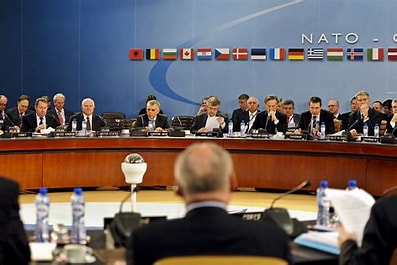
That NATO and Russia have been at war since February 24 two years ago is even banal. It is, at least for those of us who have been arguing from the very beginning that when you say Ukraine, you should actually read NATO – this, to the great misfortune of the Ukrainians who are convinced (they are less and less every day) that they are fighting a war for their own self-determination. Equally banal is that the first phase of the war is ending with NATO’s sharp military defeat on Ukrainian territory. Russia has no difficulty in holding and extending the positions it has conquered in the Donbass, and is testing the defenses of Kharkiv/Kharkov, Ukraine’s second city.
It is not only a military defeat, it is a defeat on all levels – although, as we shall see, it is far from definitive due to the furious reaction of the Western bloc. Ukraine as a nation has been driven to suicide by the cynical oligarchs in Washington, Brussels and Kiev – fully complicit in the Italy of Mattarella, Draghi and Meloni. Ukraine is now the third most indebted country in the world to the IMF, a failed state. Its infrastructure network is in tatters, as is its economy, including its once-thriving agriculture, and now boycotted even by Polish farmers. Most of its factories – we are talking about those that escaped the bombings of Moscow – have been deprived of staff, therefore disorganized, for the imperious needs of recruitment. So much so that there is talk of “pushing women and children” (yes, children) to understaffed factories. The losses of soldiers at the front are appalling. The ever-increasing flight from recruitment now makes it very difficult to replace and rotate exhausted soldiers. The mountain of deaths, 500,000 is a reliable estimate, the rampant corruption at the top of the state and in the recruitment apparatus where those who have thousands of euros in cash are easily exempted, the brutal roundups on the streets or on buses caused the ‘morale of the nation’ (and consequently also of the army) to collapse, which was high in the early days. Despite huge supplies from abroad, amounting to at least $200 billion, the Ukrainian army is collapsing. There is a lack of aircraft, tanks, artillery, anti-aircraft defense vehicles, ammunition. News of large-scale mutinies (of entire brigades, to be clear) filter through. After selling to its people and in world vision the prospect of full victory on the ground with the reconquest of Crimea, the Zelensky government, close to breakdown, is ready to launch itself into any adventure to try to save the scoundrel. Desperation drives him and his entourage to demand in addition to the F-16s (which are about to arrive) long-range missiles to strike deep inside Russia. Strike missile launch bases, and other targets even more vital to Russia. Bringing war inside Russia is their only hope of survival.
NATO commands and countries are not far behind. Indeed! To cover up the stinging defeat they have suffered so far, they seem willing to do anything but recognize the verdict of the battle-field. And so they have relaunched their war commitment against Russia with two options: 1) send NATO troops to Ukraine; 2) equip the Ukrainian army with more powerful and lethal weapons (especially, precisely, long-range missiles) to cause damage to the enemy’s energy networks and military apparatus in Crimea, Donbass and throughout Russia’s huge territory – in any case, prolong the war against Russia indefinitely with the aim of debilitating it.
The first option has been cleared by Macron: France has 2,000 soldiers ready, he claims, with training functions, not combat functions. However, it is precisely cannon fodder to be trained that is in short supply in Ukraine. This shows the inconsistency of this first option. To stop the Russian advance, and even more so to prepare a counteroffensive, hundreds of thousands of soldiers would be needed ready to fight. At the moment, however, there seem to be only Polish ones. Perhaps, and it is not known exactly to what extent. In fact, the warmongering hysteria that has taken hold of the leaders of the European Union is not adequately reflected either in the structure of their armies, or in European societies, which are currently silent, passive, but certainly not enthusiastic about going to war against Russia directly. There are also multiple obstacles to effective operational coordination between the 32 NATO countries. The only nucleus already trained for a leadership function is the United States. But so far the U.S. has ruled out direct involvement. For their purposes, the unfolding of Ukrainian events as it has been given so far is ideal, since it has brought them enormous economic and political revenues without expenses and damage of any kind (except, of course, the defeat on the field that must be avoided at all costs by prolonging and expanding the war towards Russian territory).
Although it is an exaggeration to speak of NATO armies as if they were ghosts (if only!), it is true that Russia has so far shown on the ground a capacity to define and reshape its strategic and operational plans far superior to that of NATO commands. Forced by the events of the past years – the advance of 1,000 kilometers of NATO bases towards its borders! – and undoubtedly favored by fighting at the gates of its own home, Russia has prepared for war in good time, and is much less afraid of it than the countries of Western Europe. In any case, history, with its hard sedimentation, matters. While it is in serious difficulty in terms of economic competition with Western countries in the avant-garde production sectors, on the war field Russia has important points of advantage over them: the enormous strategic depth of its territory; complete self-sufficiency in food and energy; the strength of its military-industrial complex (supported by Chinese technology supplies); a patriotic spirit that is still alive in the “Great-Russian” population. This has been seen in the civil war in Syria, and then in several African countries: Russian troops know what they are doing, both those of the state and those of the various private mercenary companies (Wagner is only the most famous). On the other hand, a possible NATO fighting contingent in Ukraine (different from the Western military advisers and trainers which have been present in Ukraine for decades) would face several unknowns: the absence of a common strategic plan, the inexperience of fighting outside their own territory (so far the Yankees have thought of everything, and they too with mediocre results, to say the least), up to the heterogeneity of the weapon and communications systems at their disposal.
That is why, of the two options indicated above, the one on which Washington, NATO and the European Union are focusing most decisively is the second. Between these three centers of power there is no coincidence of views and interests. The NATO command was most exposed, with the Social Democrat Stoltenberg in the (non-cinematic) part of Dr. Strangelove. It is no coincidence that Putin, usually cautious, called him insane in public. It is not, however, dementia, just as Putin is not the “madman” of the Western warmonger propaganda. These are large blocs of capitalist interests in a head-on collision with each other, under the impulse of an overall crisis of the system that neither one nor the other is able to control, and is imposing on both, with a sort of blind automatism typical of the way capital proceeds, a dynamic of continuous increase in the levels of confrontation. In such a process, it is natural, due to the division of functions, that the military powers directly questioned by the so far disastrous outcome of the proxy war in Ukraine, press for increasingly extreme solutions, burning one after the other the so-called “red lines” not to be crossed, in reality crossed one after the other as if nothing had happened – – first the Abrahams, then the F-16s, then the ATACMs, and we can be sure that, if necessary, the constraint (if there ever was) to hit only military targets in Russia will also fall.
On the other hand, in the European Union, the capitalist sectors in Germany, Italy and Spain that have a lot to lose from the severing of economic ties with Russia, China and the ‘BRICS world’ are resisting the rapid precipitation of the direct conflict with Russia. But the power of blackmail and influence of the United States has so far been successful over a European Union that remains, in spite of its unitary institutions and ambitions, a chaotic jungle of nationalisms. Almost all Eastern European countries have a particularly aggressive attitude towards Russia, reaching heights of authentic comic effect (such as: “Estonia will do everything possible to bring Russia to its knees”, in the words of Estonian President Karis) – which is the result of historical events dating back a long time of involuntary submission to Russia that led the ruling classes of these countries to voluntary submission to the masters of the West. The government of Czechia rejoices childishly at having been the first to obey the White House’s command to appropriate Russian wealth and allocate it to war against Russia – the exciting “freedom” to serve. Tusk’s Poland, in this way as similar to the Poland of the Kaczyński brothers as two drops of water are, is trembling with the desire to incorporate a share of Ukraine as a reward for its role in this war. Macron’s France, kicked out of West Africa and often supplanted by Russia, is waving its nuclear small umbrella in front of the rest of Europe as a last resort to preserve the status of great power that it has already lost definitively – suddenly he reversed his “dialoguing” approach towards Russia and stingy with “gifts” towards Ukraine, precisely to pursue this “beautiful and impossible” dream. As far as they are concerned, Hungary and Slovakia are trying to slow down the catastrophic course that has begun, fearing that they will end up crushed in the grip as the new Ukraines. Hungary, in particular, is forging substantial and privileged commercial, industrial and financial ties with China, such as to constitute, with Serbia, a Chinese wedge in Eastern Europe and the Balkans.
In the midst of this furious agitation of conflicting national and monopolistic interests, Germany put on the brakes, especially with its large industrial groups, but at every episode it ends up yielding to the pressure of war. And its armaments industry is on such a course that – unless there is a very strong proletarian and popular uprising against the tendency towards total war against Russia – the German bourgeoisie will again be tempted to put itself at the head of the whole of Western Europe in arms against the Russian bear. However, Germany remains the country in which two political forces of a certain size, Alternative für Deutschland and the newly formed personal party of the former leader of the Linke Wagenknecht, with parallel arguments, try to detach the national interests of domination from the path of Washington. In France and Italy, too, there are political options other than the supine alignment with Washington. But Le Pen’s Rassemblement National and Meloni’s Brothers of Italy, the former recalcitrant, the latter trotting, have greatly softened their reservations about the NATO line of command dictated from overseas, although without reaching complete alignment. Among the parties that present themselves as “sovereignists”, at least in this election campaign, there is also Salvini’s League, which professes to be against “European sovereignty” and Macron’s decision to send troops to Ukraine.
However, to mistake the perspectives outlined by these forces, or those of parties such as Melenchon’s La France insoumise, for “factors of peace”, would be to take fireflies for lanterns. Their ideological and action lines, whether they demand greater autonomy for the EU from the US boss, or demand it for their nation vis-à-vis the EU, pile more wood on the fire of inter-capitalist clashes. The same goes for the low profile, apparently among the most moderate, adopted by the Meloni government and Italy as a state. Italian capitalism has always had its hands in all NATO wars, but since it is not able to play a front-line military role in the field (its efficient war industry is quite another thing), it moves with astute diplomacy to be able to guarantee its lavish returns from the plundering of the world.
In the chaotic context of competing nationalisms and increasingly complicated mediations, day after day the line of bellicose extremism is gaining positions within the European Union, which wants to strike more and more decisively at Russia in its mighty military machine to provoke it to retaliatory moves that can be sold to public opinion as the “real cause” of an increasingly direct conflict. The maxi-exercise Steadfast Defender 2024, the most massive in decades on Russia’s borders (90,000 soldiers involved, aircraft carriers, dozens of naval and bomber vehicles, 1,100 armored vehicles, etc.), in which Italy participated with 1,700 soldiers, which ended on May 31, served as a reassurance and propulsion in favor of the Amerikan and multinational party of anti-Russian extremism – “we are many, strong, and united.”
Since we do not have privileged access to secret information, we are not able to say whether it was the Ukrainian army or directly some NATO facility that carried out the strike, but one thing is certain: in recent days there have been several attacks on the chain of radars that constitute Russia’s nuclear umbrella. At least in Armavir, in the Krasnodar region (just north of the Caucasus), this range has been severely damaged, with the partial blinding for a long period of time of the system for detecting nuclear threats arriving on Russian territory. Moscow, in an unofficial form, points the finger at Ukraine. But as desperate as the gang around Zelensky is, such an attack could not have been carried out without the direction of the Pentagon. If a high-level member of the Russian political-military hierarchy such as Rogozyn (former Deputy Minister of Defense, ambassador to NATO and director of the Roscosmos Space Agency) has gone so far as to declare: “we are on the brink of the abyss. If these enemy actions are not stopped, an irreversible collapse of the strategic security of the nuclear powers will begin,” means that the blow to Russia has been hard, very hard. The blanket of silence that covers the incident in the West is itself indicative of the extreme gravity of the moment – the Russian reaction is expected, predictably, to shift the responsibility for this escalation decided by NATO to Moscow and Putin. And Russia’s difficulty in supporting the escalation is evident given that the war in Ukraine is being fought on its doorstep, and it is on its territory that powerful and precise missiles are beginning to rain, in addition to drones, launched a few kilometers from its pre-war borders. Russia’s important military successes, in fact, have been achieved in a war that has remained, until now, a proxy war, fought by Ukraine and Ukrainians (especially proletarians) in the interest of the United States and the European Union. But when there is a turn towards a direct war between NATO and Russia, the conversion of war would lead to overwhelming Amerikan and European superiority, if China did not enter the fray directly. Only keyboard fans of Russia can be fool to the point of not understanding that the indefinite prolongation of the war will create many economic and social problems for the Putin bloc (the replacement of Shoigu with the economist Belousov at the head of the military apparatus is already a signal), and much more dramatic would be the head-on clash with NATO.
The abyss is not just the use of nuclear weapons itself (the United States has already used them in Japan and, apparently, in Iraq; Israel has already dropped the equivalent of several nuclear bombs on Gaza), crimes that are indelible. The abyss is the trigger for an all-out confrontation between NATO and Russia that has never been as close as it is today. Today, the Norwegian defence chief, Mr Kristoffersen, estimated the time span between 2 and 3 years before the auspicious event, which would have terrific repercussions on a global scale. It is no coincidence that Zelensky came out of the closet by attacking China because it “wants to derail the peace conference” scheduled in Switzerland in July without and against Russia, therefore as a war conference. It is no coincidence that the Chinese Ministry of Defense made the following solemn statement for the occasion: “The Chinese army is ready together with the Russian army to protect justice in the world”; the Chinese Armed Forces “are ready to cooperate with the Russian military for the full implementation of the important consensus reached by the heads of the two states. The PLA military personnel stand ready, together with their Russian colleagues, to protect international justice and impartiality and to do their utmost to ensure international and regional security.” No doubt this is a powerful brake on the precipitation of war events, far more powerful than the stammering of Berlin, Rome and Madrid. China is preparing for war, but it takes time.
Time is not on the side of the United States, whose society is in the grip of multiple processes of polarization and is increasingly crossed by risks of civil war, with the two candidates for the future presidency accusing each other of fascism. Even the throne of the dollar-emperor is beginning to totter as the BRICS accelerate negotiations for a new alternative currency, and in the meantime continuously expand the mutual use of their currencies. Time is not on the side of the European Union, which continues to lose market share, cohesion and confidence in itself and its future. Nor is it on the side of their Zionist outpost in the Middle East, which has never been delegitimized as it is today in its supposed civilizing function in the eyes of the oppressed and exploited masses of Palestine, the Arab-Islamic world and the world as a whole, and put in serious military difficulty by the Palestinian resistance.
Time is on the side of the ascendant capitalist powers, China above all. Whatever some “theoreticians” dazzled by the fetish of sovereign money may think, in the competition between capital and capitalism the decisive factor of last resort is the production of value, the real economy. After half a century of development of the largest former colonies of the “South” of the world and of the relocation of production by the dominant countries, the pulsating center of value production has increasingly moved outside the West. This material process corroded the stars and stripes hegemony over the world, which rested on an undisputed industrial primacy. And there’s no turning back. Of course, the transnationals based in the West are able to maintain control over companies and capital located around the world and, thanks to the imperialist structure that supports them, pocket abundant surpluses. But China or India are not Costa Rica or Tunisia, and over the last 30 to 40 years they have developed to such an extent as to dislodge the transnational corporations mentioned above by increasing areas of the world market (including shares of the US domestic market). Against the eternity of Western domination and the dreamed level of surplus profits, another variable has played a role: the expectations and struggles of the proletariat of the “colored” continents. Because it is one thing if the ratio of Chinese wages to those of Western countries is 1:10, quite another if it has fallen vertically to 1:3, 1:2 (with all the effects on other Asian countries). Should we then bring the capital that has gone out to the West? Easier said than done. Reshoring, the return home of companies that had previously relocated, has had very limited effects. Friendshoring, the Yellen formula, producing and sourcing only from allied countries, may at most change the balance of power within the Western bloc, but paradoxically it is favoring the formation of a counter-bloc, or at least a counter-camp, gradually wider around China. Apart from the enlargement of the BRICS, it would be enough to observe the progress of the recent China-Arab summit to understand how quickly the processes that erode the foundations of US domination over the world economy are advancing.
The Pentagon had set 2017 as the final target by which to unleash the attack on China to prevent it from prevailing. The next update to 2025 already seems to be too late. Many of the “prince’s advisers” feel this, divided between the realists who are in favor of harm reduction, and the fundamentalists who are in favor of going to a head-on confrontation as soon as possible. In the United States, and now also in Europe, the scales are tipped in the latter direction. A seemingly irresistible war fever rises among the ruling classes in Italy (even an individual with a robotic tongue like Monti evokes the need to shed blood, that of the proletarians of course, not of his stockbroker sons), in Europe (see here von der Leyen’s election spot), and even more so in the United States, where the favorite in the next elections Trump makes rallies promising to solve all the problems by bombing Moscow and Beijing, and his deputy-in-waiting, Haley, rushes to Israel to incite the Zionists to exterminate the Palestinians – not to mention the frenzied belligerence of the Biden administration.
At the outbreak of the war between NATO and Russia in Ukraine, we argued that it marked “a point of no return in the passage of inter-capitalist contradictions on a world scale from an economic-commercial to a strategic-military one”. And we added that it seemed ridiculous to us, and politically dangerous, to frame that conflict as the gateway to a peaceful, balanced, “multipolar world” that would certainly have been preferable to the world subjected to the dictatorship of the dollar, since the advent of the anti-capitalist revolution was out of possibility. Barely two years later, we are witnessing the resurgence of the most aggressive Japanese militarism; the most massive military exercises in China’s history around the island of Taiwan; the Taiwanese press threatening a missile attack on the Three Gorges Dam; North Korea and South Korea accusing each other of fanning the flames; the state of Israel that, in addition to the massacre in Gaza, is testing the ground for a major regional war; a general, unbridled arms race; intense discussions in almost all European countries on the ways and forms of mass military recruitment. Do you see traces of the peaceful and equitable multipolar world?
In the face of these pressing developments, it is shocking the inertia of the working class in Italy and Europe that “pretends to be dead so as not to hear the voice of its time” – this is how Rosa Luxemburg described the attitude of the German worker in the face of the First World War which had already been going on for four years, foreseeing (as of June 1918) thatit would still have to resort to social revolution, as it happened a few months later. It is worth listening to because she masterfully indicates the way in which internationalist revolutionaries must frame the great historical events and relate to a working class that remains inert in the face of an impending catastrophe that is directly implicating it:
“Historical destiny is fulfilled with implacable logic. The German proletariat, which has not been able to oppose the maelstrom of German imperialism, is now being dragged by it to overthrow socialism and democracy throughout Europe. The German worker tramples on the bones of the Russian, Ukrainian, Baltic and Finnish revolutionary proletarians, he tramples on the national existence of the Poles, Lithuanians, Romanians, he tramples on a France in the midst of economic ruin, he advances by wading deep torrents of blood, to plant everywhere the victorious banner of German imperialism.
“But every military victory which German cannon fodder helps to win abroad signifies a new political and social triumph within the Reich. With each attack on the Red Guard in Finland and southern Russia, the power of the Junkers east of the Elbe and Pan-Germanic capitalism grows. With every bombed-out city in Flanders, German democracy regresses one step.
“Even now, in the midst of the war, the German working class is being rewarded with whips and beatings, and they deserve it. (…)
“The German worker, however much he resists the idea and pretends to be dead in order not to hear the voice of his time, will therefore have to resort to the weapon of revolution, as soon as possible and in any case immediately after a hypothetical ‘German victory’. The executioner of the liberties of others, the gendarme of European reaction, will soon have to rebel against his own work, because the immutable laws of history do not allow themselves to be circumvented. With its own hands, with its own cadaverous obedience, with its ‘victory’ in the service of reaction, the German proletariat is at this very moment preparing for revolution in Europe and, therefore, in Germany.”
We do not suggest trivial historical parallels, nor do we want to emphasize – it is superfluous – the penetrating gaze on the imminent upheavals of this eagle of the communist movement. Only to accept their unshakable faith in the necessity of revolution, and to accept their invitation to denounce the passivity, inertia and even complicity – through apathy, indifference to the tragedies experienced by their class brothers – of an Italian (and European) proletariat that, in the face of the genocide in Palestine, in the face of the carnage taking place in Ukraine, looks the other way as if it were not its own destiny. A “destiny” that today takes the form of inflation, cuts in social spending to finance military spending, measures of discipline at work, poisons against “external enemies” that paralyze it in the face of the real internal class enemy. And tomorrow it will demand to pay with its lives the price of aligning itself with “its” ruling classes, when the wars that are currently “localized” will come together in a general conflagration of devastation and death, a globalized Gaza, a globalized Ukraine.
Revolutionaries, if they are revolutionaries, do not conform themselves to the state of the class. Nor do they engage in workerist populism. They have an obligation to speak out. We did so at the time of Russia’s invasion of Ukraine, heedless of being among the few to advocate defeatism on both sides. We did it after October 7, heedless of the deafening din of Islamophobic and Arabophobic propaganda (and the pinpricks of a very false “pure internationalism”). In both cases, we suffered from the indifference of almost all the proletarians, with the exception of a small section of the immigrant proletariat organized with the SI Cobas (and not only). All the more reason – whatever the immediate echo of our initiative may be – we cannot remain silent now that, while the Western-Zionist genocide of Palestinians continues in Gaza in a sea of blood and social and environmental devastation, the war between NATO and Russia in Ukraine is taking a leap forward in the direction of a large-scale direct confrontation. Any “accident” is enough to trigger it.
Nor are we easy going with those who, young and old, are mobilizing like us on the side of the Palestinian people and resistance. We are insistently asking them to broaden their gaze, to understand that the massacre of Gaza at the hands of the State of Israel, far from being a separate story, resolvable in itself, is part of the reaction of Western imperialism as a whole to its own decline. And that in order to win, the Palestinian liberation struggle requires the general Intifada of the oppressed masses of the Middle East against their own dictatorial bourgeois regimes, which are the Arab prop of the Zionist colonial machine. To those who rightly fight for the Palestinian cause, we ask them to go beyond Palestine and embrace the prospect of a global Intifada of the proletarians and the oppressed that settles accounts definitively with global capitalism – – without any illusions about the help and friendship of ascendant capitalisms, whatever the “anti-imperialist” sirens that are sounded by the bourgeois competitors of the United States and the EU.
Two years ago we began a process of organizing the forces willing to fight consistently to bring true, militant internationalism back to life in Italy as well. Along this path we have come to establish relations of unity of action on an international scale with a first common day of struggle against the wars of capital and the war economy on 24 February last. The dramatic acceleration of the ongoing confrontation between NATO and Russia pushes us to propose as soon as possible a new all-out confrontation with those who have shared all or part of this path, in order to plan new initiatives. The class battle against the enemy in “our home” – the Meloni government and the state apparatuses that are at the service of capitalist interests – certainly cannot be outsourced to the façade pacifism of the Santoro-circus which, if necessary, discovers that NATO is “temporarily” useful to us, woe betide us if we dissolve it immediately; nor to those who mistake Putin for Lenin and a reactionary of the caliber of Ali Khamenei for an Ali Shariati. We must work to promote, as far as we can do, a new and decidedly broader proletarian mobilization against the war, which will have in the sacrifices required by the war economy in the process of structuring, and in the resistance to it, an essential and unavoidable school of experience. As much as the resistance to the application of repressive and punitive measures of workers’ and social struggles by the state apparatuses will be.
As convinced partitists that we are, we will accompany step by step this path of the working and youth masses (an excellent sign, for us, the mobilizations of young people, proletarians and non-proletarians, in support of the Palestinian cause) as the most radical component of the “real movement”. We will do so with the non-codist attitude that Luxemburg suggests, certain that for the exploited and oppressed classes of the world there is no salvation from the catastrophes of capitalism, and the one that is looming is the most apocalyptic of all time, except in the social revolution. Let us tie up the threads with the great revolutionary tradition that shook the bourgeois world a century ago. The time for astonishing events is approaching.
4 June
Revolutionary Internationalist Tendency