
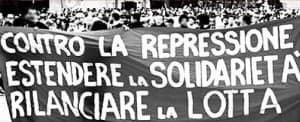
We appeal to comrades from other countries to take seriously what is happening in Italy these days: the Chamber of Deputies approved last Wednesday, September 18, a bill by the Meloni government that severely hits any form of mass protest and resistance, even passive, against police interventions against demonstrations and inside detention centers for immigrants and prisons. Soon this freedom-killing, slave, police-state law could be definitively approved by the Senate and come into force.
In our opinion, it is a quantitative and qualitative leap in state repression, organically fixed in a set of legal norms that introduce new crimes and new aggravating penalties, which does not only concern the Italian situation, but can become a model for other European and non-European countries.
It should not be forgotten that in the last twenty years Italy has been – in Europe – the vanguard of state racism against immigrant populations, and in particular against immigrant workers. Nor that a century ago it was the homeland of fascism, a particularly ferocious form of capitalist aggression against the proletarian movement.
That is why we expect the comrades of other countries to circulate this denunciation and the initiatives of struggle of the Free to Struggle Network. We intend to verify with them whether there are the conditions for a common initiative against the intensification of state repression that goes hand in hand with the relaunch of the initiative against capital’s wars and the war economy, which already saw us engaged in international coordination on February 24 this year. (Red.)
Draft Law 1660: a liberticidal, police state law, which absolutely must be stopped!
For many years, under the most varied pretexts, governments of any colors have introduced laws to limit the agility to strike, struggle, and demonstrate.
The Meloni government is determined to continue this operation by making the state repression of struggles and dissent itself make a qualitative and quantitative leap through Bill 1660, which has been in the House since Sept. 10 for discussion and very rapid approval.
With this “baton law” the government wants to settle accounts with all the ongoing realities and experiences of struggle and create the necessary legal instruments to prevent and nip in the bud future, inevitable social conflicts. The increasingly pronounced tendency toward war on the external front requires on the internal front a pacified social environment, and all state apparatuses are “working” toward this.
By introducing new crimes and new aggravating penalties, DDL 1660 affects both demonstrations against wars, starting with those against the genocide of Palestinians in Gaza, and those against the construction of new military settlements; workers’ pickets; protests against “large-scale infrastructures”, ecological catastrophes, energy speculation; the forms of struggle that these movements use to increase their effectiveness, such as road and rail blockades; and the occupation of vacant houses. And it contains very harsh regulations against any form of protest and resistance, even passive, in prisons and detention centres of immigrants without residence permits, even against the protests of family members and sympathisers in their support.
Draft Law 1660 even goes so far as to punish ‘terrorism of the word’, i.e. the detention of writings that praise the struggle – since, scratch that, behind the recourse to the category ‘terrorism’, used on purpose to create fear, there is nothing but class struggle, the fight against colonialism and social and ecological struggles.
The other side of the coin is a set of regulations that ensure, in addition to increasing their powers, total impunity for the police, shielding them from any responsibility for their behaviour, including the increasingly frequent cases of ‘uniform abuse’, severely punishing any form of resistance to their actions, and giving them the right to bear arms even when off duty.
Let us look at the new regulations in detail.
1. Draconian regulations against demonstrations and workers’ pickets
The heaviest of all is the one that provides for up to 20 years’ imprisonment for anyone who protests in a “threatening or violent manner” to prevent the realisation of “a public work” or “a strategic infrastructure” (civil or military) – in this case, mitigating circumstances cannot apply. Protests against the TAV [Treno ad Alta Velocità: High Speed Train, a project for a new train track that has a heavy impact on the territory], the bridge over the Strait of Messina, new military bases, regasifiers, the planting of wind turbines, etc., all fall within this scope. But even if it is not this kind of work, the new punishment for resistance, violence or threat (even the mere threat!) to a public official (even one), or to a state body, during a demonstration, any street demonstration – against the war or against the closure of a factory or for the freedom of arrested comrades – ranges from a minimum of 3 to a maximum of 15 years imprisonment. Paradoxical as it may seem to those who are infatuated with democracy, these are harsher repressive rules than those provided by the fascist Rocco code, which stipulated that resistance to a public officer during collective protests was a mitigating circumstance.
The road or rail blockade, an effective means of struggle resorted to in the most determined protests, becomes a crime again (it is now an administrative offence), and is punished with a sentence ranging from 6 months to 2 years. The commission of an offence in the vicinity of a railway facility is an aggravating circumstance.
DL 1660 also aggravates the punishment for those who ‘deface’ or ‘dirties’ movable and immovable property ‘used in the exercise of public functions’: imprisonment from 6 months to 1 year, and even 3 years if one is a repeat offender (for writing on walls!).
The extension of the “daspo” [prohibition to be in a particular place: to live or to pass through a city, to enter in a football stadium, etc.; the prohibition is imposed by the police commissioner and not by the judiciary] to the vicinity of railways and ports also has an obvious function in combating participation in demonstrations (we all have in mind the occupation of Bologna station or the demonstrations at the ports of Genoa, Salerno and Marghera for Palestine). The Caivano decree [a new law passed by the Italian government on September 15, 2023 ], which increased repression against minors, already provides for this, giving the judge the power to order minors not to participate in political demonstrations or protests.
In this way, the militarisation of the territories carried out in recent years with travel warrants, forced signatures, daspo, bans on demonstrations, and increasingly frequent and harsh police interventions against demonstrations and protests, takes a qualitative leap forward.
2. Very heavy penalties against the occupants of vacant houses and those in solidarity
The “abusive” occupation of empty houses, carried out with “violence or threat” (but violence against things is the simple breaking of a lock), by homeless families or individuals is punished with penalties from 2 to 7 years – and the rapid reinstatement of the owner in possession of the occupied property becomes the responsibility of the police forces who can provide for it without waiting for any judicial assessment of the specific circumstances that had led to the occupation. The punishment also extends to activists in solidarity, individuals or collectives (“cooperating people”), while you are exonerated if you actively collaborate with the police in the eviction or in the denunciation of the occupants or supporters.
This area of criminalization of hardship and social marginalization also includes the increase in penalties for begging.
3. The “terrorism of the word” is punishable by imprisonment of up to 6 years!
The bill introduces two new crimes committed, the first by those who “procure or possess documentation preparatory to the commission of attacks and sabotage for terrorist purposes”, the second by those who “distribute, disseminate, disseminate or publicize by any means material containing instructions on the preparation or use of explosive materials or [note] on any other technique or method in order to commit one or more non-culpable crimes against public safety punishable by the imprisonment of not less than a maximum of 5 years”.
Given the extreme elasticity and arbitrariness of the concept of “terrorism” – terrorists are, according to the Italian state, the Palestinian organizations fighting for the liberation of their people against the colonial, racist and genocidal state of Israel, while the state of Israel, while carrying out genocide by terrorist means, is only “defending” itself – it is evident that anyone who possesses material of these organizations, or, for example, material useful for the fight against major works (such as: instructions on how to break a fence), is punishable, in the first case, with a sentence of 2 to 6 years, in the second from 6 months to 4 years.
4. The measures against immigrants and prisoners are among the most brutal and hateful.
All the penal measures illustrated so far also concern immigrants (just think of the workers’ pickets, which in recent years have been carried out almost exclusively by porters and immigrant logistics drivers, or the occupation of houses), but there are some particularly odious ones that specifically concern them and tighten the already existing special legislation against immigrants set up in the last thirty years under the banner of state racism.
First of all: a new crime is introduced that strikes with extreme violence those who “promote, organize or direct a riot” in a CPR [Centri di Permanenza per il Rimpatrio: Detention Centres for Repatriation, set up for irregular immigrants], in a hotspot or even in a normal “reception center” – the penalty is from 1 to 6 years (for those who participate, it is from 1 to 4 years), and can rise up to 20 years if any member of the police force or the staff of the centers suffers serious or very serious injuries. But what is a revolt? As in the case of the term “terrorism”, the vagueness and arbitrariness of the concept serves to broaden the number of punishable and increase the penalties – already today “violence”, “threat” or “active resistance” can be punished, but with the new law it will be easy to “build” the hypothesis of revolt.
Secondly, immigrants locked up in CPR, hotspots and reception centers, can be heavily punished even for the mere “resistance, even passive” to the “orders given” (the orders are not even required to be legitimate) not only of police officers, but also of the staff of the centers who do not belong to the state repression corps – a norm made specifically to educate those locked up in CPR, in hotspots and reception centers to absolute submission.
Thirdly, the period of time in which the state can revoke “the citizenship granted to the foreigner” for convictions that have to do with “terrorism” is extended to 10 years (from the current 2).
Finally, in order to have a mobile phone, the immigrant from a non-European country must be in possession of that residence permit, which state legislation makes it very complicated to obtain in order to preserve an area of immigration without a residence permit to be superexploited. Given the importance that the mobile phone has today for any type of communication, it is a serious amputation of the sociality of new immigrants, and a strong impediment to their regularization process. This rule was inserted at the last moment, and is proof of how, in the absence of a strong street and mass mobilization, the parliamentary process can only further exacerbate the repressive charge of this bill.
At the same time, the new crime of prison revolt falls like a boulder on the backs of prisoners (32% of whom are immigrants) – in this case those who “promote, organize or direct a revolt are punished with imprisonment from 2 to 8 years, for those who participate the sentence is from 1 to 5 years, but with aggravating circumstances (use of weapons, injuries or deaths) the penalty raise up to 20 years! And even in this case, passive resistance to the orders of prison guards is also punished.
If this were not enough, a special aggravating circumstance is introduced for the crime of incitement to disobey the laws, if it is committed in prison or through writings or communications directed to detainees.
5. A specific rule against women could not be missing.
And in fact there is. Until now, the postponement of the execution of the sentence for pregnant women or mothers of children up to 1 year was mandatory; with the DDL 1660 it becomes optional, as it is today for mothers of children from 1 to 3 years old.
The other side of the coin of DDL 1660 is the enormous increase in the powers and protections of the police force.
Their powers are increased directly in the evacuation of occupied houses and through the right to take out of service, even without a license, non-ordinance weapons; indirectly through the generalized increase of penalties for any form of resistance, even passive, to their orders and for any form of injury, even very slight, to their bodies – which is punished ex officio with penalties from 2 to 5 years, unlike injuries to ordinary citizens which are punishable only by complaint and with lower penalties. The 5-year threshold is important because it allows the judiciary to put the alleged “guilty” in prison through pre-trial detention. Policemen, carabinieri, prison guards thus become sacred bodies, like the order of capital at whose service they are.
This is why this liberticidal, slave-owning, police-state bill, written under the dictation of military commands and for the needs of the race to a new world war, must be denounced and stopped!
We reject it in its entirety, because it affects all the struggles and forms of protest in progress, and because it serves to impose in factories, warehouses, schools, prisons, in society as a whole, an economy of war and a discipline of war that fall with their terrible material and human costs on the working classes. which are the vast majority of society.
These police-state rules increasingly recall the classic system of martial laws enacted in times of war. Precisely for this reason, an extraordinary mobilization is needed against DDL 1660, capable of opposing both its hatefully repressive and vindictive character, and the context of war from which it draws inspiration.
Rete Liberi/e di lottare – Fermiamo insieme il DDL 1660
Free to Fight Network – Let’s stop bill 1660 together
Manifesto of Free to Fight Network: Let’s stop together the Draft Law 1660
For many years, under the most varied pretexts, governments of different colors have introduced laws to limit the possibility of strike, struggle, demonstration.
The Meloni government is determined to continue this operation by making both a qualitative and quantitative leap compared to previous governments through the Draft law 1660, which on September 10 passes the Chambers for discussion and approval.
With this “truncheon-law” the government wants to “settle accounts” with all the realities and experiences of struggle in progress and create the legal instruments necessary to nip in the bud the future, inevitable social conflicts. The increasingly marked tendency to war on the external front requires a pacified social context on the internal front, and all the state apparatuses “work” on this.
The 1660 Draft law, by introducing new crimes and new aggravating penalties, affects both demonstrations against wars, starting with those against the genocide in Gaza, and those against the construction of new military settlements; the workers’ pickets; the protests against the “major works”, the ecological catastrophe, energy speculation; the forms of struggle that these movements equip themselves with to increase their effectiveness such as road and railway blockades; the occupations of vacant houses. And it contains very harsh rules against any form of protest and resistance, even passive, in prisons and detention centers for immigrants without residence permits, even against the protests of family members and supporters in support of them.
Draft law 1660 also punishes the “terrorism of the word”, i.e. the possession of writings that praise the struggle – since, scratch scratch, behind the recourse to the category “terrorism”, used on purpose to create fear, there is nothing but class struggle and social and ecological struggles.
The Draft law 1660, while criminalizing all forms of dissent, provides for total impunity for the police, who will be further protected in the increasingly frequent cases of “abuse in uniform” and will be able to carry weapons even off duty: maximum restriction of the freedom to fight for all on the one hand, maximum expansion of the power to repress, to beat and punish for the “forces of order”, protected from any responsibility for their behavior.
This Draft law is part of the more general reactionary program of the Meloni government (“God, homeland, family”) and is functional to the war economy, the arms race and towards a new global war; it is written under the dictation of the Italian, European, NATO military commands, and in line with the restriction of political freedoms that is taking shape in all the countries of the old continent: it is signed together, not surprisingly, by the three ministers of the interior, “defense” and “justice” (Piantedosi, Crosetto, Nordio).
A liberticidal, slave-owning, police-state law that must absolutely be stopped!
We want to join forces to reject this political design, and affirm that we will consider ourselves free to continue fighting.
This Draft law must be stopped: but it will certainly not be the parliamentary oppositions that will stop it, those who in past years have passed the Minniti decrees and the Salvini decrees; those who fanatically support the war between NATO and Russia in Ukraine; those who have not lifted a finger against the genocide in Palestine because they have always sided in favor of the colonial and racist oppression of Zionism against the Palestinian masses.
Only the revival of proletarian, social, ecological struggles, and against the wars in progress, only a great united movement against this bill in the workplace, schools and squares, will be able to prevent the approval of the law and, if it is approved, oppose its application and act as a barrier to employer and state repression: it is in this perspective that our assemblies have started a dialogue between movements and experiences that in past years have been almost always mutually ignored even though they all fall, in one form or another, under the blows of the judiciary, police and carabinieri.
For this reason, after the two assemblies of July 21st and August 4th, and the assembly called by the SI Cobas on July 28th, we have put on the agenda the establishment of a permanent coordination between the movements, collectives, organizations, trade unions, political organizations, individual activists who share the objective of a united mobilization against the Draft law 1660 and the militarist and warmongering design that it expresses, with the invitation to set up local nodes of this Network to promote widespread initiatives of struggle and awareness.
This coordination is called Free to Fight Network – Let’s Stop the Draft law 1660 together, precisely because at stake is the very possibility of mobilizing against the ongoing wars, against the exploitation of labor, the plundering of nature, building and energy speculation, state racism that discriminates against immigrant populations, attacks on women’s acquired rights, the possibility of resisting and fighting for the inmates in the CPRs and prisons, where every day people die of violence, torture and despair.
The Network is open to welcoming those who share its objectives, with only three (but essential) discriminating factors: to be for the total rejection of the Draft law, which cannot be reformed or amended; to be unequivocally against the ongoing wars and the war economy, from which the bill was born; to commit its forces to the development of a united mobilization, in the autumn and beyond the autumn, with the use of all the necessary means of struggle, including those that the bill wants to prohibit at all costs.
The real challenge that awaits us is to reach with our propaganda and agitation a much wider area of society than the one usually involved in protests and struggles, made up of workers, unemployed, students and ordinary people who perhaps sense the dangers we denounce, but have not yet moved.