
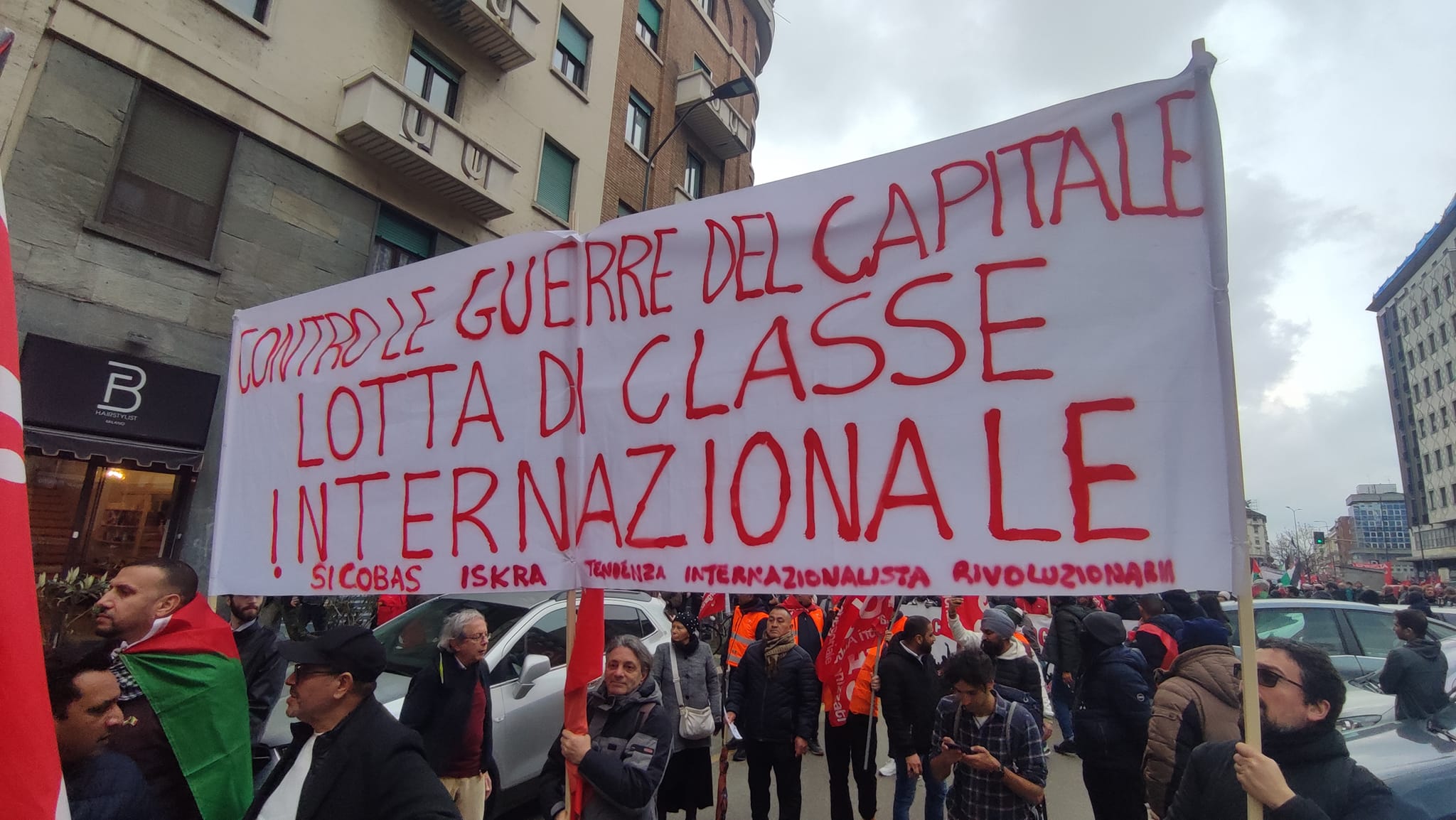
This is one of the documents approved at the recent Conference of the Revolutionary Internationalist Tendency. At its core is the key theme of internationalism, presented through the historical reconstruction of the communist proletarian movement, from its origins up to some vital issues of our days. (Red.)
As is universally known, the Manifesto of the Communist Party ends with the appeal (written in capital letters): “WORKING MEN OF ALL COUNTRIES UNITE!”. It is equally well known that at the end of February 1848, when the Manifesto was published, there was no Communist Party. The organization that presented itself in that lightning-fast way on the European political scene was the Communist League (Communist Association of Workers’ Education) which until then had had, as its emblem, the motto “All men are brothers”. In doing so, it took on the task of indicating the distinctive traits of the Communist Party, among which, in the foreground, is internationalism.
We can summarize these distinctive features as follows:
1) the Communists “The Communists fight for the attainment of the immediate aims, for the enforcement of the momentary interests of the working class”, but they are not immediatists: “in the movement of the present, they also represent and take care of the future of that movement”. That is, they bring into it the historical interests, the historical program of the proletarian movement;
2) Communists “But they never cease, for a single instant, to instil into the working class the clearest possible recognition of the hostile antagonism between bourgeoisie and proletariat”. Such a consciousness is not a spontaneous product, since spontaneity, even the most heated, bears the imprint of bourgeois influence. The hypothesis of a pure spontaneity, without interferences, has always been ungrounded, today more than ever;
3) the Communists “The Communists are distinguished from the other working-class parties [the reference here is to the English Chartists, the only working-class party existing in Europe at the time – ed.] by this only: […] In the national struggles of the proletarians of the different countries, they point out and bring to the front the common interests of the entire proletariat, independently of all nationality”, and also by the fact that “they always and everywhere represent the interests of the movement as a whole”. Therefore, while taking part in the struggles of the individual national sections of the proletariat, they are enemies of every national (and, even more so, local, sectoral) particularism;
4) the Communists support “, the Communists everywhere support every revolutionary movement against the existing social and political order of things”, always placing in the foreground “the property question”, that is, the problem of social relations of production (an aspect that Marx will explore in greater depth in the following years);
5) the Communists can achieve their goals “only by the violent overthrow of the entire existing social order”, and they are not afraid to declare this openly.
Therefore: the Communist party is the party of the social revolution – not generically the party of struggles. It is the party of the struggle for the revolutionization of bourgeois social relations (in the broadest sense) and bourgeois political relations, the party of the Communist revolution and of the international revolution: “proletarians of all countries unite!”. Which can assert itself in the “movement” by making things clear, only on condition of fighting against a series of political adversaries (with their own theories and practices) such as – in February 1848 – feudal and priestly socialism, petty-bourgeois socialism, conservative-bourgeois socialism, as well as critical-utopian communism.
In the birth certificate of the communist movement, internationalism is still limited to the “most advanced countries”. This limitation is the mirror of the limited diffusion of bourgeois social relations and, therefore, of the still limited diffusion of the proletariat. But it also depends, it is useless to hide it, on a limited study of the “colonial question” and of what Marx will later call the primitive accumulation which undoubtedly occurred on a global scale. In a valuable critical work (F. Engels and the problem of peoples without history) Roman Rosdolsky has highlighted some limitations in the approach of Engels’s treatment of the national questions then open in Eastern Europe. These limitations of a schematic and Euro-centric nature are seen in a more pronounced way – for example – in the negative judgment on the Algerian revolt against the French colonial occupation of the years 1835-1847, and in other texts of those years, which see the liberation of the colonized peoples as possible only through the action of the proletariat of the “most advanced countries”. This attitude of the youthful years, which belonged more to Engels than to Marx, began to be overcome already in the writings of the early 1850s against British (and French) colonialism in India and China. In these writings Marx formulated a statement that perhaps even seems strange and paradoxical: “the next revolt of the European peoples, their next movement in favour of republican freedom and government economy may depend on what is happening in the celestial empire – at the opposite pole of Europe – with much greater probability than on any other existing political cause”, on the events in China where “a formidable revolution” was underway, the Taiping Rebellion (1851-1864). Marx wrote this on May 20, 1853, just 5 years after the Manifesto. A definitive clarification on this essential question occurred in December 1869 when Marx wrote to Engels the following: “For a long time I believed that it was possible to overthrow the Irish regime by the ascendancy [the rise to power, the supremacy] of the English working class. I have always maintained this in the “New York Tribune”. But a more in-depth study has now convinced me of the contrary. The English working class will never do anything [Marx’s italics] before it has freed itself from Ireland. It is from Ireland that one must lever. That is why the Irish question is so important for the social movement in general”.
The limitations (or immaturity) of the internationalism contained in the Manifesto have been highlighted in order to show, by objectifying, how this dimension, at the same time theoretical and practical, has evolved and developed over time in relation to the development of capitalism and the proletariat in space, and how from a statement of general principles, as it still was in 1848, it has transformed into politics (even tragically self-negating, unfortunately, when chauvinism prevailed over internationalism in the parties that referred to Marx’s communism).
The First International [the International Workingmen’s Association (1864-1872), even if it was formally dissolved only in 1876 in Philadelphia] constitutes a first materialization of the principles set out in the Manifesto. It is an organization that was born from the impetus of workers’ organizations of a trade union, mutualist, cooperative nature and of disparate political tendencies (Mazzinians, Proudhonians, anarchists, a minority of “followers” of Marx and Engels). For the first time it is, at least potentially, a mass organization, which brings together many hundreds of “workers’ societies” that almost never exceed one hundred members, while trade union organizations are also part of it. It is impossible to have certain data on the overall numerical consistency of the First International; Marcello Musto estimates it at 150,000 members. This new situation suggests to Marx to state: the working class “possesses an element of success: numbers; but the number does not weigh on the scales unless it is united in collectivity and guided by knowledge” [our italic].
If the Communist League already had members of various nationalities (its program appeared in 20 languages), the First International constitutes a formidable leap forward also in this respect, although it remained substantially confined within the perimeter of Europe until its headquarters were transferred to the United States, on the proposal of Marx and Engels who recorded its crisis after the defeat of the Paris Commune. In its Statutes a concept already contained in the Manifesto (where it speaks of the class “that constitutes itself as a party”) returns: “the emancipation of the working class must be the work of the workers themselves”, it must be a self-emancipation. And this self-emancipation “is not a local or national problem, but a social one, it embraces all the countries in which modern society exists [our italic], and for its solution it depends on the practical and theoretical contribution of the most advanced countries”. We are still within the limitations of 1848, although there is an expansion towards the East in the direction of Poland-Russia and a projection across the Atlantic. But two facts are relevant: the impulse for the birth of the First International comes from a large workers’ assembly, of French and English workers, in July 1863, convened to claim the independence of Poland from Tsarist Russia (a not strictly workers’ issue); the “Irish question” would have ample space in the work of the General Council that lead the International.
In this new experience internationalism is filled with specific contents and political-organizational tasks: “to unite and give uniformity to the efforts, still disunited, made in the different countries to emancipate the working class”, “to develop in the workers of the different countries not only the feeling but the fact [the italics are Marx’s] of their brotherhood and to unite them to form the army of emancipation”. A first test brilliantly passed by the British working class was its opposition to being dragged ‘with all its might’ into the American civil war (1861-1865) by the British bourgeoisie, to taking the side of the slaveholders “in the infamous crusade to perpetuate and propagate slavery on the other side of the Atlantic”. In his Inaugural Address, Marx goes beyond the individual case, however, and establishes the important “duty” of the working classes “to initiate themselves into the mysteries of international politics”, to draw up their own foreign policy as “part of the general struggle” for their own emancipation. The struggle against national prejudices is the core of this policy. In an appeal of June 4, 1867, the class line to be followed in the face of the “importation of foreign workers” is fixed – forever, we can say: “if the working class wants to continue its struggle with any prospect of success, it must transform its national associations into international ones”. Consider that today, 160 years later, there are still supposed comrades who are enthusiastic about racist elements such as Sara Wagenknecht or J.L. Melenchon …
Unlike the Communist League, the First International is already capable of organizing struggles. Even on this level, its “field of action” is not strictly national because its main demand will be the reduction of the daily working hours to 8 hours – a demand that by its very nature goes beyond national borders, and will become the slogan of an international movement that takes shape in 1886 in Chicago through the work of a multinational proletariat composed of Bohemian, German, Polish, Russian, Irish, Italian, and African-American workers. [It should be noted that this movement precedes the foundation of the Second International by three years.]
The very heterogeneous political composition of the First International brings with it an uninterrupted political struggle of the minority linked to Marx-Engels against the Mazzinians (who were against strikes), the Proudhonists and the anarchists. This struggle explodes in a head-on confrontation on the occasion of the Paris Commune (March-June 1871), on the question of the state and the “dictatorship of the proletariat”: with Marx and Engels convinced that the Commune had been too little authoritarian towards its enemies (“A revolution is the most authoritarian thing there is”, Engels will polemically write), while Bakunin exalts its characteristic of eruption of the popular forces (the “miserable”, the “oppressed”) against the authoritarianism of the state in general. Faced with the question of the state and the use of political power conquered for the first time by the proletariat, “the naive collaboration between all the workers, trade unionists and socialists” fractions belonging to the First International breaks down. Even if it has been exaggerated several times, Stalinism has made it a mantra, in seeing a total opposition between Marxism and anarchism in this matter, forgetting that in Marxist theory the dictatorship of the proletariat must be, and already was in the Commune, “something that is no longer properly a state” (Lenin). However, what is most interesting for our reasoning is that in the revolutionary uprising of the Parisian masses in the spring of 1871 Marx sees “a sure step forward of the world proletarian revolution”, and on the other hand he records the existence and effectiveness of the “reactionary international”, the full collaboration between the enemy bourgeoisies of France and Prussia to crush in blood the “workers’ revolution”.
[It should be noted that up to this point the official organs of the “workers’ organization” are almost entirely male (unlike the composition of the proletariat). In the General Council of the First International there is only the English trade unionist H. Law. In the Parisian uprising of 1871 women had a very important role, amplified by the infamous reactionary propaganda against the pétroleuses – the incendiaries, pyromaniacs – (Marx: “the real women of Paris, heroic, noble and devoted like the women of antiquity”). But if you have in mind the image of the 40 most influential members of the Commune, you will find only one woman’s face: Louise Michel. It is unlikely that anyone knows about the Women’s Union for the Defense of Paris and for the Care of the Wounded by Elisabeth Dmitrieff, a Russian internationalist belonging to the First International, and her project for the total reorganization of women’s work, or other important revolutionary figures such as André Léo, Paule Mink, Victorine Brocher. Women also start out with a handicap in revolutionary organization…]
At the time of the dissolution of the First International, Engels evoked for the future a “purely communist” party capable of going beyond the ideological magma present within it. He was partially right because the new International born on 14 July 1889 in Paris (on the centenary of the storming of the Bastille) would be a socialist International composed – rather than of unions and organizations with indefinite political traits and sometimes stuck in sectarian settings – of real parties with an ideology structured on bases that owed much to Marxism. Mass parties, and in the case of the most influential of them, the German Social Democratic Party, a mass workers’ party. Engels was only partially right, however, because the entire life of the Second International, from its inception, was marked by the “struggle of a current hostile to Marxism within Marxism itself”. This current, against which Rosa Luxemburg wrote the memorable “Social Reform or Revolution?”, asserted itself until it became the majority, forcing the revolutionary and internationalist minority to break away and found a new “purely communist” International.
The historical-social context in which the Second International was born has changed profoundly since 1848 and 1864. Capitalism in Europe and North America has developed strongly and taken a further path of concentration, and even of initial centralization (anticipated in Capital), which has allowed it to strengthen its domination over society, to structure a series of state apparatuses that are increasingly efficient not only as machines of repression, but also as political-administrative machines. By virtue of this consolidation, the most powerful European bourgeoisies can open a “dialogue” with a part of the workers’ movement to weaken its radicality and ensure that it gradually and selectively inserts itself into the typical practices of bourgeois society, and becomes bourgeoisified also in its way of thinking, feeling and – as far as possible for a class that remains exploited and oppressed – of living. It must be remembered that a part of the parties joining the Second International were already legal, and gradually gained a presence in parliaments.
The lesson to be learned is that there is no “worker”, revolutionary, or even communist party that can succeed in confronting and neutralizing the antagonistic influence of the capitalist economic, social, and political environment without an incessant battle against the bourgeois context. From then until today, the art/science/wisdom of bourgeois class control and domination, also through tactical manoeuvres capable of entering into the contradictions of our camp, has been enormously refined. Although, to our advantage, this is happening today in a context of explosive systemic crisis that reduces, at least in the West, the possibilities of integration and co-optation of vast sectors of the proletariat. It reduces, but doesn’t eliminate, beware! We are always on guard against any form of mechanism.
A fundamental aspect of this process that would lead to the victory of reformism in the Second International was the nationalization of the member parties that emerges, certainly, suddenly, in 1914 with the outbreak of the war and the vote on war credits, but progressively matured over the previous twenty-five years. Although Togliatti tried to pass Lenin off as an electoralist, both Lenin and Rosa Luxemburg identified, in parallel, the parliamentary groups and the trade union leaderships as the main places where reformist positions converge. The process – however – also involved, especially in Germany, the mass of the industrial proletariat which, at the time of the split of the Second International, remained almost everywhere in majority on the side of the reformists, the result of a process of nationalization of the masses to which (as Mosse notes) national monuments, public celebrations, patriotic popular songs, the experience of choirs, sports, fairs, educational apparatuses, the mythologization of the founding past of nations, a certain type of literature, a great variety of inter-class leisure associations – all aspects of social life to which, unfortunately, we give little attention – contributed so much.
If we now observe the Second International carefully, it has been, since the end of the nineteenth century, a real battlefield between revolutionaries and opportunists who then evolved, almost entirely, into reformists, with the revolutionaries always leaning towards internationalism and the opportunists/reformists considering, and structuring, the International as a sort of federal pact between national parties, increasingly linked, and ultimately subordinated, to the interests of “their own” national capitalism, of “their own” imperialism. It is no coincidence that as the split in the Second International gradually matures, revolutionary theoretical works on imperialism become more numerous, which also constitute a response to the hypothesis of a colonialism with a human face, or even “socialist”, which takes root first of all in the leading party of the Second International, the German Social Democracy. In his 1915 election program we read: “One can well conceive of a colonial policy that we socialists can approve of as long as two principles are respected: not to oppress the natives and to have friendly relations with them” (!!??). In “Vorwärts”, the party newspaper, on December 16, 1906, one finds such a pearl: “We distinguish between a colonial policy aimed at honestly educating backward peoples and one that aims to oppress, exploit or even exterminate the natives.” Educate honestly… Kautsky: “The struggle of savages against civilization is not our struggle.” Bebel, the most cautious: “Colonial policy can in certain circumstances become a work of civilization.” For all the leaders of the German party (with the partial exception of Rosa Luxemburg) the redemption, the liberation of the peoples of the colonies could only come from the revolution of the metropolitan proletariat. Not to mention, then, the favour that the revolutionary syndicalists granted to “worker imperialism”; the misdeeds of the socialist parliamentary group in France that in 1911, by majority, approved the colonial partition of Morocco between France and Germany; or the British Fabian socialists openly in favour of British imperialism, among the first to vote, in times of “peace”, for the war credits necessary to develop the British navy. After all, in 1914 the European colonial possessions amounted to 85% of the earth’s surface, and such a domination could “appear” almost natural, as well as advantageous “for all” (including European proletarians). Only Lenin began, after the 1905 revolution, to recognize and study the great revolutionary potential of the “peoples of the East” (here, for once, we should also mention positively one of our… compatriots, Andrea Costa, an internationalist deputy capable of shouting “long live Menelik!”, the valiant Abyssinian king who routed “our” colonial troops at Adua – just think what a scandal a “long live Sinwar” would raise today…).
The outbreak of the First World War made it totally impossible for “worker”/socialist nationalists and revolutionary internationalists to remain in the same party. Socialists and proletarians of their respective parties shot at each other! – because the reformists, as social-chauvinists, socialists in words, chauvinists in deeds, had chosen to side with their own bourgeoisie, for its victory in the war, covering themselves with the most vile progressive, humanitarian, democratic, anti-colonial pretexts (there is in fact also an “anti-colonialist” colonialism, masterfully used by the United States of America both with Wilson in 1919 with the principle of “self-determination of peoples”, and in 1945 with the interested condemnations of racism and colonialism of others).
The revolutionary Marxists responded to the failure of the Second International with the conferences of Zimmerwald (5-8 September 1915) and Kienthal (25-30 April 1916), which were preceded by an international conference in Bern (26-28 March 1915) of socialist women, 70 participants, organized by Clara Zetkin, held under the banner of “war on war” – the final resolutions of Zimmerwald and Kienthal are in the appendix to our book on the war in Ukraine. In these three conferences, which called together the internationalists, “a struggle of ideas” (Lenin) took place once again. In fact, there is no lack of confused, uncertain, contradictory, incomplete, inconsistent positions on which a new beginning certainly cannot be founded. This is a point to be well established: there has not been, nor in general there can be, the formation and life of a party, or of a revolutionary organization, without open theoretical and political struggle. Irenicism, the practice of methodically blurring positions never leads to anything solid. Even a solid foundation – the most solid of all – that of the Third International, could not provide absolute guarantees in the face of objectively overwhelming forces. In the absence of solid premises, however, a breath of westerly wind is enough to bring down the house of cards.
Between August 4, 1914 and 1919, intense work was carried out to found a new International. In the meantime, the order to the parties and groups of comrades who remained on internationalist positions was to support any internationalist fighting action carried out by proletarian groups and sectors, and to try to reunite all the anti-chauvinist elements of the Second International. In between were the great slaughter of the war and the October Revolution, and the decisive prediction of the opening, with the war, of an era of crises/wars/revolutions. Decisive because it allowed those who had it to prepare for a rare event, exceptionally rapid in determining itself and turbulent as a revolutionary crisis is.
For the first time on an enormous territorial scale and with an extreme concentration of clashes and destruction, the capitalist system declares inter-imperialist war as the compulsory outcome of its own crisis or an extreme form of it. And for the first time the internationalist revolutionaries (or revolutionary Marxists) conceive the idea of a “final victory” over capitalism. At the birth of the KPD (December 30, 1918- January 1, 1919) Lenin considers the new International already a fact, even though it does not yet formally exist. And he qualifies it as “the Communist International [not social democratic, nor socialist – n.], truly proletarian, truly internationalist, truly revolutionary”. These three “truly” have been made necessary by the long and exhausting experience of opportunism, capable of putting a great distance between words and deeds. Rosa Luxemburg would scathingly note: “German Social Democracy was considered the purest incarnation of Marxist socialism”…
For the first time we are faced with a truly world party of the proletariat – it will include Asian, Arab, Latin American parties and organizations, in addition to the “usual” European and North American ones (its effective members have been estimated at around 800,000, many more than the First International, many less than the Second International, for which, however, there are no known reliable overall estimates). Its center of direction has also moved from Germany to the East. A party that conceives itself as the party of the world revolution. For Trotsky, the Third is the International “of open mass action, of revolutionary implementation, of realization”, born in the “hour of the final and decisive struggle”. In its four great congresses that we recognize as ours (with some hesitation on the fourth), the new International gives itself the strategic task of intervening according to a centralized action plan on the entire world capitalist-imperialist chain, starting from its “weak links”. It openly declares, for the first time in the history of the proletarian movement, that “the interests of the movement of each country” must be subordinated “to the interests of the revolution on an international scale”. And, this too is a first, it looks carefully and without paternalism at the peoples of the colonies, detecting in them “open revolts” and “revolutionary ferments”, and sees the liberation of the colonies and the liberation of the working class in the metropolises proceeding “in parallel” and in connection. It is no coincidence that it will decide to modify the final delivery of the Manifesto in this way: “Proletarians and oppressed peoples of the world, unite!”.
Here we cannot go into the merits of the Theses on the national and colonial question, of the Congress of the Peoples of the East in Baku (September 1920) and of the limits, and also of the ambiguities, with which the anti-feudal, anti-colonial, anti-imperialist revolution was integrated into the strategy of the world revolution. But in any case we must grasp the formidable leap in quality made by the Third International in this direction – made possible by the unprecedented depth of the crisis of the world capitalist order (with a very tormented shift from British to American hegemony, once Germany was crushed), at least as much as by the enormous development and expansion of capitalist social relations that occurred between 1889 and 1919. The world in 1919, always in maximum inequality of course, is much more closely united than thirty years earlier. This will be seen both in the rise of the revolution and in that of the bourgeois counter-revolution.
This new International does not call itself workers’ (like the First), nor socialist (like the Second), but communist, condensing in this term a set of historical, ideological, trade union, national, colonial, agrarian, women’s, institutional, social, cultural, tactical, organizational themes, unified in the reference to an internationalist revolutionary program that, once bourgeois political power has been broken and Soviet power has been established, does not intend to leave standing anything of the old world of capital or pre-capitalist forms, but intends to transform everything in the direction of the full socialization of the economy and social relations (all the means of social production must lose the character of “capital” and pass to the society organized on new, non-mercantile bases), of liberation from the old social division (based on the relationship between wage labour and capital) and international division of labour, from all forms of oppression of nation, class, sex, race.
The international proletarian movement had never arrived so “high”, so close to breaking at least some relevant links in the capitalist chain, first and foremost the Russian one on the terrain of political power. But precisely because of the enormous danger perceived by the capitalist class and the old propertied classes, it had to face a very violent, articulated globalized capitalist counteroffensive, with the democracies in the front line, followed by Italian fascism, and then the terrible war machine of Nazism. This crossfire made the class movement retreat under the weight of a series of ferocious blows and defeats on the field (in Hungary, Italy, Germany, England, China), and then surrounded the world revolution, forcing it into the enclosure of a country like Russia still on the way to full capitalism. Faced with this counteroffensive, the Third International, born late with respect to the maximum peak of the revolutionary activity of the proletarian masses in Europe and too ‘unbalanced’ due to the preponderant weight in it of Russia and the Russian party, has understandably tried to respond with a defensive tactic in Russia and internationally. NEP, united front, etc. are in this context. And they are there – at the beginning – in the wise attempt to take a breath, reorganize the forces, try to make inroads into the working-class majority in Europe that remained in the ranks of the reformist parties, “waiting” for new revolutionary crises. But the overwhelming force of the counterrevolution (which begins in Europe and arrives, lastly, also in Russia) means that both in the individual national parties and in the International, one step after another, the original revolutionary and, indeed, internationalist plan is abandoned.
With the formalization of the theory of socialism in a single (backward) country, this change in the nature of the politics of the International experiences a key passage that will prove to be irreversible due to the setback of the entire revolutionary process on a global scale. Bordiga summarizes well: “The Marxist-condemned thesis is not: Even in a single country, the proletarian conquest of power is possible – and – Even in a single country of full capitalism, it is possible [to start] the socialist transformation. The condemned thesis is that in a single non-capitalist country, with the sole conquest of political power, the socialist transformation” is possible. This mystification, then, will allow Stalin and his followers to progressively subordinate the entire International to the decisions and priorities of the Russian party, which has entered into symbiosis with the State, dictated increasingly by the stringent needs of the “construction of capitalism” in Russia in the form of state industrialism. If in this way the Russian proletariat is subjected to the needs of building a modern capitalist system in Russia, the proletariat of European and Western countries is called upon to support the needs of the “socialist” state. In turn, the exploited masses of the colonized or semi-colonized countries are handed over to their respective nationalist leaderships (who will massacre them, if necessary – see the outcome of the workers’ uprisings in Canton and Shanghai in 1925-1927). In this way what Bordiga called the reversal of the pyramid occurs: instead of – from top to bottom – the Communist International, the Russian party, the Russian state as in the original structure of the Third, we have: Russian state (as an expression of Russian capitalism in development), Russian party, International. Once again, therefore, the abandonment of the revolutionary perspective is identified with the abandonment of internationalism. And vice versa.
The progressive nationalization of the Russian party is combined with that of the European parties that are moving in the direction of mending ties with the social democracies and the reformists, of launching popular fronts first and then national anti-fascist and anti-Nazi fronts, in which the proletariat is increasingly subordinated as a blood donor for the nation to be liberated, redeemed or regenerated with bourgeois democracy. The prototype of this march of the European communist parties from internationalism to social nationalism, from revolution to reformism, from communism to democratic capitalism disguised as progressive democracy, was the PCI, the party of the Stalinist political counter-revolution in Italy. In Russia this counter-revolution passed through the almost complete extermination of the old Bolshevik guard; in Italy or France through the marginalization, ghettoization, criminalization of the small minorities that remained on the revolutionary-internationalist terrain, and sometimes even through their physical elimination (in Spain, in Northern Italy).
The PCI formally began this journey in 1943-44 (the substantial beginning was much earlier) as a “worker”-bourgeois party that maintained in its program the reference to socialism in the USSR version, and then, through a series of metamorphoses involving “Eurocommunism” and ambiguity towards the USSR, became, with the collapse of the “homeland of socialism”, not only an entirely bourgeois party with an increasingly slender working-class base, but even a party entirely organic to big capital – a position it reached by passing through the ranks of the “productive middle classes” and a series of name changes that correspond to progressive changes in program. It is no coincidence that the majority branch of the PCI ended up merging with the most relevant branch from the former Christian Democracy, the other mass interclass party, which in the period of the USA/USSR bipolarism (which excluded the PCI from the government) had been the cornerstone party of the bourgeoisie. Demonstrating that the substantial difference between the PCI and the DC had not been in their class orientation (bourgeois for both) for some time now, but in their international alignments.
The Third International as an International of revolutionary action, conceived during the First World War and born immediately after it, was progressively disintegrated by Stalinism to be tragically dissolved in 1943 right in the midst of the second world massacre to please the imperialist allies from overseas. What followed? One hundred years of lugubrious uninterrupted counter-revolution? Absolutely not! Neither the revolution disappeared, nor the class struggle disappeared. Only: the revolution was dislocated elsewhere, and with other social and political characteristics – just as the most dynamic growth of capitalism was progressively dislocated elsewhere. And the class struggle had to restart in the “most advanced countries” from more backward positions.
It was not a question of the resumption of the proletarian revolution defeated on the field in the 1920s after a grandiose international cycle of battles (the Spanish civil war can, perhaps, be considered the last gasp of that cycle). It was a question of the tricontinental development of the anti-colonial, national, popular revolution, with the masses of poor peasants and petty bourgeois social strata often as front-line protagonists. It is what Bordiga defined as “the incandescent awakening of coloured people”.
If in Europe the proletarian revolution was defeated on the field; if in Russia it curled up in itself as if disappeared; in the East, however, the revolution is alive and involves gigantic forces. These are the formidable waves of anti-feudal civil wars, which have brought down decrepit institutions of oppression, and of national wars of independence that have given Euro-American imperialism more trouble than the proletarians of the metropolises. In the countries dominated and controlled by the old and new imperialism, a chain of authentic social revolutions took place between 1945 and 1976, even if they were limited to the establishment of bourgeois social relations. Agrarian and national social revolutions that in these countries brought the emancipation of the proletariat and the exploited closer precisely through the formation of a modern industrialism, their participation in revolutionary movements, which in many cases constituted their entry into world history as protagonists. The blows dealt by these movements to the world capitalist order that emerged from the First and Second World Wars are of historic significance. Today it is common knowledge to speak of the decline of American imperialism, but it should be remembered (today almost everyone forgets it) that the United States suffered its first stinging defeat on the world stage in Vietnam in the 1960s and 1970s, and had already come close to it in Korea in 1950-53. While the socialist and communist hue of these movements should certainly be rejected, their battle should be supported without reservations. A revolutionary battle.
It must be admitted that very few of the comrades who remained on the ground of internationalism understood this, and did not adopt an indifferentist position. Very few were able to grasp that the pressing march of the “yellow and black brothers” could also make the backward “white” proletarians, crushed almost everywhere in Europe by the task of post-war reconstruction, regain time and ground, reactivating the class struggle in the metropolises, as happened punctually in the 1960s and 1970s, in France, Belgium, Italy, and the United States. Of course, in that period of years the possibility of a true conjunction of forces between the proletarians of the whole world and the oppressed peoples fighting against colonialism, which was put on the agenda of the Third International in 1920 in Moscow and Baku, was excluded. Despite this, the liberating value of anti-colonial revolutions and uprisings was extraordinary for the proletarian movement on a global scale. And nothing can be detracted from this by the advent of financial and thermo-nuclear neo-colonialism or the current rise of some ex-colonial countries, or the fact that ex-revolutionary China has risen to the rank of a great capitalist power. What remains is that the potential strength of the international proletariat has multiplied in the meantime, acquiring a greater specific weight precisely where the national-popular revolution had advanced further. In this way, economic and social preconditions were created that were objectively more favourable to a new cycle of proletarian uprisings that were even more effectively internationalized than in 1917-1927. In short, the short century has not passed in vain.
This great cycle of anti-colonial revolutions has given birth to its own ideology, Third Worldism; to its own “International”, the Non-Aligned Movement born in 1955 in Bandung; to its own theoretical production (think of the Cuban magazine “Tricontinental”); to its own gallery of parties and leaders of notable importance (from Mao to Ho Chi Min, from Castro to Che Guevara, from Ben Bella to Lumumba, from Fanon to Sankara etc.). But, due to its “popular”, inter-class nature, it could not go beyond the constitution in various forms of an Inter-national, an aggregate of new nations eager to shake off historical colonial domination and protect themselves from the lurking neo-colonialism also through “mutual aid” which however had precise, insurmountable limits from the start, since they were national interests. And it could also, suddenly, as a consequence of the growth of power of the respective national capitalisms and a divergence of interests, evolve into ruptures, economic-diplomatic conflicts, even wars, as in the case of the war between two “socialist countries”, China and Vietnam, in February-March 1979, which resulted in tens of thousands of deaths. However, for our cause, there remains an indelible result of the tricontinental revolutionary movement: the complete globalization of the proletariat which remains, for us, the only social class capable of standing as the fulcrum and guide of the anti-capitalist social revolution with which the great systemic crisis of the capitalist world order is pregnant – on condition of being “guided by knowledge” and by the “clear awareness of the hostile antagonism” between capitalism and communism.
And in our field, here in Europe? Have they been a hundred years of dark retreat, without any light? In this case too the answer is: No! The fight against Stalinism has already seen in the years between the 1920s and 1930s a series of small groups of organized militants, the archipelago of the international left with two race champions like Leon Trotsky and Amadeo Bordiga. In the dispersion of the former, in the divergence of the paths of resistance to the hegemony of Stalinism in the proletarian movement between Trotsky and Bordiga (the one inclined to a subjective interpretation of Russian and world events, with an objectively impracticable plan of struggle; the other dominated by an excess of objectivism and by an unacceptable renunciation of any type of coordination with his own comrades) is written the tragedy of defeat, the impossibility of giving life to a new International capable of drawing the lessons of defeat.
The Fourth International was not such. Nor could it have been, if it is true that the birth of revolutionary parties has never been separated from the existence of great revolutionary ferments (1848, 1917-19) or, at least, of social situations favourable to the presence of strong thrusts of class struggle combined with powerful triggers (in 1864, Poland; in 1889, the struggle for the 8-hour day). On the contrary, behind its birth there were two great defeats: the defeat of the proletarian revolution in Europe (with the rise of Nazi-fascism), and the defeat of the most consistently revolutionary internationalist positions within the International and the Russian party. Even less so (a new International) were the fragments of the Italian Left, all flowing back through different paths into a common bloodless propaganda of principles, increasingly distant from the real movement. In the post-war decades, the vast galaxy of Trotskyist parties and organizations instead tried to stay in touch with or be within the “real movement”, but it did so, generally, by taking Trotsky’s weaknesses to extremes with an exaggerated faith in the role of tactics and organization, in the certainty that communists can remain such even within organizations that have nothing of revolutionary or communist, and the construction of false or equivocal theoretical-political categories such as bureaucracy as a class, the degenerated workers’ state, the centrality of transition instead of revolution, etc. Even the Bordigist groups radicalized some of Bordiga’s weaknesses or obsessions such as the categories of invariance, the idea that it is the party that constitutes the class (not vice versa), the rejection of any form of united front, indifferentism in matters of anti-colonial struggles, etc. We are thus in the presence of two forms of lame internationalism, because in the case of many Trotskyist groups/parties there has been subservience to the USSR after the break of the Stalin-Hitler pact and Stalin’s alliance with the Western imperialist powers, and after the war a growing adherence to national interests and to the nationalist directions of the anti-colonial struggles (making Castro, Ben Bella, Tito their own ‘champions’), although such adherence has been covered by internationalist declamations; in the case of the Bordigist groups there has been the explicit rejection of the struggle of the exploited of the colonies or of the dominated countries, or at least a total indifference towards them, even though they are masses oppressed by “our” imperialisms.
What is alive and well left of this resistance to Stalinism and the nationalization of the old workers’ movement are the political battles – of an internationalist nature – conducted by Trotsky until his assassination (with the exception of his proposal for a “military and not political front” with Stalin’s USSR), and the theoretical battle conducted by Bordiga in the post-war period to re-present the cornerstones of Marxist doctrine disfigured by several decades of revisionism, which however necessarily suffers from having been conducted outside of an incandescent social context. In both, however, especially in Bordiga, one can see the underestimation of the historical role of the masses in the revolutionary process and work of real socialization of the economy. This serious basic deficiency reduces the critical scope of their opposition to Stalinism, whose fetishism for the state and very little consideration for the leading role of the masses are well known (a question, however, that deserves to be discussed). In any case, the history of these resistances has long since reached its end. To date, there are few groups of Trotskyist origin or affiliation that have not fallen into various forms of reformism or opportunism, and, if based in Western countries, into Westernism, as was seen in the war in Ukraine, with a majority of Trotskyist groups siding with Ukraine, that is, with Western imperialism (the Partido Obrero is one of the rare exceptions). And Bordigist nuclei capable of political action are practically non-existent (another thing is, this is the experience of some of us, to have drawn from Bordiga’s “lessons” useful antibodies to reformism and intermediism). If there are individual forces or nuclei still alive that come from these two traditions, their reference to the past, the element of continuity with the past, always plays a negative, paralyzing role.
On the social level, in the century that separates us from the fateful years of 1926-1927, the most significant break in the whole of the West were the years of ’68 in Italy, Belgium, France, the United States (leaving aside the great extra-metropolitan events, first of all the Tet offensive in Vietnam) which were not failed revolutions nor possible triggers of civil war, as in some erroneous interpretations, typical of workerism (see the document already presented) and guerrillaism. They were, and this is no small thing, a powerful mass awakening, worker, social (of blacks and women above all), student on an international scale after the long stasis of struggles in the post-war period. [Before the years of ’68, in Europe there was only the small window, or fissure?, of the years 1943-1945 in Italy, Greece and the Balkans, which we discussed in the recent book on the Resistance, limited to Italy.]
In only one case, in that period of years, and with reference to the industrial proletariat, is the term revolution or revolutionary uprising not entirely out of place: it is the Chinese cultural revolution of 1966-67. Perhaps it will be surprising to know that for sixty years now, nowhere else in the world have workers discussed so much the Paris Commune (“the model of the Paris Commune”), the Critique of the Gotha Program, State and Revolution, etc., as in Shanghai and other industrial cities of China in 1966-1967. Once again: internationalism… Yet a generation later, during the student and worker Tian Anmen Square uprising (however, the two components of that uprising are not coincident), the Internationale was the anthem of the movement, also sung during recent student and worker protests.
The inevitable resumption of the class struggle and the proletarian movement has a vital need to “rediscover”, “recover”, assimilate, relive the great history of struggle of the world proletariat. A history woven, illuminated, from the mid-1800s onwards, by Marxist doctrine. A very long history punctuated by innumerable revolts and partial clashes. A history of attempted and victorious revolutions, the Paris Commune of 1871 and the Russian October of 1917, which have made history. And they continue to make it long after their defeat because they have shown what extraordinary innovations in social relations the working class and its party are capable of, once in power. The story of the three Internationals that between 1864 and 1919 paved the way for future generations of workers and communists, bringing the mass of common workers, the “slaves born to be slaves”, to the stage of world history as protagonists. A story in which the materialist, all-encompassing critique of capitalism is written in indelible characters. Of its economy, its politics, its culture, its armed forces, its science, its art, of the domination of the commodity over all areas of social and personal life. The corrosive, revolutionary, internationalist critique of every form of oppression. Including – increasingly – that exercised on non-human nature.
Within this tormented path (unlike the bourgeoisie, to reach power, the proletariat cannot avail itself of any economic power conquered within capitalist society), the potential strength of the international proletariat has literally soared. Just to give a little concreteness to this statement: from 1965 to today, the world workforce has grown 2.5 times. Today it exceeds 3.6 billion workers (40% women, 60% men). Just under a billion are employed in agriculture, 900 million in industry, 1.8 billion in services (or service industry), approximately 200 million are unemployed (officially). Wage workers are estimated by the ILO at over 1.8 billion, 52% of the 3.5 billion employed. In a context of rapid global expansion of wage relations (in 1991 there were 1 billion wage earners, in 2000 they were still only 45% of the total employed), there remains a notable gap between the nations with the oldest capitalist development, the imperialists in the lead, and vast areas of the South of the world. In the latter, however, the vast majority of non-wage earners are peasants who are increasingly the object of real submission to the transnational agribusiness companies, of which they are becoming de facto wage earners even without having a formal relationship of dependence on them. On a planetary scale, especially in the coloured continents, an aggressive process of expropriation and colonization of the land is underway, so intense that it is managing to further thin out even the meagre peasant population of the rich countries.
Then, although it is an exaggeration and a mistake to speak of the disappearance of the “middle classes” (which are instead rapidly expanding in emerging countries), for several decades in Western countries, starting with the USA, the salaried strata of the middle classes have been experiencing a process of (unfinished) proletarianization, with the loss of privileges and prestige as a result of both the electronic revolution and the neo-liberal “revolution”. On a global scale, the intertwined processes of salarization and proletarianization of the world of work reflect the progressive reduction of small independent producers and their growing submission to the mega-concentrations of capital.
The Western proletariat itself, which especially after the Second World War had set foot in the “paradises” of mass consumption, bourgeois rights and institutions, to some extent de-proletarianizing itself, is experiencing a creeping process of re-proletarianization. In access to work, housing, education, healthcare, trade union freedoms, political life, Western workers are today – if we may use this expression – more proletarian, more lacking in reserves, more structurally precarious, more on the margins of institutions, than they were yesterday. And the great extension of paid care work marks, for paid women, even a half-return to forms of “servile” work.
Unlike all the great crises of the past, including the revolutionary crisis of the years 1917-1927, we have today a strong and globally expanded nucleus of 600-700 million industrial workers around whom an immense army is concentrated (increasingly concentrated in urban areas) of other proletarians, wage earners, semi-proletarians, and social strata in the process of proletarianization, which longitudinally crosses all branches of social activity. The material strength of the proletariat has never been so great. This new situation places the most class-conscious proletarians in the best “practical” conditions to acquire an “exact knowledge of the mutual relations of all the classes of contemporary society”, and to react, as Lenin demanded, “against every abuse, against every manifestation of arbitrariness and oppression, of violence, of abuse, whatever the class that is affected” from a class, communist point of view, “and not from any point of view” [the italics are L.’s]. As you see, some of the characteristic features of the Manifesto return, in other words.
With regard specifically to proletarian internationalism, we indicate here only two knots to be faced and untied by the new party of the class, and with which internationalist revolutionaries worthy of the name must already grapple today. Two knots so closely linked that they can be considered as one.
The first issue concerns the division, the distance, both material and psychological, between the proletariat of the North and the proletariat of the South of the world. Although a process of gradual “southernization” of an ever larger portion of the proletariat of the North has been underway for decades; although the improvement in the average living conditions (less with regard to working conditions) of the proletariat of a certain number of countries of the South of the world, especially those in which the anti-colonial revolution has gone most deeply, is a fact; the distances are still wide. They are also wide on the level of social psychology. The workers of the emerging countries of the South arrive at this turning point in a rather excited mood. Either because their anti-colonial revolutions, to which they have contributed a lot and in which their people have stood up, are not yet that far away; and because of their young age; and as they have within them the hope, not yet dried up, of reaching the living conditions of the workers of the North, a hope that can only be realized through the erosion of market spaces previously occupied by the West, by the companies of these countries, and through strong struggles by the workers.
On the other hand Western workers arrive at this historical turning point rather pessimistic, frightened, if not embittered towards their class brothers from the Global South. In the absence of an international and internationalist organization aimed at weaving the threads between the ‘old’ and the new proletariat, between the exploited and the super-exploited; on the contrary, in the presence of political and trade union organizations strongly marked by adherence and loyalty to their respective national (imperialist) capitalisms, it was inevitable that feelings, prejudices, and hostile positions towards the proletarians of the colored continents would spread among Western workers in the era of turbo-capitalism, seen as unfair competitors who ‘steal our jobs’, ‘ruin us’ because they accept conditions that ‘we’ would never accept (see delocalizations), and therefore to be treated as dangerous adversaries. It was inevitable that new ‘social’ right-wing bourgeois forces would emerge ready to seize and capitalize on the fruits of the ‘worker’ and ‘progressive’ nationalism sown throughout the twentieth century by social democracies and Stalinism. And this has occurred consistently with the various Le Pen, Bossi, Haider, Weidel, and so on, and the significant ‘working-class’ affiliation with their movements, and today with the left’s mimicry of similar beasts. This is a fundamental area of intervention.
The second issue, closely linked to this, is that of the relationship between native workers and immigrants here, and in all Western countries and increasingly in some emerging countries (see the Gulf, but not only there). Trump’s arrival in the White House relaunches on a global scale one of the most tested cards that the capitalists and Euro-Atlantic governments have in hand: to divert the anger of Western workers against immigrants, rekindling the tragic illusion that Western proletarians can parry the blows of the crisis by collaborating with their own capitalists, governments, states to unload them on their class brothers from the East and the South of the world. But the latter will not passively accept becoming the sacrificial lambs. They did not do so even when, centuries ago, the balance of power with the forces of European proto-capitalism was clearly unbalanced to their disadvantage. They will not do so today. And this time more than in the past it will be true that, by collaborating to crush the peoples and the proletarians of the East and the South of the world, Western workers will collaborate to crush themselves, to reserve for themselves a destiny of backwardness and impoverishment. It is up to us and to the internationalist revolutionaries of the whole world to work so that there is, instead of a tragedy, a happy ending.
Focusing our attention here on these two issues that impose themselves on us with a very particular urgency in our political initiative, does not at all imply that we consider the peasant question – for example – to be without political weight. On the contrary. We are well aware that in many countries of Africa, Asia and South America there still exists an enormous poor peasant population in the countryside oppressed by global capital that has now subjected the entire world agricultural production to itself, but that for this reason we cannot consider them as laborers; they are dispossessed, but for this reason they have not given up the dream of accessing a piece of land of their own. Just as we are aware that there still exists, in these countries, an “indigenous” question that cannot be reduced to the simple question of the Latin American ‘Indians’. In the countryside of the world there is certainly a non-negligible revolutionary potential, which we need to study and reason about, convinced as we are that the class struggle is not at all reducible to urban contexts, nor to the sole objective antagonism between capital and proletariat.
Let us also think of the many, often heroic, struggles against environmental devastation that take place mostly in the countryside of the South of the world and that every year see the assassination of hundreds of militants who perhaps it is reductive to define as “environmentalists”. No workerism, at least no intentional workerism; although we must always know how to be wary of the fact that being in a Western imperialist country conditions us in any case, no matter how many antidotes we want to implement. If in this text we only make this fleeting reference to this, this is because we recognize as a fact that we are behind in this matter, and that we must make up for it. The International Anti-Imperialist United Front against fascism, war and environmental destruction, with its members in the South of the world, can help in this direction.
To conclude, Trotsky wrote: “men do not make revolution more willingly than they make war”. The same can be said for the great battles that an era of crises/wars/ecological catastrophes/revolutions heralds. The workers of the North and the South of the world are dragged into them by their hair. They would like to avoid them, but they cannot. Unless they accept being overwhelmed by the landslide. Whether they like it or not, they are forced to fight as their only weapon of defense. They are called to erect defensive embankments in the fight and through it, first of all to put themselves across the rush towards a new world war. And to face a series of political and international political knots (remember Marx’s expression?) that will push them to break away from their respective bourgeoisies, to rediscover their complete autonomy, if they do not want to be overwhelmed in a common ruin with their class enemies. But it is not a question of a mere, “fair” distribution of the wealth produced. The tendency towards war, as we have repeatedly argued together, now overdetermines everything. Not only in international politics, but also in that of individual countries. The stakes are higher than ever.
In the midst of this inevitable class (and state) conflict, we must work for the birth of a new proletarian movement that is genuinely composed of proletarians of all races and colors, truly global, in which the class struggle of the metropolises and the anti-imperialist drive of the “peripheries” will intertwine more closely than ever. Composed – finally! – of the exploited women no less than the exploited men, in which the struggle against oppression in the workplaces will merge with the struggle against every other form of seemingly ‘secondary’ oppression. A movement in which the distance between the self-activity of the working masses and the party activity, the anti-capitalist practice and the communist doctrine, will be shortened like never before. A movement aimed at reclaiming the integrity of the communist program and its internationalist nature.
***
In the last three years, and especially in the last few months, we have taken the first steps in this direction, with our active participation, and in several cases with the role of promoters, in international initiatives with a few organizations with which we share the defeatist position towards the war in Ukraine and the opposition to both belligerent camps, for the formation of a proletarian internationalist camp. The initiative for the international day of mobilization on February 24, 2024 (second anniversary of the war), which had repercussions in about twenty countries came from us (in Italy it merged with the national demonstration in Milan alongside the Palestinian resistance).
We have seen how the war in Ukraine has divided the various political families that refer to both the Marxist and anarchist revolutionary movements into supporters of Ukraine (and consequently of the NATO front), pro-Russian “campists”, and internationalist defeatists, causing a political reshuffling among the various currents.
In our initiative we have put in the foreground the convergence on the fundamental political issues, overcoming the barriers of “political families” or ideological traditions. This is why for more than a couple of years we have been working together with the Argentine Partido Obrero, of Trotskyist tradition, with the Turkish SEP, which refers to Trotskyism, with Communist Liberation (formerly NAR) of Greece – which, born many years ago from a split of the KKE, does not refer to a specific tradition of anti-Stalinism -, and with the MLPD, of Stalinist-Maoist tradition. The fact that organizations from historically opposite “families” have agreed to coordinate without sectarian attitudes is in itself a new fact and an important result.
There is much work to be done in this direction, because the number of organizations with which there is a convergence of political positions is much larger, and to a large extent they still have to be discovered. Among these, we have already established relations as TIR with the Turkish Marksist Tutum (Communist Attitude), which does not belong to any specific current of Marxism, and has established a mass proletarian organization, UID-DER, with a significant presence among the workers’ vanguards and in several cities in Turkey. UID-DER shared our appeal for February 24, 2024 with initiatives in various cities during the week, involving hundreds of people, while respecting criteria of “confidentiality” so as not to leave itself open to repression.
In Japan we have recently made contact with the Japan Revolutionary Communist League – National Committee, an organization that dates back to the late 1950s, resulting from a split in the Japanese CP after the Russian invasion against the Hungarian uprising of 1956, which in the late 1960s-early 1970s played a leading role in the Japanese Zengakuren student movement and subsequently suffered heavy repressive attacks. After a phase in which adventurist tendencies prevailed, for three decades it has been conducting important organizational and propaganda work, centered on opposition to Japanese rearmament and the preparation of war against China by Japanese imperialism in alliance with American imperialism. This campaign, especially in the last year, is gathering support in the new student movement. (…)
With the PO and JRCL there remain differences of analysis especially on Russia and China, and we need to work also on the theoretical level to avoid that these differences could translate into different positions when faced with new scenarios.
The war on Gaza has seen a fundamental convergence in support for the Palestinian resistance, and a distancing from any illusion of a “campist” solution to the Palestinian question.
Trumpism, with the changed the US attitude towards Russia, Ukraine and Europe, changes the fields of force but does not cause problems of alignment for those like us who have taken a defeatist position against both camps. Europe today finds itself at the epicentre of international tensions, and its rearmament choice represents a challenge to our ability to lead an opposition that goes beyond propaganda – as we have already begun to do effectively in the promotion and direction of the activity of the Network against the Security Bill. The fact of being part of an international network, and not a voice in the wilderness, gives more strength to the perspective and the battle that we propose, first of all against the rearmament of the Italian government, and against any policy of military intervention; against nationalist sovereignism as against imperialist Europeanism.
Among the organizations with which we are treading a common path, the PO is undoubtedly the one with the greatest mass influence, also strong with over 60 years of activity under wildly changing political conditions (from parliamentary democracy to military dictatorship, from Peronism to Mileism). From a greater knowledge of their organizational experiences and their methods of internal organization and external activity, we can gain precious advice (to be carefully evaluated, of course) on how to proceed in our organisational structuring, reducing learning times through trial and error. The MLPD and the JRCL also certainly have decades of organizational experience, and in the initiatives they have organized they have shown undoubted organizational skills. It will therefore be useful, in defining both our organizational structure and in structuring our external activity, to study and compare not only the evolution of the political positions of the organizations with which we relate, but also their no less important organizational experiences. In the political struggle, the winner is not the one who “is right”, but the one who knows how to translate his reason into an organized force.