
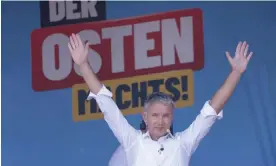
Last Sunday’s [September, 1st] elections in Thuringia and Saxony, although involving less than 10% of the total population of Germany, were undoubtedly an earthquake in German and, consequently, European politics.
The overbearing affirmation of the AfD on the right and that of the BSW, the Sahra Wagenknecht Alliance, on the (so-called) left foreshadow, after the European elections, a clear trend line, that will probably not unfurl in the short-term.
In the Italian press obsessed with Russophobia, the dominant interpretation is that of the victory of the pro-Russians or pro-Putinists. It goes without saying that, after the electoral defeat suffered by the warmongering Macron, this second blow to the head of a coalition increasingly aligned with the orders of the NATO commands like that of Berlin fills Putin and his followers with satisfaction. That is understandable, after seeing the green beast Baerbock and the amoeba Scholz, ready to sign any arms supply to Kiev (while he had refused to do so until a moment before) fall into the abyss after Truss and Sunak… For us, however, things are different. And although the issue of the war in Ukraine has had a great weight in the outcome of the last elections, we need to dig deeper: we must look at the changes that have been underway for quite some time, long before February 2022 (which was merely an acceleration of this process), in the international division of labour and the sharpening of international competition that have penalized both Germany and the EU, causing a growing social unrest in all European countries, including the richest ones.
For at least five years, Germany has ceased to be the driving force of the European economy and has entered into stagnation. A triple issue has come to a head on which the German economy is now stuck, with inevitable repercussions on the social and political life of the country: the post-unification boom based on low-cost labor and raw materials, the obsession with a balanced budget, the relationship with the United States.
The post-unification boom was based on massive relocations to some Eastern European countries (Slovakia, Czechia, Hungary, Romania, etc.); on the use of low-cost labor from East Germany, locally or after passing through the West; on immigration from Europe and the world, which has never fallen below 500,000 new arrivals per year, and in several years has largely exceeded one million – Germany is still the main immigration destination in Europe (1). The other key factor was the stable supply of Russian oil and gas at favourable prices, so convenient that the North Stream was designed and built in very short time. The inexhaustible development of the Chinese domestic market, then, had allowed for many years German capital to make the most of these special competitive advantages, chalking up a series of records for its exports.
Everything goes, however. An advantage enjoyed for a long time with a purely conservative attitude can turn into a handicap. The systematic use of low-cost labour and raw materials has “vitiated” German capital, which has ensured mountains of profits without taking care to invest adequately in technological research and innovation, thus, in fact, losing the race for the electric car, even in a sector, car production, in which it had excelled for decades. If we add to this the scarcity of state investments due to the historical obsession with containing public debt, we will understand why, in a span of thirty years, Germany has lost the world records of competitiveness and productivity in the developed sectors of manufacturing production and is struggling, far behind the United States and China, in the cutting-edge sectors.
The great crisis of 2008, which first under the Obama administration, then under the Trump administration, pushed the United States into very aggressive industrial policies towards its European allies, and the war between NATO and Russia in Ukraine were two brutal blows to the expectation of German capitalism to be able to reproduce indefinitely its own “model” of development based on exports and “mutually advantageous” exchanges with Russia and China (in reality more advantageous for Germany than for Russia and China). Washington’s decision to impose draconian sanctions on Russia and the sabotage of the North Stream have plunged the German economy into a swamp of stagnation from which it will certainly not be able to emerge by relaunching the “old model”. Never forget that for the United States, the war in Ukraine is at the same time a war against Russia and a war against the EU, in particular against Germany – the attempt of the German capitalist class to save itself from this attack by gradually aligning with NATO has not been successful. And the bill is getting higher by the day.
And so, on the very day of the joint electoral victory of AfD and BSW, for the first time in eighty years Volkswagen announces the closure of one or more factories in Germany and the end of the agreement with the IGM on the freeze on layoffs until 2029 – also a political event of special importance, if one considers that large German companies are the only ones in Europe where unions still have a seat on the boards of directors. The clash which happened yesterday in Wolfsburg between the head of Volkswagen’s financial division, Antlitz, and the works council also marks the end of an era for the car giant. To the need to cut production and employment in Germany, IGM representative Daniela Cavallo replied: “never in my life” will I accept the closure of a factory, we will make “a strenuous resistance” against the company’s decisions.
Even for the workers of the most powerful large-scale industry, the “social market economy” must therefore be shelved, that which the Hartz IV government of the Social Democrat Schroeder – a close friend of Putin and later a senior executive of Gazprom and Rosneft – had already shelved for the most precarious section of the working class by institutionalizing its further precariousness (especially in the eastern part of the country) and by strengthening state control over the recipients of social benefits. In the meantime – as a counter-trend to the overall cost of labour that remained too high in the face of fierce competition from rising capitalisms – the German government, with Merkel at the forefront, continued to favour the entry into Germany of masses of immigrants. The last two massive entries were in 2015 with about a million refugees fleeing from Assad’s Syria, and in the last two years with hundreds of thousands of workers fleeing from Zelensky’s Ukraine. It was not a question of charity, of course, but of the imperialist appropriation of trained, often graduate, workforce. This even if not all Ukrainian female refugees entered the labour market, being able to benefit from a sort of special support treatment for themselves and their children, more favourable than that reserved to other nationalities – a circumstance, this, skilfully exploited by AfD and BSW. (2)
The cost of this progressive regression of Germany in the international division of labour has been imposed on the whole of the working class, with – however – many inequalities, which make a unitary response difficult: between West and East, where the majority of the poor are concentrated, among pensioners and not only; between employees of large companies and the ever-widening area of unstable and underpaid work (Germany has long been the country of jobs for 1 euro an hour); between native workers and immigrants; between regular immigrants and illegalized immigrants; between men and women, often forced to work part-time there too. Masses of wage earners who have already been severely penalized in recent years fear that this decline may continue, causing them to sink into a condition of poverty, insecurity, and social contempt that has not been seen in Germany for a century. A fear that is particularly strong in the East, where it merges with the widespread resentment of still being considered and treated as second-rate Germans.
The success in the middle classes and also among the proletariat of two formations such as the AfD and the BSW can be explained by the extent and depth of this social malaise, and by the ability of their leaders to fraudulently present themselves as “anti-system” forces capable of providing answers to those “neglected” by governments and parties in power for decades. There is not much specifically German in all this, if one thinks back to who governs in Italy and how they came to power, to the Le Pen/Mélenchon duo in France, different but similar and so on. The essential content of the responses of the AfD and BSW can be summarized in this way: for the AfD, first of all, urgent measures must be taken against bloodsucking immigrants, the primary public danger, and millions of them must be expelled, with a stop to forced multiculturalism; the sovereignty lost to the advantage of Brussels and Washington must be recovered, and this recovery will bring benefits to German workers; a stop to “aid” to Ukraine. For the BSW, the main focus is on stopping “aid” to Ukraine and the war against Russia, because it has greatly damaged the German economy and German workers; social spending must be increased, also through the recovery of lost sovereignty; and measures must be taken against immigrant-parasites, especially refugees. In short, in one case national-socialism (“Everything for Germany”, according to Höcke’s slogan, a motto, and not the only one, that he took from the Nazi SA), in the other social-nationalism.
The “anti-system” posture of these two parties is a play: neither one nor the other, in fact, dares to question the capitalist system, and both have already declared themselves available to govern in Thuringia and Saxony, and in the future also at a national level, with the parties of the “system”. In the specific case of Wagenknecht, her formal proposal to the CDU is public: BSW support for Michael Kretschmer (CDU) as governor of Saxony, in exchange for CDU support for Katja Wolf (BSW) as governor of Thuringia. And there is already heated discussion in the traditional parties about which of the two fake anti-system parties to ally with. However, it is possible that Scholz’s proposal to form a collective barrier against the AfD will prevail, a proposal that will probably have the opposite effect of strengthening his false “revolutionary” credentials. Except that on the same day the very same clownish Scholz put 18 Afghan asylum seekers on a plane and sent them “home”, and except that it’s always him who declared to “Der Spiegel”, speaking about the “hatred against Israel”, that “we must finally deport on a large scale” immigrants with an Arab background… And, breaking news, it seems that he even wants to adopt, for these deportations, the “Rwanda plan” launched by the British Conservative governments, that is: “to build a collective barrier against the AfD”, making the AfD’s priorities his own.
Portraying this political-electoral process (and the underlying social movement of opinion, at the moment) as the rise of an indistinct black tide, is misleading. There is undoubtedly a strong component of nationalism and racism in it; but if one bears in mind the amount of Russophobic and Islamophobic slime that Christian Democrats, Social Democrats, Greens and Liberals have spread in recent decades, and the amount of measures they have taken, albeit moderating their language, against immigrant populations, it is clear that a vote given to the parties in government or to the CDU does not in itself have any specific anti-nationalist and anti-racist value. On the contrary: it was precisely these parties, with their “collective West über alles” chauvinism and incessant proclamations against “anti-Semitism” (seen even where there is not even a shadow of it), that prepared the advent of AfD and BSW. The only difference is that the nationalism sponsored by this new binomial that is now riding the crest of the wave is anti-American and anti-EU (much more than pro-Russian), although – at the moment – it is forced to move within the political-military confines of NATO and the EU, in the absence of a different strategic perspective. A new German nationalism is in the order of things. But since it cannot consist of a ridiculous autarchic perspective, it must prefigure a supranational role for Germany capable of parrying the blows that have been inflicted on it, and of putting into play a comprehensive project that the current AfD and BSW can anticipate, but not yet represent. German capitalism is in crisis, but it certainly cannot renounce its imperialist vocation. And the same goes for the EU.
In addition to this mix of aggressive nationalism and racism that comes from far away, from the state and capitalist institutions of the whole of Europe (not just Germany), the vote of Thuringia and Saxony also shows an interesting sign of rejection of the war in Ukraine and the risks of general war that it entails, which could not be addressed to the government parties or to the CDU (them being in solidarity with NATO warmongers and supporting the accelerated race to rearmament). To whom could such a feeling or concern be addressed? “When you are left with no alternatives”, explained Thomas Brussig-Lapalisse in yesterday’s “la Repubblica”, you turn to those who present themselves as the alternative. Wagenknecht in particular was clever in presenting the vote as a choice between war and peace. While the propagandists of the AfD were clever in drawing, against the dictatorial bureaucracies of Brussels, the prospect of “a free Europe based on a free union of equal peoples”, and therefore without wars, if you want to believe these vulgar swindlers. Here lies the contradiction: because an understandable and in itself positive feeling could also be the channel through which the grip on sectors of the proletariat of openly reactionary forces like the AfD, or falsely progressive ones like the BSW, is consolidated.
The social, gender and racial composition of the vote in Saxony and Thuringia is not yet entirely clear. But three elements appear to be certain: the vote for the AfD was stronger in rural areas and in small towns than in medium-large cities, much stronger among men than among women (ratio 2:1), consistent in the most oppressed strata of the proletariat and among young people. But it is a typical “populist” imposture that of Weidel, who presents the AfD as “the workers’ favorite party”. So is Wagenknecht’s claim (expressed in very soft tones, however) to belong to the left and to want peace – something impossible if one accepts, as she does, capitalism in its entirety, and if one calls for a “sovereign” role for Germany – that is, one of command over the European and world market.
This latest political earthquake in Germany, which heralds others in that country and throughout Europe, a Europe that – according to Draghi – may be close to its end, also speaks to us of the current disorientation and division of the working class, in many cases absent from the polls (less than on previous occasions), in any case so far incapable of expressing its own autonomous position, independent from all the components of the fragmented field of bourgeois parties. This condition is temporary, because everything has happened and will happen in a crisis-laden Germany and Europe, both furiously committed to emerge from the crisis, but the attenuation of class antagonisms. The accumulated wisdom of bourgeois politicians lies in sowing antidotes to the reemergence of class consciousness and organization. The proliferation of demagogic formations and demagogues on the right as well as on the “left”, however, is not the last word of history. Not even in Germany. It must not be so. We will have the opportunity to see this when we deal, in an article to come, with the efforts necessary to respond on, albeit incomplete, classist and internationalist grounds to these latest developments.
Notes
(1) Since 2013, approximately one million people have immigrated to Germany every year. In 2022, 20.2 million people living in Germany (more than 18% of the total population) were first-generation immigrants or children of both immigrant parents. The main areas of origin are Turkey, Eastern and Southern Europe, Africa, the Middle East, Asia and South America.
(https://www.infomigrants.net/en/post/54441/germany-net-migration-at-all-time-high
(2) The policies of always conditional “openness” to immigration pursued for many years by German governments can also be explained as a means to counteract the effects of population aging. An IMF text on the decline in productivity in Germany insists on this point
(https://www.imf.org/en/News/Articles/2024/03/27/germanys-real-challenges-are-aging-underinvestment-and-too-much-red-tape ) which presents population aging as one of the challenges that Germany will have to face in the coming years because:
– retirements will partly concern highly qualified workers, thus further aggravating the shortage of qualified workers that afflict the German labour market;
– population aging will increase the demand for care and health services, draining workforce from manufacturing;
– public spending on pensions and health care services will increase to the detriment of investment in infrastructure, one of the areas that negatively influence German productivity.