
Cade oggi il cinquantesimo anniversario della liberazione di Saigon, avvenuta il 30 aprile 1975. Una data che, con la disfatta militare e politica inflitta dal popolo vietnamita al super-imperialismo yankee, segna l’inizio di un’epoca – l’epoca del declino della tirannica supremazia amerikana nel mondo. La ricorda qui Giacomo Donis, uno strenuo oppositore di quella guerra, e di tutte le guerre scatenate dall’Amerika.
Donis, nato negli Stati Uniti, ha portato il suo radicale rifiuto della “guerra amerikana” fino alla decisione di farsi esule. La sua originalissima, filosofica, divertente autobiografia politicaThe Empty Shield (Eyewear Publishing, 2020), ha come sfondo e tessuto connettivo proprio quella grande vicenda storica, conclusa da una Grande Vittoria e un’altrettanto Grande Sconfitta.
L’intensa passione per la vita e la liberazione dall’oppressione che lo portò in gioventù ad essere contro la guerra dell’Amerika al popolo del Vietnam, lo conduce oggi in Palestina dove – come accadde per il Vietnam – i criminali bombardamenti degli oppressori colonialisti non riusciranno a piegare un popolo che lì è nato, lì resiste, lì resterà fino a quando “i nostri villaggi torneranno. I nostri giardini fioriranno. I nostri limoni e i nostri ulivi risorgeranno”. (Red.)
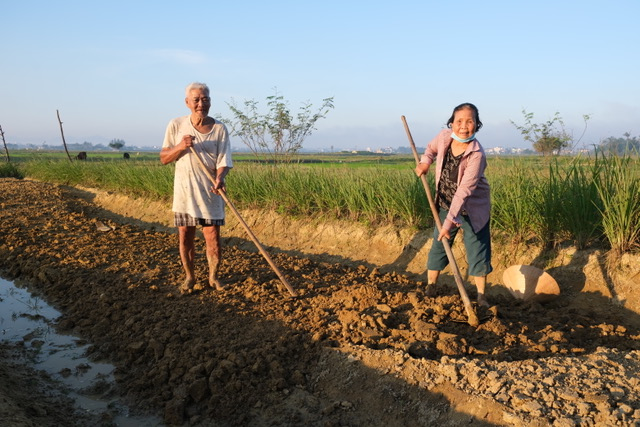
A wise old political friend in Paris sent me this photo some years ago, with the message ‘they won their war.’ Rejoice! This couple, maybe about my age, hoeing their land, many decades after their, and my, and our experience of the war in their country. The Amerikan War in the defense of tyranny. A war fought, viciously, for thirty years, and which ended with the Great Spring Victory, the liberation of Saigon fifty years ago today.
A war that was many wars. First, a revolutionary war: in September, 1945, Ho Chi Minh, in Hanoi, declared the free and independent Republic of Vietnam, ending what he called the ‘double-yoke’ of imperialism: the French since 1850, the Japanese since 1940. Within weeks French troops entered Saigon. A year later, November 1946, powered by U.S. ships, the French bombarded Haiphong, and then invaded Haiphong and Hanoi. In December the Viet Minh counterattacked. For the next thirty years, the fight of the Vietnamese people will be for their self-determination.
The French War, from 1946 to 1954, in the defense of a disgraceful and dying colonialism. Despite the gigantic military and financial support of the (supposedly anti-colonialist) Amerikans, it ended, as we know, with the obliteration at Dien Bien Phu. It was time for peace in a battered but unified Vietnam, which did in fact win the war but, then, in Geneva lost the peace. Badly. The Geneva Accords were passable on paper but criminal in the event: the temporary North-South division, to be followed in 1956 by free elections to re-unify the country. Enter the Amerikans (but they were already there): we shall permit no communism in the fictitious entity of ‘South Vietnam’! A new phase of the thirty-year-long Amerikan War: from colonialism to tyranny, home-grown and big-time. Ngo Dinh Diem, 1954 to 1963, Washington’s man, the savior of liberty. From the French who, as Ho said, ‘built more prisons than schools,’ to a corrupt gang of northern Catholics lording it over the Buddhist south, building concentration camps all over the country and ‘tiger cages’ on prison islands. A reign of such terror that even the Amerikans tired of it in the end.
A war that was many wars. The Viet Minh (some were communists, some ‘simply’ freedom fighters) still in the South after the Geneva debacle organized their resistance, carefully, little by little, culminating, in December 1960, in the formation of the National Liberation Front (the so-called Viet Cong). The Tyranny was Great, and two-headed: Amerikan, and ‘native’ Vietnamese. From here (from JFK to LBJ) until the full Amerikanization of the war in 1965, when the Marines went ashore and ‘Rolling Thunder’ began its ceaseless bombardment of the North, this could properly be termed a ‘civil war.’ Yes, with Amerikan ‘advisors,’ but basically between Vietnamese in the South — where, strangely enough, practically all the ‘Northern’ Viet Cong were southerners, and most of the Diem-spawned ‘Southerners’ were actually northerners. A strange civil war, in the south of Vietnam. The North, of course, lived under the heinous bombardment of the B-52s from March 1965 until the climactic ‘Christmas Bombing’ of 1972.
Many wars: let me mention just two more. First, the long, and ‘diplomatically’ violent, war on neutralization: for Washington a neutral Vietnam meant free elections and that meant communism, and this had to be be prevented at all costs. Then, Nixon! Kissinger! From Amerikanization to Vietnamization. A new phase of the thirty-year Amerikan War, but we well remember this one! Fewer and fewer Amerikan boots, and corpses, on the ground, more and more bombers in the air. Nixon! Kissinger! 1969 to the ‘Christmas Peace’ of 1972 saw the most horrific slaughter of the entire Amerikan War, in South and in North Vietnam, in Laos and Cambodia, MILLIONS of dead. A B-52 is a B-52. From 1965, no longer a revolutionary war, or an anti-colonial war, or a civil war, but a great war of national liberation.
With the Tet Offensive in 1968 Ho’s Republic of Vietnam lost some battles and lost many patriots but effectively won its war. The moment is analogous not to Stalingrad but to Hitler’s failed assault on Moscow in 1941: not on paper but in the event, the game was up. The resistance had proved superior to the aggressor. But let us get back to today, 30 April 2025. The famous sardine-packed helicopters taking off from the roof of the U.S. Embassy. The Ambassador, Graham Martin, Amerikan patriot and animal lover, nearly missed the last one because, at all costs, he had to retrieve his pet poodle.
The last act of the Amerikan Wars in Vietnam. The poodle had the last word, and it was a good word. In local terms, tyranny has limits, and even ends, in the end. Sometimes, in some cases. Globally, as we know, it is a disastrously different story. But I need to get back to the Great Spring Victory. I had arrived in Venice on 6 January 1973, in permanent exile from the U.S.A. Here, to fight capitalism and build not a ‘Great’ but a socially just society. Then came Andreotti, Craxi, Berlusconi, and look at the leaders we have today! But they were good years in Venice, for a while. I still believe that 30 April 1975 was the greatest day in my entire life. Who could imagine it today, in this dead ghost town — that day Venice literally exploded. I was there. This explosion of joy and triumph was more than and different from the two football World Cups we won later, great as those were. Everyone hanging out the windows or pouring through the streets, women and men of all ages, children, truly fantastic old Venetian ladies, boys diving off the Rialto Bridge until dawn. Celebrating the liberation of Saigon. A cry of liberation heard all around the world. This was not the 4th of July. I, for the first time in my life, was home.
‘They won their war.’
I have an old friend in Paris, but also a new friend in Ramallah. A new form of wisdom. Brilliant wisdom. Wisdom is not ‘true’ and not ‘fact.’ Wisdom is what we are fighting with, and for. What? Aren’t we fighting for justice? But what is justice? Justice is just a word. We live in a world of political realities. And we do not like any of them! More prisons than schools. Our Uncle Ho once said: The Amerikans will be here for ten years, twenty years, thirty years, but we will be here forever. My friend in Ramallah wrote me yesterday: Resistance! Muqawama! Today it is the Israelis who destroy our land and kill our people, but the invaders could just as well be French, or Germans, or Martians! It may take generations, or centuries, but we will win our war. Because we are the people of Gaza, of the West Bank, of Palestine. Muqawama! Our villages will return. Our gardens will bloom. Our lemon and our olive trees will rise again.
====
“Hanno vinto la loro guerra”. 30 aprile 1975, la liberazione di Saigon
Alcuni anni fa una vecchia e saggia amica politica di Parigi mi ha inviato questa foto, con il messaggio: “hanno vinto la loro guerra”. Allegria! Questa coppia di vietnamiti, che forse hanno più o meno la mia età, zappano la loro terra, molti decenni dopo la loro, la mia, la nostra esperienza della guerra nel loro paese. La guerra amerikana in difesa della tirannia. Una guerra combattuta ferocemente, per trent’anni, e che si è conclusa cinquant’anni fa con la Grande Vittoria di Primavera, la liberazione di Saigon.
Una guerra che è stata tante guerre. Per prima cosa, è stata una guerra rivoluzionaria: nel settembre del 1945, ad Hanoi Ho Chi Minh proclamò la Repubblica libera e indipendente del Vietnam, ponendo fine a quello che chiamò il “doppio giogo” dell’imperialismo: dal 1850 i francesi, dal 1940 i giapponesi. Nel giro di poche settimane le truppe francesi entrarono a Saigon. Un anno dopo, nel novembre 1946, supportati da navi statunitensi, i francesi bombardarono Haiphong e Hanoi. A dicembre i Viet Minh contrattaccarono. Per i successivi trenta anni, la lotta del popolo vietnamita sarebbe stata per la propria autodeterminazione.
Poi è stata la guerra della Francia, dal 1946 al 1954, in difesa di un colonialismo infame e morente. Nonostante il gigantesco sostegno militare e finanziario degli amerikani (i presunti anticolonialisti), si concluse, come sappiamo, con la totale disfatta di Dien Bien Phu. Era l’ora della pace per un Vietnam martoriato ma unificato, che aveva vinto la guerra, ma a Ginevra, subito dopo, perse la pace. Male. Gli Accordi di Ginevra erano passabili sulla carta, ma criminali nei fatti: la temporanea divisione Nord-Sud doveva essere seguita nel 1956 da libere elezioni per riunificare il paese. Ed è allora che entrano in scena gli amerikani (in realtà erano già lì): non permetteremo alcun comunismo nell’entità fittizia “Vietnam del Sud”! Una nuova fase della trentennale Guerra Amerikana: dal colonialismo alla tirannia, fatta in casa e in grande stile. Ngo Dinh Diem, dal 1954 al 1963, è l’uomo di Washington, il salvatore della libertà. Dai francesi che, come disse Ho, “hanno costruito più prigioni che scuole”, si passa ad una banda di corrotti cattolici del nord che spadroneggiano sul sud buddista, costruendo campi di concentramento in tutto il paese e “gabbie per tigri” sulle isole-prigioni. Un regno di terrore tale che alla fine anche gli Amerikani si stancarono.
Una guerra che è stata tante guerre. I Viet Minh (alcuni di loro erano comunisti, altri “semplicemente” combattenti per la libertà) che erano ancora nel Sud dopo la debacle di Ginevra organizzarono la loro resistenza, con cura, poco a poco, fino ad arrivare, nel dicembre 1960, alla formazione del Fronte di Liberazione Nazionale (il cosiddetto Viet Cong). La tirannia era grande, e a due teste: amerikana, e “nativa” vietnamita. Da qui (da JFK a LBJ) in poi, fino alla completa amerikanizzazione della guerra nel 1965, quando sbarcarono i Marines e “Rolling Thunder” iniziò il suo incessante bombardamento del Nord, questa potrebbe essere definita, in modo proprio, una “guerra civile”. Certo, con i “consiglieri” americani sul terreno, ma fondamentalmente una guerra tra i vietnamiti del Sud – dove, cosa strana, praticamente tutti i Viet Cong “del Nord” erano meridionali, e la maggior parte dei “meridionali” covati da Diem erano in realtà settentrionali. Una strana guerra civile, nel Sud Vietnam. Il Nord, inutile dire, visse sotto l’atroce bombardamento dei B-52 dal marzo 1965 fino al culmine del “bombardamento di Natale” del 1972.
Molte guerre in una: permettetemi di citarne solo altre due. In primo luogo, la lunga e “diplomaticamente” violenta guerra per la neutralizzazione: per Washington un Vietnam neutrale significava libere elezioni, e quindi comunismo – una cosa da impedire a tutti i costi. Ed ecco Nixon! E Kissinger! Dall’amerikanizzazione alla vietnamizzazione. Una nuova fase della trentennale Guerra Amerikana, ma questa la ricordiamo bene! Sempre meno stivali, e cadaveri, amerikani a terra, sempre più bombardieri in aria. Nixon! Kissinger! Dal 1969 alla “Pace di Natale” del 1972 si assistette al massacro più devastante dell’intera storia della guerra amerikana, nel Vietnam del Sud e nel Vietnam del Nord, in Laos e in Cambogia: MILIONI di morti. Un B-52 è un B-52. Dal 1965, non più una guerra rivoluzionaria, o una guerra anticoloniale, o una guerra civile, ma una grande guerra di liberazione nazionale.
Con l’offensiva del Tet nel 1968 la Repubblica del Vietnam di Ho perse alcune battaglie e molti patrioti, ma vinse la sua guerra. Quel momento è analogo non a Stalingrado, ma al fallito assalto di Hitler a Mosca nel 1941: non sulla carta, ma nella realtà, i giochi erano fatti. La resistenza si era dimostrata più forte dell’aggressore. Ma torniamo ad oggi, 30 aprile 2025. I famosi elicotteri affollati come scatole di sardine che decollano dal tetto dell’ambasciata degli Stati Uniti. L’Ambasciatore, Graham Martin, patriota americano e amante degli animali, ha quasi perso l’ultimo perché doveva recuperare ad ogni costo il suo barboncino.
L’ultimo atto delle guerre americane in Vietnam. Il barboncino ebbe l’ultima parola, e fu una buona parola. A livello locale, la tirannia ha dei limiti, e comunque finisce. A volte. In alcuni casi. A livello globale, come sappiamo, la storia è disastrosamente diversa. Ma ho bisogno di tornare alla Grande Vittoria di Primavera. Ero arrivato a Venezia il 6 gennaio 1973, in esilio permanente dagli U.S.A. Ero qui per combattere il capitalismo e costruire non una “Great Society”, ma una società socialmente giusta. Poi sono arrivati Andreotti, Craxi, Berlusconi, e guardate i leader che abbiamo oggi! Ma furono anni buoni a Venezia, per un po’. Ancora oggi sono convinto che il 30 aprile 1975 sia stato il giorno più bello della mia vita. Chi potrebbe immaginarlo oggi, in questa città fantasma? Quel giorno Venezia letteralmente esplose. Io ero lì. Questa esplosione di gioia e di trionfo è stata più forte e diversa da quelle dei due Mondiali di calcio che abbiamo vinto dopo, per quanto grande fosse la festa. Tutti erano appesi alle finestre, o si riversavano per strada: donne e uomini di tutte le età, bambini, anziane donne veneziane davvero fantastiche, ragazzi che si tuffavano dal Ponte di Rialto fino all’alba. Celebravano la liberazione di Saigon. Un grido di liberazione udito in tutto il mondo. Non era il 4 luglio. Io, per la prima volta nella mia vita, ero a casa.
“Hanno vinto la loro guerra”.
Ho una vecchia amica a Parigi, ma anche un nuovo amico a Ramallah. Una nuova forma di saggezza. Una saggezza brillante. La saggezza non è il ‘vero’, né è il ‘fatto’. La saggezza è ciò con cui stiamo combattendo, e per cui stiamo combattendo. Come! Non stiamo combattendo per la giustizia? Ma cos’è la giustizia? Giustizia è solo una parola. Viviamo in un mondo di realtà politiche. E nessuna di loro ci piace! Più prigioni che scuole. Una volta lo zio Ho ha detto: gli amerikani saranno qui per dieci, venti, trenta anni, ma noi saremo qui per sempre. Il mio amico a Ramallah mi ha scritto ieri: Resistenza! Muqawama! Oggi sono gli israeliani che distruggono la nostra terra e uccidono il nostro popolo, ma gli invasori potrebbero benissimo essere francesi, o tedeschi, o marziani! Potrebbero volerci generazioni, o secoli, ma noi vinceremo la nostra guerra. Perché siamo il popolo di Gaza, della Cisgiordania, della Palestina. Muqawama! I nostri villaggi torneranno. I nostri giardini fioriranno. I nostri limoni e i nostri ulivi risorgeranno.